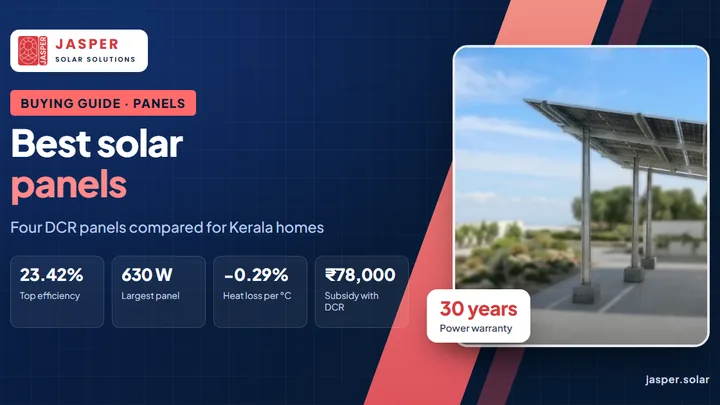

- The Emmvee Titanium Duo is a 560 to 605 W n-type TOPCon panel with glass on both faces, up to 23.42% efficiency, a −0.29% per °C heat coefficient and a 30-year power warranty that keeps 87.4% of rated output at year 30.
- Emmvee has made panels in Bengaluru since 1992 and now makes its own TOPCon cells, so the panel is available as a DCR module for the PM Surya Ghar subsidy.
- At 605 W the panel stays inside the limits of both the TSUN 6-in-1 microinverter and the SolarEdge S1000 optimiser, so you can pair it with either panel-level system and let every panel work on its own.
- Six panels make 3.63 kWp, which earns the full ₹78,000 subsidy. Jasper Solar designs, installs and commissions the whole system in Thiruvananthapuram and Kollam.
Emmvee is one of India's oldest solar manufacturers, and its Titanium Duo panel is the one we recommend first for Kerala homes that want a high-output TOPCon panel from an Indian maker. This guide reads the Emmvee datasheet for you, explains what each figure means on a Kerala roof, and shows why the panel works so well with the two inverter systems we install most: the SolarEdge inverter with power optimisers and the TSUN microinverter.
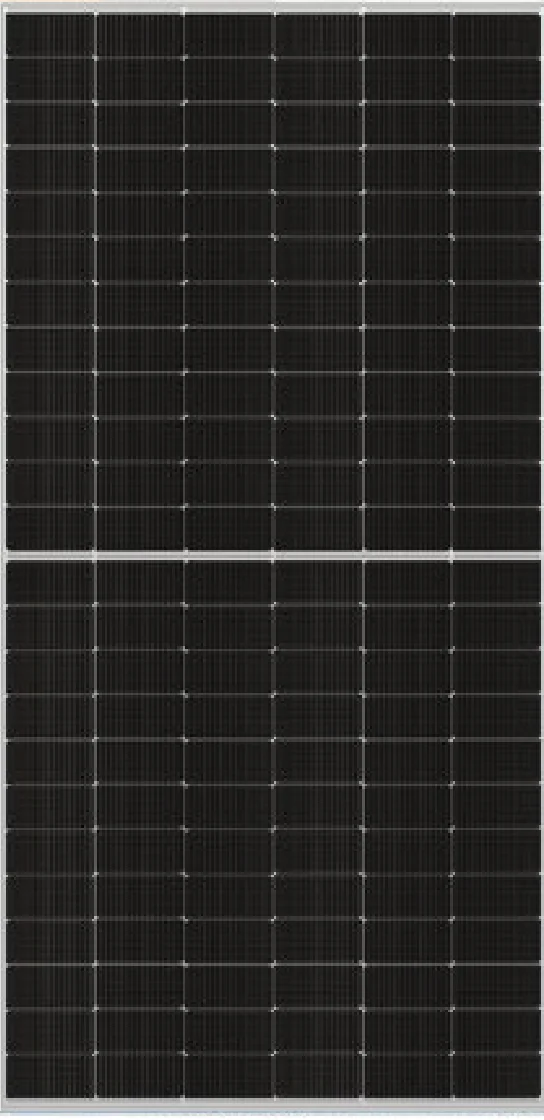
Who makes it: Emmvee, Bengaluru
Emmvee Photovoltaic Power Limited started in 1992 and builds its panels at Bettahalasur, on the airport road out of Bengaluru. It is one of the few Indian makers that produces its own n-type TOPCon cells as well as the finished panels: about 10.3 GW a year of modules and 2.94 GW of TOPCon cells as of June 2026. Its TOPCon cells have been on the government's ALMM List II since the list was first published in July 2025, alongside its modules on List I. That matters for the subsidy, as the DCR section below explains. The datasheet carries IEC 61215 and IEC 61730 certification from TÜV Rheinland, UL 61730, and the salt-mist and ammonia-resistance tests that coastal and farm roofs need.
Emmvee Titanium Duo at a glance
All figures are from Emmvee's datasheet for the E560HCBG144-T to E605HCBG144-T models (download above). The datasheet is the US edition, so we have converted its inches and pounds.
| Specification | Emmvee Titanium Duo (M10R, 144 cells) |
|---|---|
| Power range | 560 W to 605 W, in 5 W steps, tolerance 0 to +5 W |
| Module efficiency | 21.68% to 23.42% |
| Cells | 144 half-cut n-type TOPCon cells, 182 × 91 mm, multi-busbar |
| Construction | Glass to glass: 2 mm high-transmission AR-coated glass front and back, anodised aluminium frame |
| Bifaciality | 80% ± 5% |
| Temperature coefficient of power | −0.29% per °C |
| NOCT | 45 °C ± 2 °C |
| Low light | At least 95% of STC efficiency at 200 W/m² |
| Mechanical load | 5,400 Pa; hail of 24 mm at 23 m/s |
| Junction box | 3-part split box, IP68, 3 bypass diodes, 4 mm² cables of 500 mm, MC4-compatible connectors |
| Max system voltage | 1,500 V DC; 30 A maximum reverse current |
| Size and weight | 2,278 × 1,134 × 35 mm, 32 kg |
| Warranty | 12-year product, 30-year performance |
| Degradation | 1.0% in year one, then 0.40% a year; 87.4% guaranteed at 30 years |
| Certifications on the datasheet | IEC 61215, IEC 61730 (TÜV Rheinland), UL 61730, salt mist, ammonia, PID resistance, CE |
The electrical figures that decide inverter matching are at the top of the datasheet. For the 605 W model: open-circuit voltage 52.47 V, short-circuit current 14.67 A, and 43.42 V at 13.95 A at maximum power. We come back to those numbers in the inverter section.
How it compares with the other panels we fit
We also install the Premier Energies TOPCon panel and the ReNew bifacial mono PERC panel. Here is how the three stack up on the figures that matter most over 25 years, each from its maker's datasheet.
| Emmvee Titanium Duo | Premier TOPCon | ReNew mono PERC | |
|---|---|---|---|
| Technology | n-type TOPCon | n-type TOPCon | Mono PERC |
| Power | 560 to 605 W | 600 to 630 W | 535 to 560 W |
| Efficiency | up to 23.42% | up to 23.32% | up to 21.68% |
| Temperature coefficient | −0.29% per °C | −0.29% per °C | −0.32% per °C |
| Year-one degradation | 1.0% | 1% | 2% |
| Power at 30 years (warranted) | 87.4% | 87.4% | 84.95% |
| Glass | 2 mm front and back | Dual glass | 2 mm front and back |
The two TOPCon panels are close on every line. Emmvee's edge is that it makes its own cells and sits one step lower in the power range, which keeps each panel at 32 kg and 2.28 m, a size that fits a small terrace well. If you want a proven PERC panel at a lower price, the ReNew is still a sound choice. Read our Premier Energies TOPCon and ReNew mono PERC guides for their full datasheets.
What the datasheet means on a Kerala roof
- Heat: at −0.29% per °C, a panel running 25 °C above test conditions on a hot April afternoon loses about 7% of its rated output. The ReNew PERC panel loses about 8% under the same sun. Our generation estimate of about 133 units per kW a month already allows for this.
- Monsoon and humidity: glass on both faces keeps moisture away from the cells far better than a plastic backsheet, and the junction box is sealed to IP68. The TOPCon cells are PID resistant, which matters when a panel sits wet for weeks at a time.
- Sea air: homes near the coast from Poovar to Paravur get salt in the air. The datasheet lists TÜV salt-mist certification, so the frame, glass and contacts are tested for it.
- Cloudy days: the panel keeps at least 95% of its efficiency at 200 W/m², which is a dull monsoon morning. That is where TOPCon's low-light behaviour shows up on the KSEB meter.
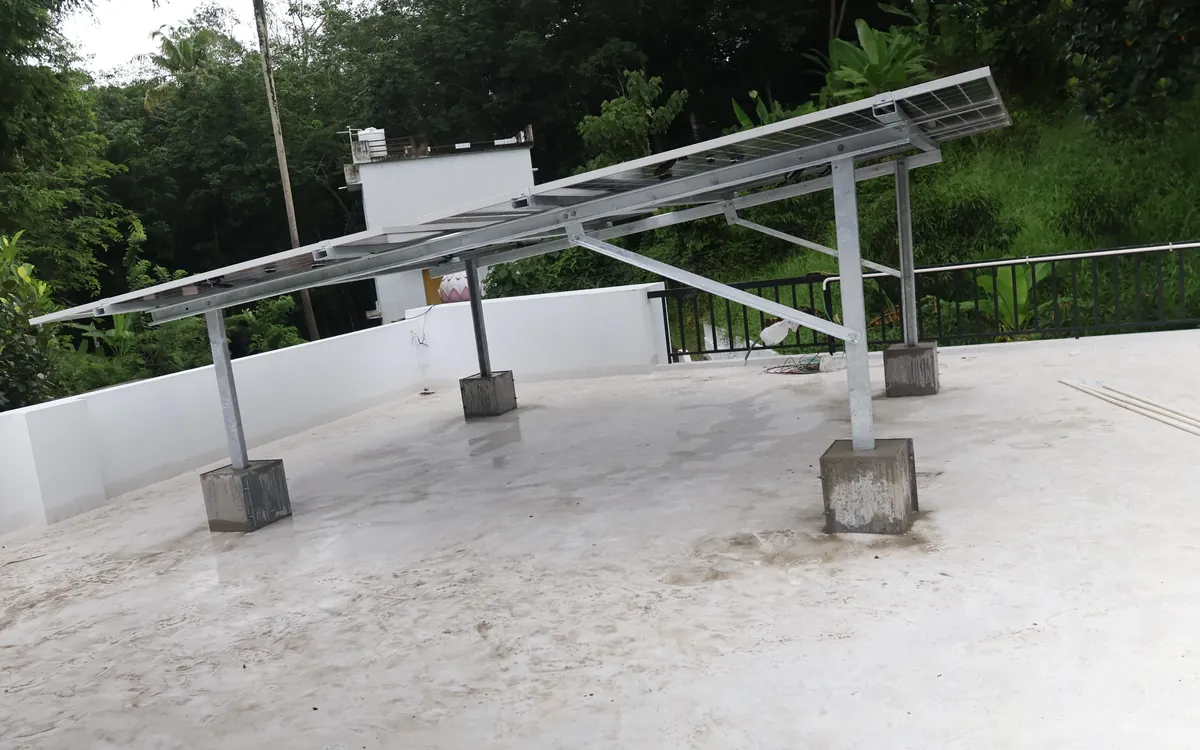
- Wind and weight: 5,400 Pa of mechanical load is far above what IS 875 asks of a Thiruvananthapuram roof, but the structure under it is what fails first in a storm. We mount every panel on a hot-dip galvanized structure designed to IS 875 Part 3 and bolt it, never weld it.
- Bifacial gain: with 80% bifaciality, the rear face adds real output on an elevated structure over a light-coloured terrace. On a tiled slope with the panel flat to the roof, count on the front face only.
The best combination: Emmvee with SolarEdge or TSUN
A 605 W panel is only as good as the electronics behind it. A plain string inverter ties every panel to the weakest one, so a coconut frond's shadow over one panel at 3 pm pulls down the whole string. Both systems we recommend give each panel its own tracker: SolarEdge does it with an optimiser under every panel and one inverter on the wall, and TSUN does it with a microinverter on the roof that takes six panels. We put the two systems side by side in our TSUN vs SolarEdge 3 kW comparison; here is how the Emmvee panel fits each of them.
| Emmvee 605 W into… | SolarEdge S1000 optimiser | TSUN TSOL-MS3000 6-in-1 |
|---|---|---|
| Panel voltage (Voc) against the limit | 52.47 V against 125 V | 52.47 V against 60 V per input |
| Panel current (Isc) against the limit | 14.67 A against 15 A | 14.67 A against 18 A |
| Panel power against the limit | 605 W against 1,100 W | 605 W against 700+ W per input |
| Panels on a 3 kW system | 6, one optimiser each, into one SE3000H | 6, into one MS3000 on the roof |
| DC voltage on the roof | About 380 V while running, 1 V per optimiser when off | Never above 60 V |
| Where the inverter sits | On the wall near the meter | Under the panels |
| Warranty on the electronics (India) | 8 years inverter and optimisers | 12 years |
Two details from the Emmvee datasheet are worth checking before you sign a quote with any other panel. First, Kerala's coolest mornings are around 18 °C, and open-circuit voltage rises by 0.25% for every degree below 25 °C, so the 605 W panel peaks at roughly 53.5 V: still well under the TSUN input's 60 V ceiling. Second, the 14.67 A short-circuit current sits just inside the S1000's 15 A rating. A 620 W or 630 W panel from another maker can exceed it, which is one reason we match this Emmvee model with SolarEdge rather than the largest panel on the market.
Choose Emmvee with SolarEdge if you want the highest conversion efficiency (about 97.6% weighted), arc-fault protection, an inverter you can reach from the ground, and a plant that can grow to 5 or 6 kW on the same inverter. Choose Emmvee with TSUN if you want no high-voltage DC on the roof, nothing on your wall, the longer 12-year electronics warranty and the simplest wiring. Both pairings qualify for the subsidy with the DCR version of the panel. Our SolarEdge vs string inverter and TSUN microinverter guides go deeper on each.
How many Emmvee panels do you need?
| System | Panels (605 W) | Capacity | Approx. monthly units | Subsidy |
|---|---|---|---|---|
| 2 kW | 4 | 2.42 kWp | ~320 | ₹60,000 |
| 3 kW | 5 | 3.03 kWp | ~400 | ₹78,000 |
| 3 kW, fuller roof | 6 | 3.63 kWp | ~480 | ₹78,000 |
| 5 kW | 9 | 5.45 kWp | ~725 | ₹78,000 |
Monthly units use about 133 units per kW a month, the average across our installations in Kerala. Six panels on a 3 kW inverter is our usual design because the inverter clips only a little at midday and the extra panels lift the morning and evening output. Each panel needs about 2.6 square metres of roof. See how to size your system from your KSEB bill if you are not sure which row you are in.
Subsidy and DCR
The PM Surya Ghar subsidy of up to ₹78,000 requires DCR panels: modules built with Indian-made cells from an ALMM-listed maker. Emmvee makes its own TOPCon cells in Bengaluru and is on ALMM List II for cells as well as List I for modules, so the Titanium Duo is available in a DCR version. For every subsidy project we fit the DCR model, record its serial numbers in the KSEB and national portal paperwork and give you the certificate. Our subsidy guide walks through the application.
Why Jasper Solar is the installer to choose for Emmvee
A panel with a 30-year warranty deserves an installation that will last as long. This is what Jasper Solar Solutions brings to an Emmvee system in Thiruvananthapuram and Kollam, and why we believe we are the best installer you can pick for it:
- Empanelled and authorised. We are MNRE empanelled, KSEB authorised and a registered PM Surya Ghar vendor, so the subsidy, the net-metering application and the KSEB inspection are handled by the same engineer who designed your roof.
- Design before quote. Every job starts with a free site survey, a shade check and a 3D layout, so you see where each panel goes and what it will generate before you pay anything.
- A structure built for 32 kg panels and Kerala wind. IIT/NIT-certified hot-dip galvanized sections designed to IS 875 Part 3, bolted and elevated where it helps bifacial gain. Our structure guide shows why we never weld on site.
- Panel-level electronics as standard. We install SolarEdge and TSUN every week, so the pairing above is a design we have built and commissioned, not a datasheet exercise. Our single line diagrams are free to download for your KSEB file.
- Earthing and lightning protection to IEC 62305, with surge protection on both the DC and AC side, on every roof.
- One accountable team. Project engineer Er. Akhil S.T has delivered more than 400 solar projects, and you reach the same team for service after commissioning.
Common questions
Is the Emmvee Titanium Duo a DCR panel?
Emmvee makes its own TOPCon cells and is on ALMM List I and List II, so DCR versions of the panel are available. We fit the DCR version on every subsidy project and give you its certificate.
Does a 605 W panel work with a TSUN microinverter?
Yes. The TSUN 6-in-1 takes panels of 400 to 700+ W at up to 60 V and 18 A per input. The 605 W Emmvee is 52.47 V and 14.67 A at test conditions, inside both limits even on a cool morning.
Does it work with SolarEdge optimisers?
Yes. The S1000 optimiser accepts up to 1,100 W, 125 V and 15 A per panel. The 605 W Emmvee's 14.67 A short-circuit current is within the 15 A rating, which is one reason we pair SolarEdge with this model rather than a 630 W panel.
What does the 30-year warranty cover?
Emmvee guarantees at least 99% of rated power after year one, then no more than 0.40% loss a year, so 87.4% at year 30. The 12-year product warranty covers manufacturing defects. Ask for Emmvee's warranty document for the full terms.
How heavy is it, and will my roof take it?
Each panel is 32 kg and 2.28 by 1.13 m. A concrete terrace takes the load easily; on a tiled or sheet roof we check the purlins and design the structure to spread the load. The site survey settles this before the quote.
Which is better for my home, SolarEdge or TSUN?
Both give every panel its own tracker. SolarEdge is a little more efficient and keeps the inverter on the wall; TSUN keeps the roof under 60 V DC and has the longer warranty. The roof decides, and we quote both so you can compare.
Want Emmvee panels on your roof? Book a free site visit and we will design your system, quote it with SolarEdge and with TSUN, and work out the subsidy for you. Compare panel types in our guide to choosing solar panels.
Sources
- Emmvee Photovoltaic Power Limited, Titanium Duo 144 half-cut cell n-type TOPCon bifacial glass-to-glass module datasheet, 560–605 W (PDF, download above)
- SolarQuarter, Emmvee's Q1 FY27 results: 10.3 GW of module and 2.94 GW of TOPCon cell capacity, 16 July 2026
- Mercom India, MNRE releases ALMM List II for solar cells, with Emmvee's n-type TOPCon cells enlisted, 31 July 2025
- SolarEdge, S1000 power optimiser datasheet for India and Home Wave single-phase inverter datasheet for India (PDF)
- TSUNESS Co., Ltd, GEN3 6-in-1 microinverter datasheet (PDF)
- Press Information Bureau, Cabinet approves PM-Surya Ghar: Muft Bijli Yojana, 29 February 2024

Er. Akhil S.TFounder and Project Engineer, Jasper Solar Solutions
Founder of Jasper Solar Solutions and a project engineer with 7 years in the solar field and more than 400 completed solar projects. Akhil designs and oversees rooftop installations for homes and businesses, from site survey to KSEB commissioning.