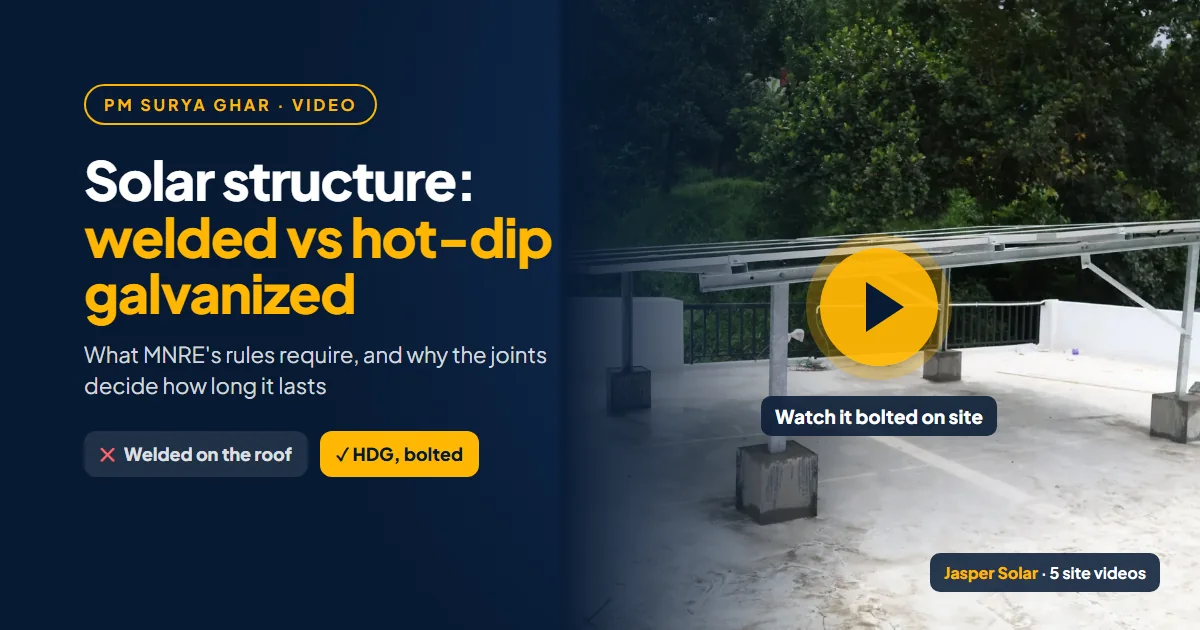
Video: watch our team build a hot-dip galvanized frame on a Kerala terrace. Every joint is a pre-drilled hole and a bolt, tightened on the roof; nothing is welded.
The structure is the part of a solar plant few people look at, and the part that decides whether the plant still stands straight in 25 years. MNRE asks it to last at least that long. Kerala's two monsoons and salty coastal air are hard on steel, so how the frame is made matters more than how it looks on the day it goes up. We read the PM Surya Ghar rules, the Indian standards behind them and published corrosion data, and compared the two ways structures are built on Kerala terraces: welded on the roof, or hot-dip galvanized and bolted.
What PM Surya Ghar requires of the structure
The minimum specifications are in Annexure 3 of MNRE's operational guidelines for PM Surya Ghar: Muft Bijli Yojana (office memorandum 318/17/2024-GCRT of 7 June 2024). Section 3 covers the module mounting structure (MMS). The main points:
- Material (clause 3.2, as amended in May 2026): hot-dip galvanized iron, aluminium, hot-dip galvanized mild steel (MS) or ZAM alloy. MS is preferred for raised structures.
- Standards (3.3): steel to IS 2062:2011 and galvanizing to the latest IS 4759. Aluminium to AA6063 T6, coated or anodised against corrosion. ZAM to IS 18513:2023.
- Fasteners (3.4): bolts, nuts and fasteners of SS 304 stainless steel or hot-dip galvanized, aluminium clamps for the panels, and a structure that is corrosion resistant and electrolytically compatible with the panel frames.
- Wind (3.6 and 3.8): designed for the wind zone of the site with a factor of safety of at least 1.5, and secured against that wind speed. The installer is responsible for wind damage during the guarantee period.
- Life (3.11): designed to withstand operating conditions for at least 25 years.
- Clearance: the guidelines describe module mounting structures with at least 600 mm clearance from the roof at the lowest point. A plant on an elevated structure must have "a minimum ground clearance of 8 feet at the lowest point" to be eligible for the subsidy.
For RCC terraces, Annexure 3 also gives reference sizes for elevated structures. They are marked "for reference only", but they show what MNRE considers a sound frame:
| Part | Up to 1 m above the roof | 1 to 2 m | 2 to 3 m |
|---|---|---|---|
| Base plate | 5 mm | 6 mm | 8 mm |
| Column | 2 mm lipped channel (70 × 40) or 3 mm C-channel | 2 mm lipped channel (80 × 50) or 3 mm C-channel | 2.6 mm square (50 × 50) or rectangular (60 × 40) hollow section, or 3 mm C-channel |
| Rafter | 2 mm lipped channel (70 × 40) or 3 mm C-channel | 2 mm lipped channel (70 × 40) or 3 mm C-channel | 2 mm lipped channel (80 × 50) or 3 mm channel |
| Purlin | 2 mm lipped channel (60 × 40) | 2 mm lipped channel (70 × 40) | 2 mm lipped channel (80 × 50) |
| Bracing | 2 mm | 2 mm | 3 mm |
| Connections | Bolted completely: at least 12 mm bolts from leg to rafter and 10 mm bolts from rafter to purlin | ||
| Fasteners | SS 304 for the panels; SS 304 or hot-dip galvanized grade 8.8 for the rest | ||
Section sizes are in millimetres, web × flange. Annexure 3 adds heavier members for structures more than 3 m above the roof. Notice the line repeated for every height: "The structure connection should be bolted completely." A frame welded together on the roof does not follow it.
The May 2026 change: ZAM alloy allowed
On 19 May 2026, MNRE issued office memorandum 318/61/2025-GCRT-Part(2), amending clauses 3.2 and 3.3 of Annexure 3. After requests to include zinc-aluminium-magnesium (ZAM) alloy, and inputs from the National Institute of Solar Energy (NISE), it adds ZAM as a fourth material, to be made as per IS 18513:2023. All other structure rules stay the same.
IS 18513:2023 covers steel sheets, plates and strips coated with ZAM alloy by a continuous hot-dip process at the mill. The coated sheet is then roll-formed into channels, so the cut edges and punched holes are not dipped; makers say the alloy protects them better than plain zinc. If you are offered a ZAM structure, ask for the coating grade and the supplier's IS 18513 certificate.
Welded or hot-dip galvanized: how each is made
Both kinds of structure start as mild steel. What differs is when the zinc goes on and how the pieces are joined.
A welded structure is cut and welded together on or near your roof, either from black mild steel that is then painted, or from pre-galvanized (GI) tube. Pre-galvanized tube is coated on a continuous line at the mill, so its zinc is thin, and welding burns it off at every joint. The welds are then painted over.
A hot-dip galvanized (HDG) structure is cut, drilled and, where needed, welded in a factory. Only then is each finished part dipped in molten zinc at about 450 °C. The zinc reacts with the steel to form zinc-iron alloy layers that are harder than the steel itself, under an outer layer of pure zinc. Because the whole part goes into the bath, the coating covers edges, corners, bolt holes and the inside of hollow sections. On site, the parts are only bolted together.
| Compared | Welded on site | Hot-dip galvanized, bolted |
|---|---|---|
| Where the frame is made | On or near your roof | In a factory; assembled on the roof |
| Joints | Welded | Bolted |
| Zinc at the joints | None: ground or burnt off, then painted | Full coating, applied after any factory welding |
| Cut edges, holes, inside of tubes | Sheared edges and punched holes in pre-galvanized steel have no zinc | Coated, since the whole part is dipped |
| Zinc thickness | About 19 µm a side on G90 pre-galvanized sheet; none on painted black steel | At least 460 g/m², about 64 µm, on 2 to 5 mm steel under IS 4759 |
| Coating | Mostly pure zinc, softer than steel | Zinc-iron alloy layers harder than steel |
| Roof repairs later | The frame has to be cut | Unbolt, repair, refit |
| MNRE's reference designs | Do not follow "bolted completely" | Follow it |
| Price on the quote | Often lower | Higher |
How long the zinc lasts: the numbers
Zinc protects steel by slowly corroding in its place, so a coating's life depends on two things: how thick it is, and how fast the air around your roof eats it. The international standard ISO 9223 groups sites into corrosivity categories, with a first-year zinc loss for each. Dividing coating thickness by that loss gives a rough number of years before the zinc is used up:
| Site (ISO 9223) | Zinc lost a year | HDG, 80 µm (Jasper Solar) | HDG, 64 µm (IS 4759 minimum) | Pre-galvanized G90, 19 µm |
|---|---|---|---|---|
| C3: urban, or coastal with little salt | 0.7 to 2.1 µm | 38 to 114 years | 31 to 92 years | 9 to 27 years |
| C4: industrial, or coastal with moderate salt | 2.1 to 4.2 µm | 19 to 38 years | 15 to 31 years | 5 to 9 years |
| C5: coastal with heavy salt | 4.2 to 8.4 µm | 10 to 19 years | 8 to 15 years | 2 to 5 years |
Treat these as rough guides, not guarantees. First-year zinc loss is usually higher than in later years, and the AGA's own model gives 47 to 143 years before first maintenance for a 100 µm hot-dip coating at a C3 site. Salt spray, standing water and bird droppings shorten the life. The pattern does not change: a hot-dip coating outlasts thin pre-galvanized zinc several times over. At a weld, the table does not apply at all, because the zinc has been ground or burnt away and only paint is left.
Why the weld is the weak point
Zinc boils at about 907 °C, far below the temperature at which steel melts, so a welding arc vaporises the coating around the joint. To make a sound weld on galvanized steel, the American Galvanizers Association (AGA) advises grinding the zinc off 1 to 4 inches (about 25 to 100 mm) on every side of the joint first. Afterwards, the bare steel must be repaired by one of the methods in ASTM A780: zinc-rich paint, sprayed zinc or zinc solder. Even a correct repair, the AGA notes, "is not the uniform, metallurgically bonded coating" that hot-dip galvanizing gives.
On Kerala terraces, we often see welds simply brushed over with silver (aluminium) paint, which is not one of the ASTM A780 repair methods. A typical home structure has dozens of joints. Each one is where rainwater collects and where the frame flexes in the wind, so the weakest coating sits at the wettest, most stressed point. Rust that starts there can creep under the paint long before it shows.
How to check the structure in your quote
- Material in writing: hot-dip galvanized steel, aluminium or ZAM, as Annexure 3 allows. "GI structure" alone does not say whether it is hot-dip galvanized after fabrication.
- Certificates: IS 2062 for the steel, and a galvanizing test report to IS 4759 that states the coating mass or thickness.
- Welding on site: ask whether any welding will be done on your roof. For a hot-dip galvanized frame, the answer should be no.
- Bolts: at least 12 mm from leg to rafter and 10 mm from rafter to purlin, SS 304 for the panel fasteners and SS 304 or hot-dip galvanized grade 8.8 for the rest.
- Member sizes: compare them with the reference table above for your structure's height.
- Wind design: ask for the structural design for your location, with a factor of safety of at least 1.5.
- Anchoring: ask how each base is fixed to the slab and sealed against leaks.
A coating thickness gauge, held against the steel, reads the zinc in microns and settles any doubt after installation. For the other checks to make before you sign, see how to choose a solar company in Kerala.
How Jasper Solar builds its structures
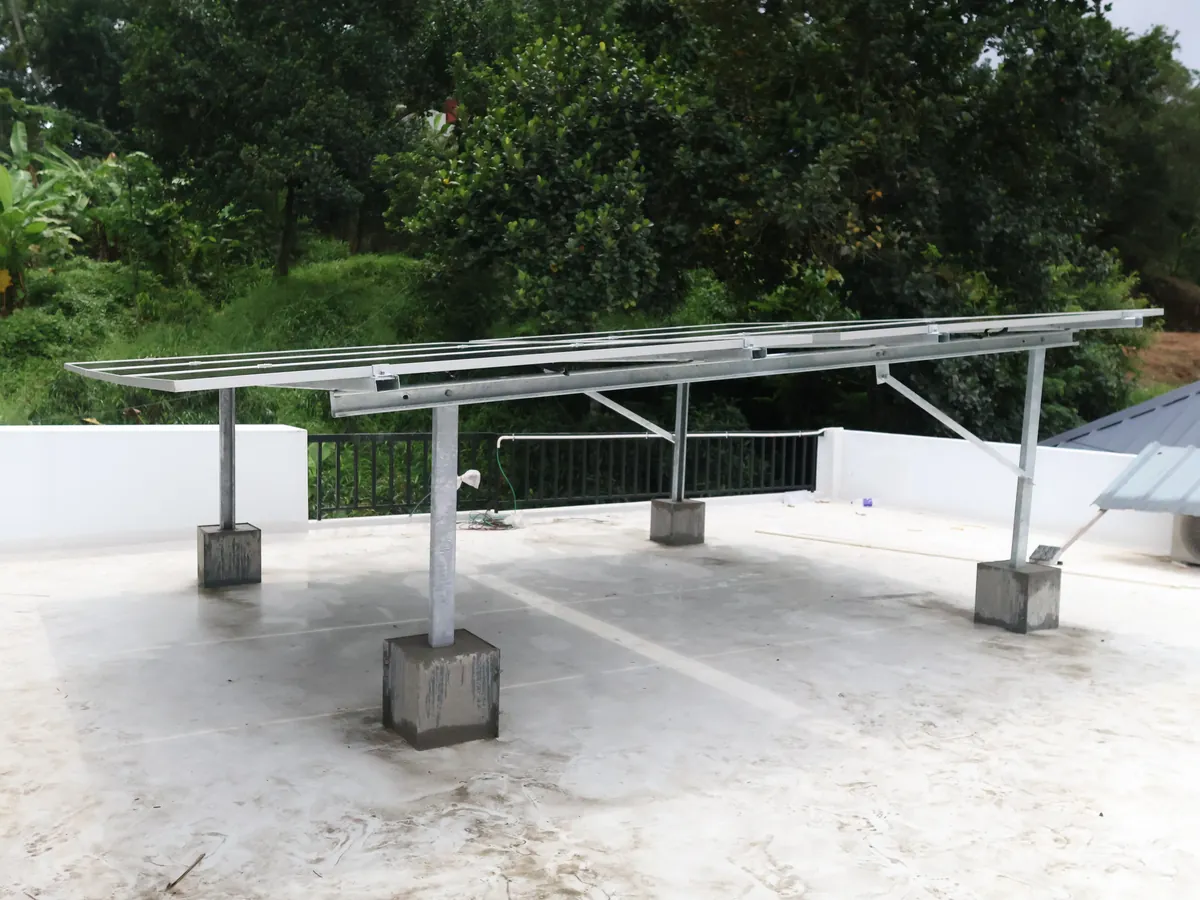
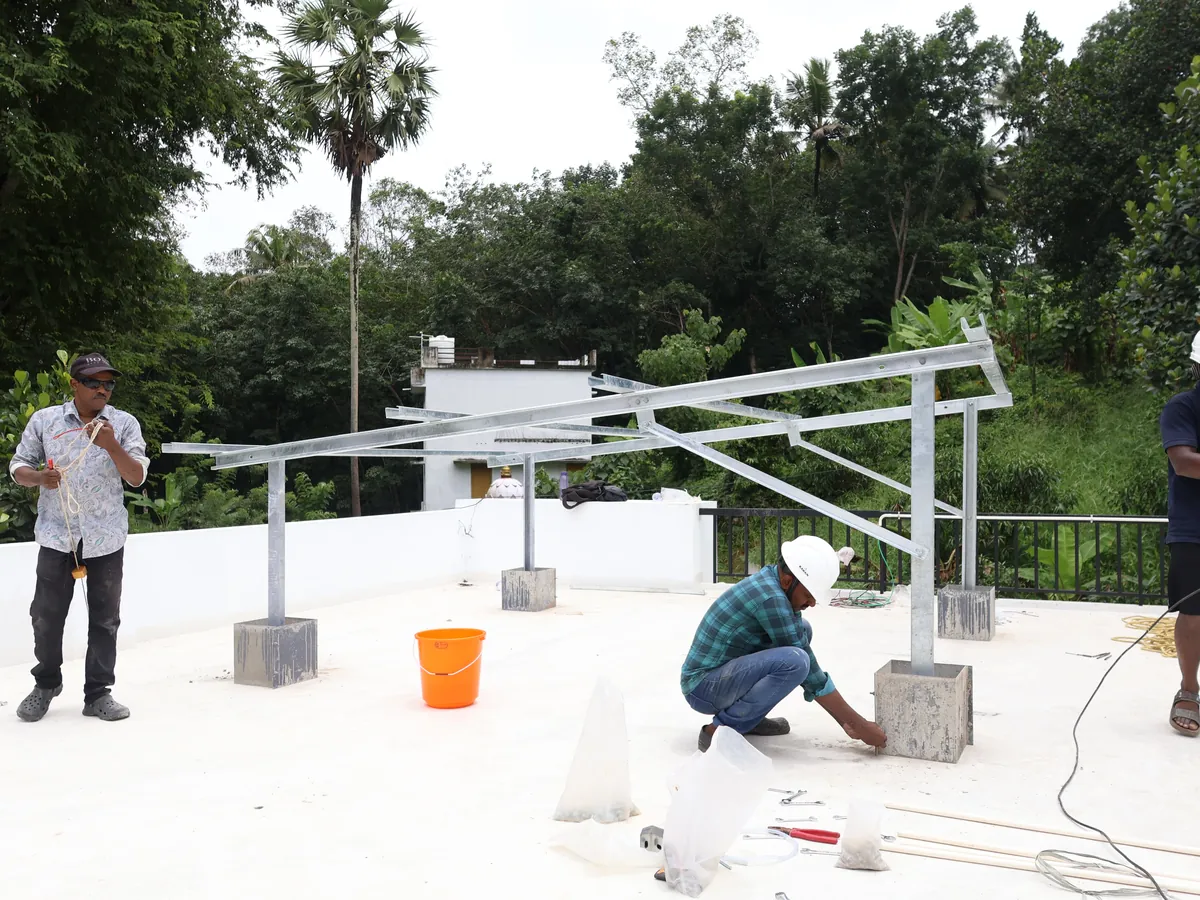
Every Jasper Solar plant stands on a hot-dip galvanized steel structure. What that means on your roof:
- 80 to 100 µm of zinc: above the IS 4759 minimum of about 64 µm for the 2 to 5 mm sections rooftop structures use, chosen for Kerala's humid and coastal air.
- Galvanized after fabrication, bolted on site: parts are cut, drilled and galvanized before they reach you, then bolted together on the roof. No welding on your terrace, so the coating stays whole at every joint. The videos at the top of this page show it.
- Certified designs: our structures are tested and certified by IIT/NIT and designed to IS 875 (Part 3) wind loads for your location, as clause 3.6 asks.
- Fischer chemical anchors: each base is fixed to the slab with chemical anchors that resist vibration, with a concrete pedestal at the foot of each post.
- A leak guarantee: under our ZeroCost™ plan, a water-leakage guarantee of up to ₹1 lakh for 12 months.
Every plant is subsidy-ready under PM Surya Ghar, and we handle the KSEB and portal paperwork; see our step-by-step PM Surya Ghar application guide. To see the structure your roof needs, book a free home visit: our engineer will design it with you in a free 3D layout.
Common questions
Which solar structure is allowed under PM Surya Ghar?
Hot-dip galvanized iron, aluminium, hot-dip galvanized mild steel and, since MNRE's amendment of 19 May 2026, zinc-aluminium-magnesium (ZAM) alloy. Steel must meet IS 2062:2011 with galvanizing to IS 4759, aluminium AA6063 T6, and ZAM IS 18513:2023.
Is a welded GI structure allowed under PM Surya Ghar?
Annexure 3 asks for hot-dip galvanized steel with galvanizing to IS 4759, and its reference designs for elevated terrace structures say the connections should be bolted completely. Welding after galvanizing removes the zinc at each joint, so those joints no longer have the coating the rules call for.
What is the difference between GI and hot-dip galvanized?
"GI" usually means pre-galvanized tube or sheet, coated on a continuous line at the mill: about 19 µm a side for G90 grade, with bare cut edges. Hot-dip galvanized parts are dipped after they are made, giving at least about 64 µm on 2 to 5 mm steel under IS 4759, over every surface.
How thick should the galvanizing be on a solar structure?
IS 4759 sets the minimum by steel thickness: 460 g/m², about 64 µm, for 2 to 5 mm steel, and 610 g/m², about 85 µm, for 5 mm and above. Jasper Solar uses 80 to 100 µm.
Is ZAM better than hot-dip galvanized?
It depends on the grade. ZAM is coated at the mill before the sheet is formed, and its alloy is made to resist corrosion better than plain zinc of the same thickness, but the cut edges and holes are not dipped. Compare the coating on the certificates, and check that a ZAM supplier meets IS 18513:2023.
Sources
- Ministry of New and Renewable Energy, Operational Guidelines for PM Surya Ghar: Muft Bijli Yojana, CFA to Residential Consumers, OM 318/17/2024-GCRT, 7 June 2024, Annexure 3, section 3 (copy hosted by JAKEDA)
- Ministry of New and Renewable Energy, OM 318/61/2025-GCRT-Part(2), Amendment in Technical Specifications for Rooftop Solar Plants (ZAM alloy), 19 May 2026 (download above)
- Bureau of Indian Standards, IS 4759:1996, Hot-dip zinc coatings on structural steel and other allied products, Table 1; IS 18513:2023, Hot-dip zinc-aluminium-magnesium alloy coated steel sheets, plates and strips
- American Galvanizers Association, HDG corrosion rates for ISO categories C1–C5/X, 2 December 2021
- American Galvanizers Association, Step-by-step: recoating after welding galvanized steel components, 30 June 2026
- American Galvanizers Association, Hot-dip galvanizing vs. continuous sheet galvanizing (PDF)

Er. Akhil S.TProject Engineer, Jasper Solar Solutions
Project engineer with 7 years in the solar field and more than 400 completed solar projects. Akhil designs and oversees rooftop installations for homes and businesses, from site survey to KSEB commissioning.