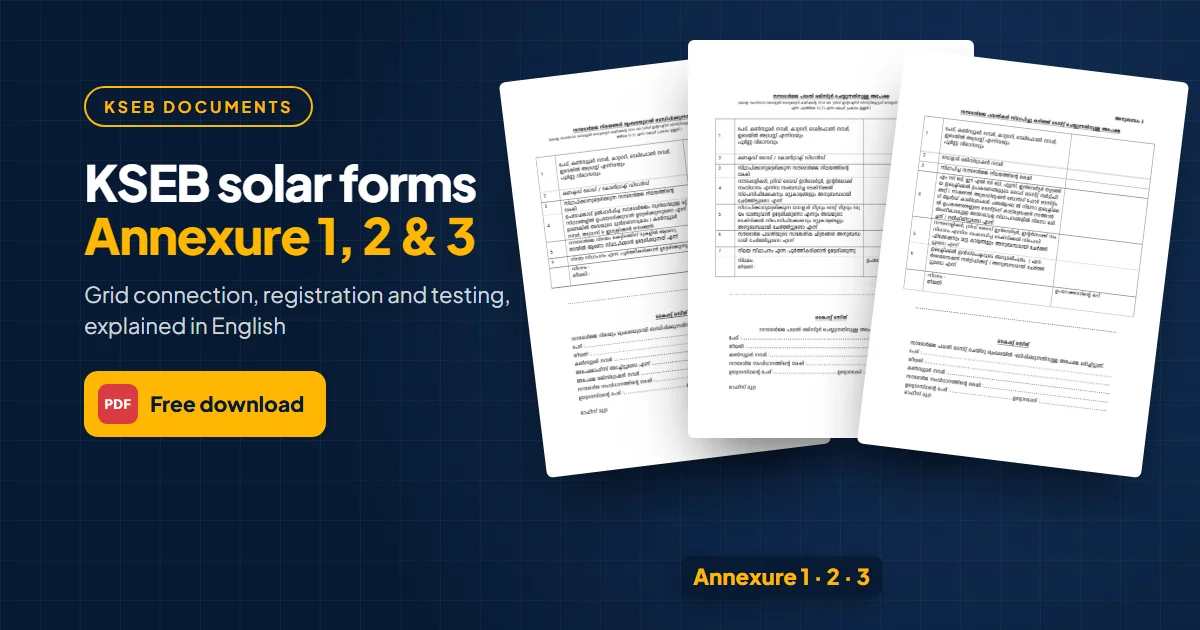
Before a rooftop solar plant can feed the KSEB grid, the paperwork moves in three steps: ask for a connection, register the plant, then have it tested. Each step has a one-page form, called an annexure, that your KSEB electrical section office receives and acknowledges with a receipt. The forms are in Malayalam; this guide explains every question in English and lists the documents to attach.
The three KSEB annexures at a glance
| Form | Malayalam title, in English | When | What you attach |
|---|---|---|---|
| Annexure 1 | Application to connect solar energy plants to the grid | Before installation, to get feasibility | Application fee |
| Annexure 2 | Application to register the solar energy scheme | After feasibility, before installation | Panel, inverter and interlock specifications, meter details, single line diagram |
| Annexure 3 | Application to test solar energy schemes after installation | After installation | Type test certificates, specifications, Electrical Inspector's energisation certificate |
How the KSEB connection process works
The steps and time limits are set by the KSERC (Renewable Energy and Net Metering) Regulations, 2020:
- Feasibility application: submit the connection application with the application fee to your KSEB section office. KSEB acknowledges and registers it immediately, processes applications in the order received, and tells you within 15 days whether the connection is feasible (Regulation 18).
- Registration: within 30 days of hearing that it is feasible, submit the registration application with the technical documents. KSEB checks it within seven working days, tells you of any defects and the registration fee, and assigns a registration number within seven days of a complete application (Regulation 19).
- Installation: the registration is valid for one year, which can be extended by up to six months for reasons beyond your control. The plant must be installed by a licensed electrical contractor in that time.
- Electrical Inspector: the Electrical Inspector inspects within 10 working days of the work completion report and issues a safety certificate.
- Testing and connection: KSEB tests the plant within seven days of receiving the Electrical Inspector's approval. After a successful test, you and KSEB sign a connection agreement, and KSEB connects the plant within seven days of the agreement.
The same regulations set an application fee of ₹1,000 and a registration fee of ₹1,000 per kW or part of a kW. KSEB refunds 80% of the registration fee if the plant is installed within the validity period. Check the current fees with your section office, as the regulations have since been amended.
Annexure 1: application to connect a solar plant
Annexure 1 starts the process. The form says it is made under regulation 13(1) of KSERC's 2014 Grid Interactive Distributed Solar Energy Systems regulations. Its questions, in English:
| No. | What the form asks |
|---|---|
| 1 | Name, consumer number, tariff category, phone number, email address and full postal address |
| 2 | Connected load or contract demand |
| 3 | Capacity of the solar plant you plan to install |
| 4 | Whether you plan to use the solar energy at other premises you own, and if so their order of priority (consumer number, address and electrical section of each) |
| 5 | Whether the plant will be on the roof of the building or on the ground |
| 6 | The date by which you plan to complete the installation |
You sign with the place and date. The acknowledgement slip at the bottom is filled in by the KSEB officer: your name, date, consumer number, whether the application fee was paid, the application registration number and the plant capacity, with the officer's name, designation and office seal. Keep this slip; its registration number is your reference for the rest of the process.
Your connected load and consumer number are printed on your KSEB bill. To choose the plant capacity, see how to size a solar system from your KSEB bill.
Annexure 2: registering your solar plant
Annexure 2 registers the plant once feasibility is confirmed. The form says it is made under regulation 13(7) of the 2014 regulations. It repeats the first three questions and adds:
| No. | What the form asks |
|---|---|
| 1–3 | Your details, connected load or contract demand, and plant capacity, as in Annexure 1 |
| 4 | Whether the technical specifications and other details of the solar panels, grid-tied inverter and interlock arrangement are attached |
| 5 | Whether you plan to buy the solar meter and net meter yourself, and whether their technical specifications are attached |
| 6 | Whether the technical drawings of the solar plant are attached |
| 7 | The date by which you plan to complete the installation |
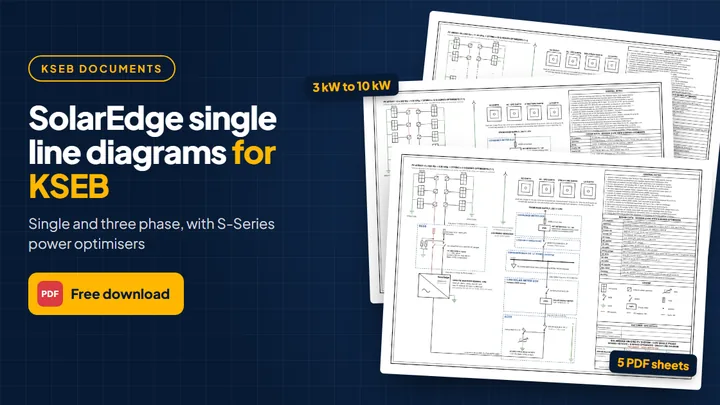
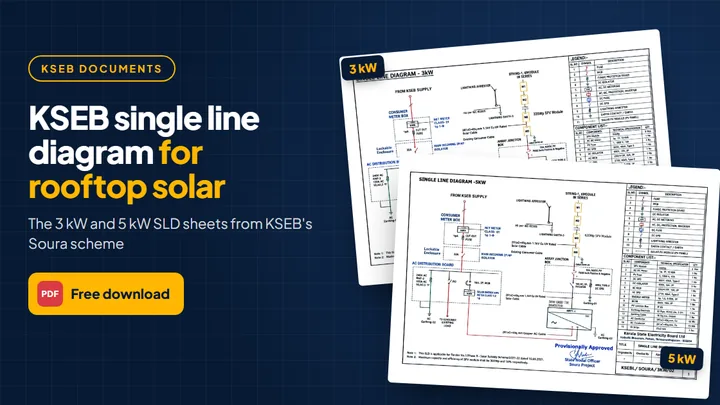
The technical drawing in question 6 is the plant's single line diagram (SLD): one drawing that shows the panels, protection devices, inverter, meters and earthing. For examples, see our KSEB single line diagram for rooftop solar and our SolarEdge single line diagrams from 3 kW to 10 kW, both free PDF downloads. The datasheets of your panels and inverter cover question 4.
Annexure 3: testing the plant after installation
Annexure 3 asks KSEB to test the installed plant and connect it to the grid. Its questions:
| No. | What the form asks |
|---|---|
| 1 | Your details, as in Annexure 1 |
| 2 | Your solar registration number (from Annexure 2) |
| 3 | Capacity of the installed solar plant |
| 4 | Whether type test certificates of the electrical equipment, such as the MCB, ELCB, fuses and inverter, are provided, from NABL (National Accreditation Board for Testing and Calibration Laboratories) or an accredited international testing and calibration laboratory |
| 5 | Whether the technical specifications of the solar panels, grid-tied inverter and interlock arrangement are attached |
| 6 | Whether the Electrical Inspector's permission (energisation certificate) is attached |
The acknowledgement slip confirms that KSEB has received your application to test the solar plant and connect it to the grid. The test and connection then follow the time limits above.
Documents to keep ready
- Your latest KSEB bill, for the consumer number, tariff category and connected load.
- Datasheets of the solar panels, inverter and interlock (isolating) arrangement.
- Meter details, if you will buy the solar meter and net meter yourself.
- The single line diagram of your plant.
- Type test certificates of the MCB, ELCB, fuses and inverter, from NABL or an accredited international laboratory.
- The Electrical Inspector's energisation certificate, once issued.
- The acknowledgement slips of each annexure, with their registration numbers.
Are these forms still current?
Annexures 1 and 2 refer to KSERC's 2014 Grid Interactive Distributed Solar Energy Systems regulations. Those were repealed by the KSERC (Renewable Energy and Net Metering) Regulations, 2020, which say that anything done under the old regulations counts as done under the corresponding new provisions. The 2020 regulations have their own Annexure-A (application for connectivity) and Annexure-B (application for registration), which ask for the same information, plus whether you are on time-of-day billing and your preferred mode of communication.
Home owners who claim the central subsidy also apply on the PM Surya Ghar national portal; see our step-by-step PM Surya Ghar application guide. Section offices differ in which form they ask for, so confirm with yours before you submit.
Jasper Solar fills in and submits these forms for every plant we install, together with the single line diagram and test certificates. To get started, book a free home visit.
Common questions
What is Annexure 1 in KSEB solar?
Annexure 1 is the application to connect a solar plant to the KSEB grid. It asks for your consumer details, connected load, the proposed plant capacity and where it will be installed, and starts KSEB's feasibility check.
What is the difference between Annexure 2 and Annexure 3?
Annexure 2 registers the plant before installation, with the technical specifications and the single line diagram. Annexure 3 asks KSEB to test and connect the plant after installation, with the type test certificates and the Electrical Inspector's energisation certificate.
How long does KSEB take to approve feasibility?
Under the KSERC 2020 regulations, KSEB must check feasibility and inform you within 15 days of receiving the application.
What is the KSEB solar registration fee?
The KSERC 2020 regulations set ₹1,000 per kW or part of a kW, with 80% refunded if the plant is installed within the validity of the registration. Check the current fee with your section office.
Are the forms available in English?
The forms on this page are in Malayalam, as used at KSEB section offices. This guide gives an English version of every question.
Sources
- Kerala State Electricity Board, solar Annexure 1, Annexure 2 and Annexure 3 application forms (downloads above)
- Kerala State Electricity Regulatory Commission, KSERC (Renewable Energy and Net Metering) Regulations, 2020, Regulations 18, 19 and 69, the Schedule of fees and Annexures A and B

Er. Akhil S.TProject Engineer, Jasper Solar Solutions
Project engineer with 7 years in the solar field and more than 400 completed solar projects. Akhil designs and oversees rooftop installations for homes and businesses, from site survey to KSEB commissioning.