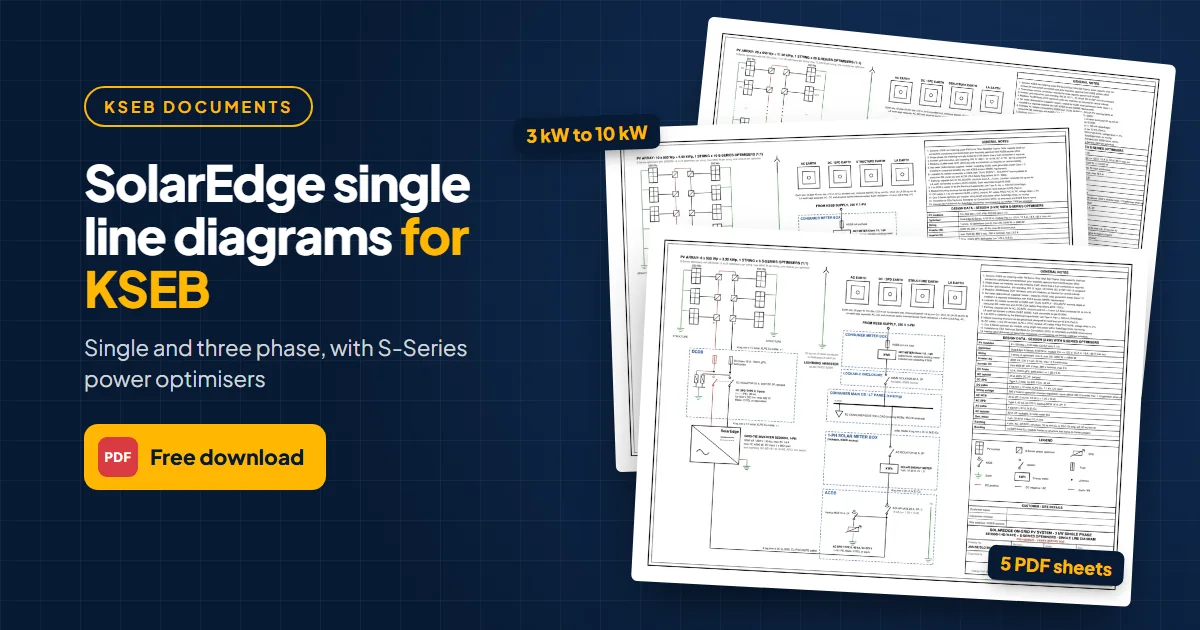
KSEB's standard drawings show a plain string inverter. A SolarEdge system adds a power optimiser behind every panel, which changes how the DC side is drawn and rated. This page explains our SolarEdge SLDs, compares the five sizes, and shows how to read the drawing your installer submits with the KSEB paperwork.
What is different in a SolarEdge SLD?
Three things set a SolarEdge drawing apart from the KSEB single line diagram for a string inverter:
- An optimiser on every panel: each module connects to its own S-Series power optimiser, and the optimisers are wired in series to form the string. The drawings mark this as 1:1, one module per optimiser.
- An inverter-regulated string voltage: the inverter holds the string at a set working voltage, about 380 V on the single-phase SE3000H and SE5000H and about 750 V on the three-phase SE5K and SE8K, instead of letting it rise and fall with sunlight and temperature. It never exceeds the inverter's maximum DC input.
- Safe DC when switched off: when the inverter or the AC supply is off, each optimiser drops to about 1 V, so the roof cables are not left at full string voltage during maintenance or a fire.
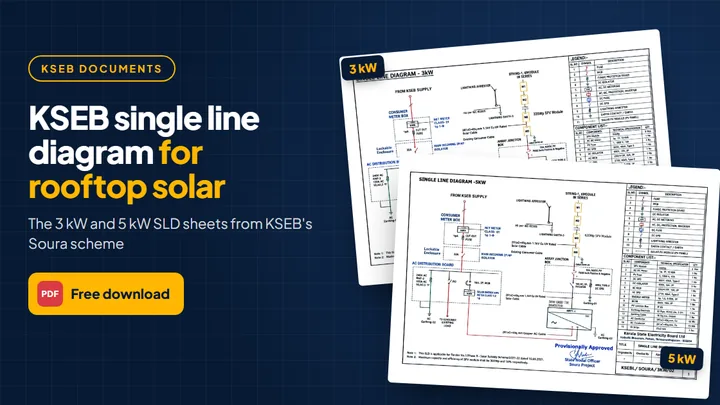
Our SolarEdge vs string inverter guide covers when these features are worth paying for on a Kerala roof.
The five SolarEdge SLDs compared
All five sheets use one string of S-Series optimisers. The ratings below are printed on each drawing:
| Sheet | 3 kW SE3000H | 5 kW SE5000H | 5 kW SE5K | 8 kW SE8K | 10 kW SE10K |
|---|---|---|---|---|---|
| Supply | Single phase | Single phase | Three phase | Three phase | Three phase |
| Panels | 6 × 550 Wp (3.30 kWp) | 10 × 550 Wp (5.50 kWp) | 14 × 450 Wp (6.30 kWp) | 18 × 550 Wp (9.90 kWp) | 20 × 550 Wp (11.00 kWp) |
| String voltage in operation | 380 V | 380 V | 750 V | 750 V | 680–950 V |
| DC fuses (both poles) | 15 A | 20 A | 15 A | 20 A | 25 A |
| DC isolator and DC SPD | 25 A, 600 V | 25 A, 600 V | 25 A, 1000 V | 25 A, 1000 V | 32 A, 1000 V |
| Inverter AC output | 14 A | 23 A | 8 A per phase | 13 A per phase | 16 A per phase |
| Solar MCB | 20 A, 2-pole | 32 A, 2-pole | 16 A, 4-pole | 20 A, 4-pole | 25 A, 4-pole |
| AC cable (copper) | 4 sq mm, 3-core | 6 sq mm, 3-core | 4 sq mm, 4-core + PE | 4 sq mm, 4-core + PE | 6 sq mm, 4-core + PE |
| Main and AC isolators | 32 A, 2-pole | 40 A, 2-pole | 32 A, 4-pole | 32 A, 4-pole | 40 A, 4-pole |
Every sheet sizes the solar MCB at 1.25 times or more the inverter's AC output, and the DC fuses at 1.25 times or more its DC input current. The DC isolator and DC surge protection device are rated above the inverter's maximum DC input voltage: 480 V on the single-phase inverters and 900 V or 1000 V on the three-phase ones.
The 3 kW SolarEdge SLD, part by part
The 3 kW SE3000H sheet shows the layout all five share. Read it from the panels, through the inverter, to the KSEB supply:
- Solar array: 6 modules of 550 Wp, 3.30 kWp in all, as one string of 6 S-Series optimisers. The sheet notes the SE3000H accepts 6 to 25 optimisers in a string.
- DC cable: 4 sq mm single-core solar XLPE copper cable, 1.1 kV and UV rated, for both the positive and negative runs.
- DC distribution box (DCDB): 15 A, 1000 V gPV fuses on both poles, a 25 A, 600 V two-pole ganged DC isolator, and a Type II DC surge protection device (40 kA, Uc 600 V DC).
- SolarEdge SE3000H inverter: single-phase HD-Wave, 3000 VA, 230 V, 50 Hz, maximum 14 A AC output, with anti-islanding and arc-fault protection and a built-in DC switch. Its DC input is rated 480 V maximum and 380 V nominal.
- AC distribution box (ACDB): a 20 A, 2-pole, C-curve, 10 kA solar MCB, and a Type II AC surge protection device (40 kA, Uc 275 V) behind a 16 A backup MCB.
- Solar meter box: a lockable box with a 32 A, 2-pole AC isolator and a class 1.0 solar energy meter that records generation, with access for KSEB staff.
- Consumer main board and main isolator: the solar feeder joins your existing main distribution board, and a 32 A, 2-pole lockable main isolator lets the supply be isolated.
- Net meter: a class 1.0 bidirectional meter in the consumer meter box, installed and sealed by KSEB in place of the existing meter.
- Earthing and lightning protection: four earth pits, for AC, DC and surge protection, the mounting structure, and the lightning arrester (as per IS/IEC 62305, with a 50 sq mm aluminium down conductor). The lightning earth is kept separate; the other three are interconnected, with a target below 5 ohm.
Single phase or three phase?
The three-phase sheets keep the same layout with three-phase parts: a 4-pole solar MCB and isolators, a 3P+N AC surge protection device, 4-core cable with a separate earth conductor, and three-phase, 4-wire solar and net meters. Because the string runs at about 750 V instead of 380 V, the DC isolator and surge protection device are rated 1000 V instead of 600 V.
The sheets note that single-phase net metering is normally limited to 5 kW, and that a three-phase connection is needed above that. A 5 kW plant can be single or three phase, which is why the set has both an SE5000H and an SE5K sheet.
Can I use these SLDs for my plant?
Use them as a reference. The drawings are marked provisional, and the SLD submitted for your connection has to show your actual system: your panel make and wattage, the number of optimisers, the cable runs on your roof, and your consumer number and KSEB section, which each sheet has boxes for. A different panel wattage changes the string and the ratings, so each plant gets its own sheet, checked by our engineer. For the subsidy side, see our Kerala solar subsidy guide.
Common questions
Are the SolarEdge SLDs free to download?
Yes. All five SolarEdge single line diagrams, 3 kW to 10 kW, are free A3 PDFs on this page, one by one or as a single PDF.
Does a SolarEdge system still need DC fuses, an isolator and surge protection?
Yes. Every sheet keeps DC fuses on both poles, a DC isolator and a DC surge protection device between the optimisers and the inverter, as well as AC protection after it.
Why are the three-phase DC parts rated 1000 V?
The three-phase SolarEdge inverters run the string at about 750 V and accept up to 900 V or 1000 V, so the DC isolator and surge protection device are rated 1000 V. The single-phase inverters run at about 380 V and accept up to 480 V, so 600 V parts are used.
When do I need a three-phase SolarEdge system?
The sheets note that single-phase net metering is normally limited to 5 kW. Above that, the plant needs a three-phase connection and a three-phase inverter such as the SE8K or SE10K.
Are these drawings approved by KSEB?
No. They are Jasper Solar's reference drawings, marked provisional and subject to KSEB approval. Your plant's SLD is submitted to KSEB with the connection papers.
Sources
- Jasper Solar Solutions, SolarEdge on-grid PV system single line diagrams JSS/SE/SLD/1PH/3KW/01, JSS/SE/SLD/1PH/5KW/01, JSS/SE/SLD/3PH/5KW/01, JSS/SE/SLD/3PH/8KW/01 and JSS/SE/SLD/3PH/10KW/01, Rev. 00 (downloads above)
- SolarEdge, single-phase inverter datasheet for Europe, India and the Philippines (SE3000H input and output ratings)
- Kerala State Electricity Regulatory Commission, KSERC (Renewable Energy and Net Metering) Regulations, 2020

Er. Akhil S.TProject Engineer, Jasper Solar Solutions
Project engineer with 7 years in the solar field and more than 400 completed solar projects. Akhil designs and oversees rooftop installations for homes and businesses, from site survey to KSEB commissioning.