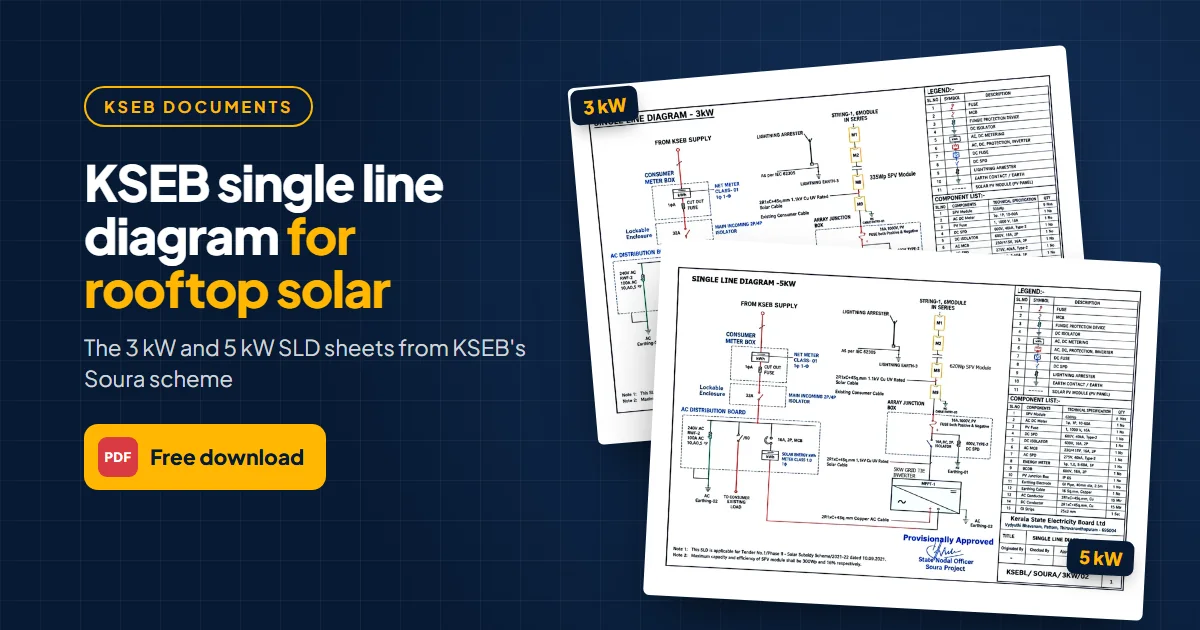
A single line diagram is the one drawing that shows how a rooftop solar plant is wired, from the panels to the KSEB meter. When your installer applies to KSEB for the net meter, the drawing travels with the paperwork, and it is worth knowing what it says. Below, every part of KSEB's own 3 kW and 5 kW sheets is explained in the order the power flows.
What is a single line diagram?
A single line diagram, or SLD, draws an electrical system with one line for each circuit, even when that circuit has two or more wires. It leaves out the physical layout and shows only what is connected to what, with the rating of each part. For rooftop solar, it answers three questions at a glance: how many panels are in each string, what protects the DC and AC sides, and where the plant meets the KSEB supply.
Both drawings below carry KSEB's title block (Kerala State Electricity Board Ltd, Vydyuthi Bhavanam, Pattom, Thiruvananthapuram) and are marked "Provisionally Approved" by the State Nodal Officer, Soura Project. Note 1 on each sheet says it applies to Tender No.1/Phase II – Solar Subsidy Scheme/2021-22, dated 10.09.2021.
The KSEB SLD, part by part
Read the drawing from the panels on the right to the KSEB supply on the left. The ratings below are the ones printed in the component list on both sheets.
- Solar panels in a string: the modules are wired in series into one string, marked M1 to M9 on the sheet. The 3 kW sheet lists 9 modules of 335 Wp; the 5 kW sheet lists 8 modules of 620 Wp.
- Array junction box: an IP65 PV junction box near the panels. It holds a 16 A, 1000 V PV fuse on both the positive and negative lines, a 16 A, 2-pole DC isolator rated 600 V, and a 600 V, 40 kA, Type-2 DC surge protection device (SPD).
- DC cable: 2R × C × 4 sq mm copper solar cable rated 1.1 kV and UV resistant, 15 metres in the component list.
- Grid-tie inverter: a single-MPPT grid-tie inverter (3 kW or 5 kW) that turns the panels' DC into AC in step with the KSEB supply.
- AC protection and solar meter: in the AC distribution board, a 16 A, 2-pole MCB, a 275 V, 40 kA, Type-2 AC SPD, and a single-phase, class 1.0 solar energy meter (5–60 A) that records what the plant generates. The AC cable is 2R × C × 4 sq mm copper, also 15 metres.
- Main incoming isolator: a 32 A, 2-pole or 4-pole isolator in a lockable enclosure, so the supply can be switched off and locked during work.
- Net meter: a single-phase, class 1 net meter in the consumer meter box, with a cut-out fuse, between your house and the KSEB supply. It records units drawn from and sent to the grid.
- Earthing and lightning protection: three separate earths. Earthing-01 on the DC side, Earthing-02 on the AC side, and Lightning Earth-3 for a lightning arrester installed as per IEC 62305. The component list gives GI pipe earth electrodes (40 mm diameter, 2.5 m), 16 sq mm copper earthing cable and 25 × 3 mm GI strips.
For how the net meter turns these units into your bill, see our KSEB solar bill guide.
3 kW and 5 kW sheets compared
The two drawings use the same layout. The differences are the panels and the inverter:
| Item on the sheet | 3 kW SLD | 5 kW SLD |
|---|---|---|
| Solar modules | 9 × 335 Wp | 8 × 620 Wp |
| Panel capacity | 3,015 Wp | 4,960 Wp |
| Inverter | 3 kW grid-tie, 1 MPPT | 5 kW grid-tie, 1 MPPT |
| PV fuse, DC isolator, DC SPD | 16 A 1000 V fuse, 16 A 600 V isolator, 600 V 40 kA Type-2 SPD (same on both) | |
| AC MCB, AC SPD | 16 A 2-pole MCB, 275 V 40 kA Type-2 SPD (same on both) | |
| Meters | Single-phase solar meter and net meter (same on both) | |
| Drawing number in the title block | KSEBL/SOURA/3KW/02, Rev. 1 (both sheets) | |
Both are single-phase, on-grid plants without a battery. A hybrid system adds a battery and a backup circuit that these sheets do not show; our on-grid vs hybrid vs off-grid guide explains the difference. For a system with SolarEdge power optimisers, see our SolarEdge single line diagram.
Where the SLD fits in your KSEB application
Net metering for rooftop solar in Kerala is governed by the KSERC (Renewable Energy and Net Metering) Regulations, 2020. In practice, the installer prepares the connection papers for the KSEB section office, and the SLD is the page that shows exactly what has been installed: the panel and inverter ratings, the protection devices and where the net meter sits. When the section office checks the plant before fitting the net meter, the plant on the roof should match the drawing. The SLD is attached to the registration form, Annexure 2; see our guide to the KSEB solar Annexure 1, 2 and 3 forms.
These sheets were issued for KSEB's Soura subsidy tender of 2021-22. Homes in Kerala now claim the central subsidy under PM Surya Ghar; see our Kerala solar subsidy guide and the step-by-step application guide.
Can I use this SLD for my own house?
Use it as a reference, not as your plant's drawing. The SLD submitted for your connection has to show your actual system: the make and wattage of your panels, how many are in each string, your inverter's rating and number of MPPTs, the cable sizes and run lengths, and whether your supply is single-phase or three-phase. A 4 kW plant, or a 5 kW plant with 550 Wp panels, needs its own drawing with ratings checked against those panels.
What to check in your installer's SLD
- Panels and strings match your quotation: wattage, number of modules and modules per string.
- DC protection sits between the panels and the inverter: a fuse on both the positive and negative lines, a DC isolator and a DC surge protection device.
- AC protection after the inverter: an MCB and an AC surge protection device.
- Two meters: a solar generation meter and the KSEB net meter, shown separately.
- A lockable isolator on the main incoming supply.
- Three earths, including a dedicated earth for the lightning arrester.
- Cable sizes for both DC and AC runs, with copper conductors and UV-rated solar cable on the roof.
Jasper Solar draws the SLD for every plant we install and handles the KSEB paperwork with it. If you would like a design for your roof, book a free home visit.
Common questions
Is the KSEB single line diagram free to download?
Yes. The 3 kW and 5 kW SLDs on this page are free PDF downloads in A3 size, as issued by KSEB under its Soura rooftop solar scheme.
Do I have to draw the SLD myself?
No. Your installer prepares the SLD for your plant and submits it with the KSEB connection papers.
Can I submit the 3 kW or 5 kW sheet for my plant?
Only if your plant matches it exactly. The drawing must show your own panels, inverter, strings and cables, so most plants need a drawing of their own.
Why are there three earthing points on the SLD?
The drawing keeps separate earths for the DC side, the AC side and the lightning arrester, which is installed as per IEC 62305.
Do these drawings cover hybrid or three-phase systems?
No. Both sheets show single-phase on-grid plants without a battery. Hybrid and three-phase plants need their own SLD.
Sources
- Kerala State Electricity Board Ltd, Soura Project: Single Line Diagram – 3 kW and Single Line Diagram – 5 kW, drawing KSEBL/SOURA/3KW/02, Rev. 1 (downloads above)
- Kerala State Electricity Regulatory Commission, KSERC (Renewable Energy and Net Metering) Regulations, 2020, notification dated 07.02.2020
- Mercom India, Residential rooftop solar systems of 1 kW to cost ₹53,651 in Kerala, 13 July 2021 (KSEB's 200 MW rooftop tender)

Er. Akhil S.TProject Engineer, Jasper Solar Solutions
Project engineer with 7 years in the solar field and more than 400 completed solar projects. Akhil designs and oversees rooftop installations for homes and businesses, from site survey to KSEB commissioning.