- A string inverter treats a row of panels as one unit, so one shaded or dirty panel pulls down the whole row. SolarEdge fits a power optimizer to every panel, so each one works at its own best.
- SolarEdge also gives panel-by-panel monitoring on your phone and drops the roof wiring to a touch-safe 1 V per panel whenever the inverter switches off.
- It costs more upfront than a standard string inverter. It pays off most on Kerala roofs with coconut-tree shade, water tanks or panels facing different directions.
- Your PM Surya Ghar subsidy is the same either way: up to ₹78,000, based on panel capacity. Jasper Solar designs and installs SolarEdge systems and handles the subsidy paperwork.
Every rooftop solar system has an inverter: the box that turns the panels' DC power into the AC power your home uses. Most homes in Kerala get a string inverter. SolarEdge takes a different approach, adding a small power optimizer behind every panel. This guide explains how the two compare, what the SolarEdge products for Indian homes can do, and when the extra cost is worth it on your roof.
How a string inverter works
In a string system, the panels are wired in series, like bulbs on an old-style serial light set, and the whole string feeds one inverter. The inverter finds a single best operating point for the entire string.
That works well when every panel gets the same sun. The weak spot is mismatch: if one panel is shaded by a coconut frond, covered in leaves or simply ageing faster, the current through the whole string drops towards that weakest panel. One problem panel costs you output from all of them.
How SolarEdge is different
A SolarEdge system has two parts:
- Power optimizers mounted behind each panel. Each one tracks its own panel's best operating point (module-level MPPT), so a shaded panel no longer drags down its neighbours.
- A SolarEdge inverter designed to work only with those optimizers. It runs at a fixed input voltage, which the optimizers deliver however much sun each panel is getting.
The result is that every panel contributes what it can, and the system reports each panel's output separately.
SolarEdge vs string inverter, side by side
| SolarEdge (optimizer + inverter) | String inverter | |
|---|---|---|
| Shade or dirt on one panel | Only that panel produces less | The whole string produces less |
| Panels facing different directions | Allowed in the same system | Usually needs separate strings or inverter inputs |
| Monitoring | Every panel, on your phone | Whole system or per string |
| Roof wiring when the inverter is off | About 1 V per panel (SafeDC) | Full string voltage stays live while the sun shines |
| Arc fault protection | Built into the inverter | Depends on the model |
| Parts on the roof | One optimizer per panel | Panels and cables only |
| Upfront cost | Higher | Lower |
A string inverter has fewer components and a lower price. On an open, unshaded roof facing one direction, it does the job well. SolarEdge earns its extra cost where conditions on the roof are uneven. Jasper Solar also installs TSUN microinverters, another panel-level option that converts power right next to the panels.
The SolarEdge products for Indian homes
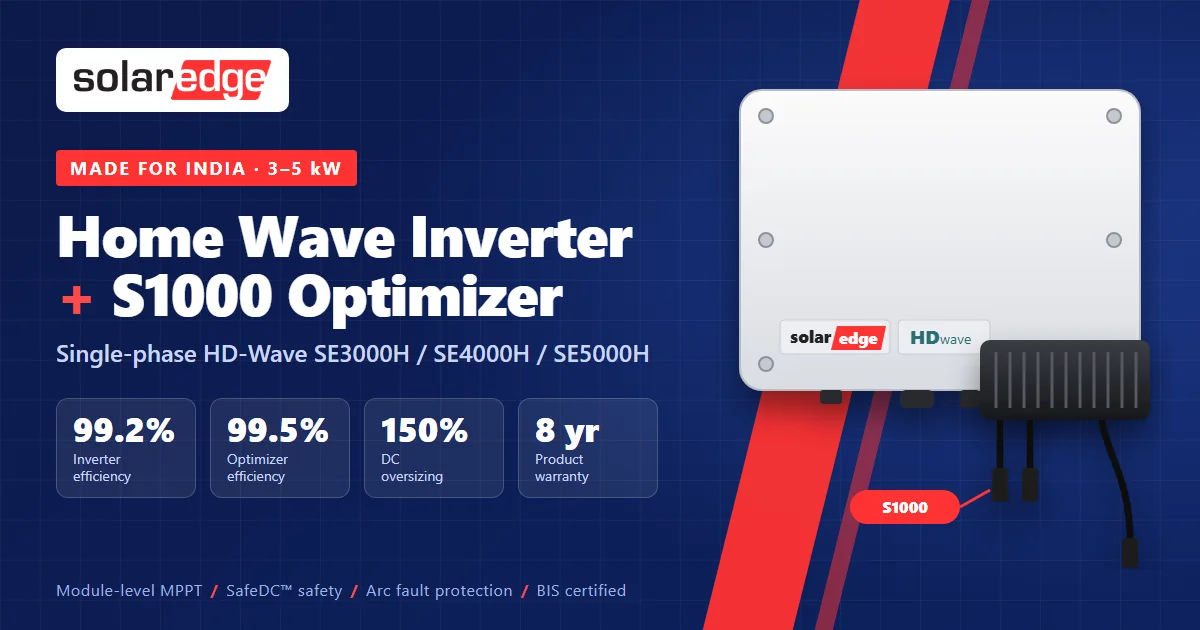
For single-phase homes, SolarEdge's India range is the Home Wave inverter in three sizes, paired with the S1000 power optimizer. The figures below are from SolarEdge's India datasheets (July 2025).
| Home Wave inverter | SE3000H | SE4000H | SE5000H |
|---|---|---|---|
| Rated AC output | 3,000 VA | 4,000 VA | 5,000 VA |
| Maximum DC (panel) power | 4,500 W | 6,000 W | 7,500 W |
| Maximum efficiency | 99.2% | ||
| Weight | 7.8 kg | 9 kg | 9 kg |
Other points worth knowing about the Home Wave inverter:
- 150% DC oversizing: you can connect up to 1.5 times the inverter's rating in panels, so a 3 kW inverter can take 4.5 kW of panels.
- Built for Kerala weather: IP65 rated for indoor or outdoor mounting, cooled without fans, and quieter than 25 dBA. It delivers full power up to at least 50°C.
- Safety: integrated arc fault protection, islanding protection, and BIS certification to IS 16221 and IS 16169 for grid-connected inverters in India.
- Easy setup: commissioned from a smartphone with the SolarEdge SetApp, with Ethernet, RS485 or optional Wi-Fi for monitoring.
The S1000 optimizer handles panels up to 1,100 W with 99.5% peak efficiency. It is IP68 rated, works from -40°C to +85°C, and includes Sense Connect, which watches the cable connectors for overheating caused by loose fittings or wear. Both the inverter and the optimizer carry an 8-year warranty in India, per SolarEdge's India warranty terms.
Where SolarEdge pays off in Kerala
- Partial shade: coconut and jackfruit trees, a neighbour's upper floor, a water tank or a stair room that shades part of the array for part of the day.
- Split roofs: sloped roofs with panels on two or more faces, or small terraces where panels have to fit around obstacles.
- Monitoring you can act on: if one panel underperforms, the app shows exactly which one, so a service visit fixes it rather than searching for it.
- Safety on roofs people use: terraces where family members dry clothes or walk often benefit from the touch-safe 1 V shutdown.
If your roof is open, unshaded and faces one direction, a quality string inverter will give similar output for less money. We will tell you which one your roof needs after the site survey.
PM Surya Ghar subsidy with SolarEdge
The PM Surya Ghar subsidy for homes depends on the solar panel capacity, not on the inverter brand. A SolarEdge system and a string inverter system of the same size get the same subsidy: up to ₹78,000 for 3 kW and above. The panels must meet the Domestic Content Requirement, and the system must be installed by a registered vendor.
The extra cost of the optimizers is not subsidised, so it is part of the payback calculation. Our subsidy guide walks through the application, and our GST guide explains how the 2025 GST cut affects your quote.
How we design a SolarEdge system
SolarEdge sets strict design rules, and following them matters for performance and warranty. With the Home Wave inverters, each optimizer connects to one panel, and a string needs between 6 and 25 optimizers, carrying up to 6,840 W. In practice:
- 3 kW home: six 540 W panels (3.24 kW) on an SE3000H, which meets the six-optimizer minimum.
- 5 kW home: ten 540 W panels (5.4 kW) on an SE5000H, within the 7,500 W DC limit.
Strings of different lengths and orientations can share one inverter, as long as the longest and shortest strings differ by no more than 5 optimizers. Not sure what size you need? Start by sizing the system from your KSEB bill.
How Jasper Solar installs SolarEdge
Jasper Solar designs and installs SolarEdge systems across Thiruvananthapuram, Kollam and Kottayam. A typical project runs like this:
- Site survey and shade check: we map trees, tanks and walls that shade the roof through the day and across the seasons.
- Design: we size the inverter and plan strings and optimizer placement within SolarEdge's rules, and quote a string inverter option alongside so you can compare.
- Installation: optimizers are fixed to the mounting structure behind each panel, on our IIT/NIT certified hot-dip galvanized structures.
- Commissioning: the inverter is set up with SetApp, and every panel is checked in the monitoring platform before we hand over.
- Paperwork: we handle KSEB net metering and the PM Surya Ghar subsidy application from start to finish.
Common questions
Does a SolarEdge system work during a power cut?
No. The Home Wave inverter is grid-tied and shuts down when KSEB supply fails, like any on-grid inverter, to protect line workers. If you need backup, read our guide to hybrid solar systems and ask us about a design with a battery.
Can I see each panel's output?
Yes. Module-level monitoring is built in, so the SolarEdge app shows the output of every panel, not just the total.
Does SolarEdge reduce my subsidy?
No. The subsidy is based on panel capacity, so it is the same as for a string inverter system of the same size.
Is SolarEdge worth it for an unshaded roof?
The gain is smaller. You still get panel-level monitoring and the 1 V safety shutdown, but if output is your only concern, a string inverter may give better value. We quote both so you can decide.
Want to know if SolarEdge suits your roof? Book a free site visit and we will design a SolarEdge and a string inverter option side by side, with the subsidy and payback for each.