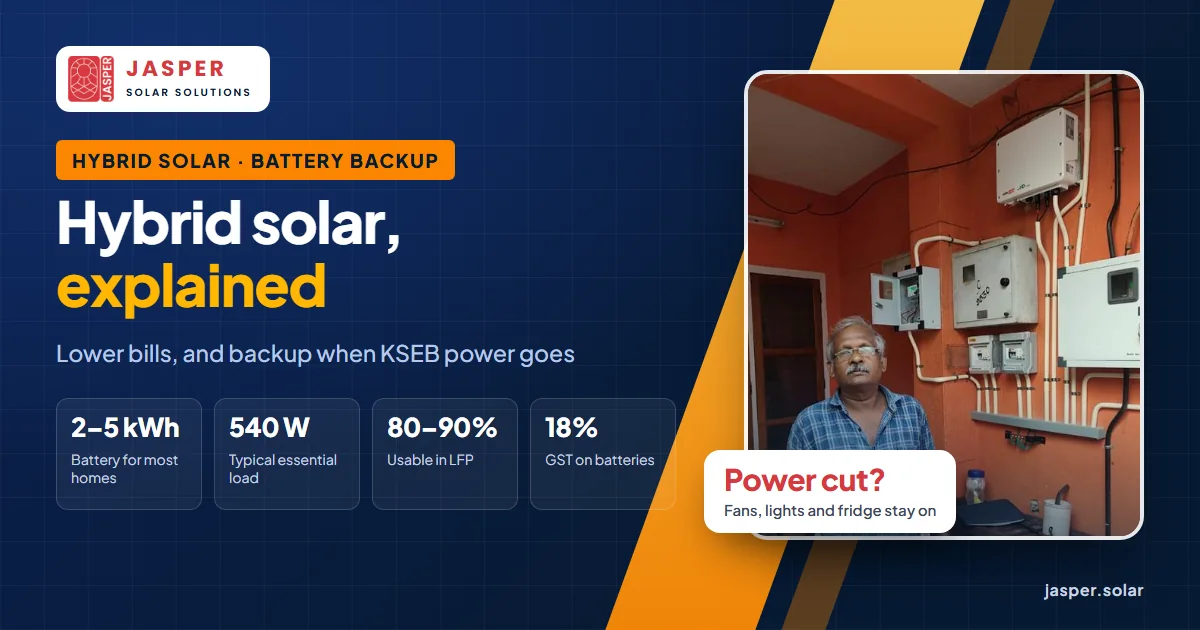
- A hybrid system is an on-grid system with a battery. It cuts your KSEB bill like on-grid solar and keeps essentials running during power cuts.
- The hybrid inverter is the brain: it decides, second by second, whether solar power goes to your home, the battery or the grid.
- Size the battery for the loads you need in an outage (fans, lights, fridge, Wi-Fi), not for the whole house. Most homes need 2 to 5 kWh.
- The PM Surya Ghar subsidy is paid on the panel capacity. The battery gets no subsidy and carries 18% GST.
Kerala homes lose power more often than most people would like: a tree on the line during the monsoon, a transformer fault, a scheduled shutdown for maintenance. A standard on-grid solar system cannot help in those moments, because it switches off with the grid. A hybrid solar system is the answer for homes that want lower bills and backup from the same rooftop.
What a hybrid solar system is
A hybrid system combines three sources of power: your solar panels, a battery and the KSEB grid. One hybrid inverter connects all three and manages the flow between them. During the day, solar powers your home first, tops up the battery next and exports any surplus to KSEB through your net meter. At night or in a power cut, the battery takes over.
That is the key difference from the other two system types. An on-grid system has no battery, and an off-grid system has no grid connection. Our on-grid vs hybrid vs off-grid comparison covers how the three stack up side by side.
The four parts and what each one does
| Part | What it does |
|---|---|
| Solar panels | Turn sunlight into DC electricity. A 1 kW array makes about 120 units a month in Thiruvananthapuram. |
| Hybrid inverter | Converts DC to the AC your home uses, charges and discharges the battery, and talks to the grid. |
| Battery | Stores surplus solar for the evening and for power cuts. |
| Net meter | Records what you import from and export to KSEB, so exports are credited on your bill. |
What happens during a power cut
When the grid fails, every grid-connected inverter must stop exporting at once. This safety rule, called anti-islanding, protects KSEB line workers repairing the fault. An on-grid inverter simply shuts down, so your panels sit idle even on a sunny afternoon.
A hybrid inverter disconnects your home from the grid instead of shutting down. It then runs your backup circuit from the battery and keeps charging it from the panels while the sun is up. The switch takes a fraction of a second, so fans keep turning and the Wi-Fi router usually stays on. When KSEB supply returns, the inverter reconnects on its own.
The three ways a hybrid inverter can run
- Self-use first: solar powers the home, the battery stores the surplus and covers the evening, and the grid fills any gap. This gives the lowest bills.
- Backup first: the battery stays close to full and is used only in a power cut. This is best where outages are frequent or someone works from home.
- Export first: surplus goes to the grid before the battery. This makes sense only when export credit is worth more than stored power.
Most Kerala homes do well on backup-first through the monsoon and self-use first in the dry months. A good installer sets this up for you and shows you how to switch.
How to size the battery
Size the battery for the appliances you need in an outage, not for the whole house. Air conditioners, water heaters and induction cooktops draw too much to run from a home battery for long, so they are normally left off the backup circuit.
A typical essential load looks like this:
| Appliance | Power |
|---|---|
| Refrigerator (average) | 150 W |
| 4 ceiling fans | 300 W |
| 6 LED lights | 60 W |
| Wi-Fi router and phone charging | 30 W |
| Total | 540 W |
To run that for 4 hours, you need about 2.2 kWh of usable energy (540 W × 4 h). Usable energy depends on the battery type, because no battery should be emptied completely:
- Lithium (LFP): can safely use about 80 to 90% of its rated capacity, so a 2.5 to 3 kWh battery covers this load.
- Lead-acid: should not go below about 50% to protect its life, so you would need roughly 4.5 kWh of rated capacity for the same backup.
Lithium or lead-acid?
Lithium iron phosphate (LFP) batteries cost more upfront but last far longer. Manufacturers typically rate them for several thousand charge cycles, against several hundred to around 1,500 for lead-acid. They also need no water top-ups and take less space on the wall.
If you use the battery every evening in self-use mode, LFP usually works out cheaper over 10 years because a lead-acid bank will need replacing along the way. If the battery is only for occasional power cuts, a tubular lead-acid bank can still make sense on a tight budget. Either way, compare the warranty years and rated cycles on the datasheet, not just the price.
Cost, subsidy and GST
A hybrid system costs more than an on-grid system of the same size, mainly because of the battery and the more capable inverter. Three rules shape the final price:
- Subsidy: the PM Surya Ghar subsidy for homes is calculated on the rated capacity of the solar panels, not the inverter or battery, and the panels must meet the Domestic Content Requirement. A 3 kW hybrid system gets the same subsidy as a 3 kW on-grid one: up to ₹78,000. See our subsidy guide for the steps.
- GST: panels and inverters now carry 5% GST, but batteries stay at 18%. Our GST guide explains the effect on your quote.
- Net metering: under Kerala's 2025 KSERC regulations, battery storage now plays a part in how larger rooftop systems are approved for net metering. The limits depend on your system size, so check the current rule with KSEB or your installer before you finalise the design.
Is a hybrid system right for your home?
A hybrid system is worth the extra cost if any of these apply:
- Your area has power cuts several times a month, especially during the monsoon.
- Someone works or studies from home and needs Wi-Fi and a laptop through outages.
- A family member relies on medical equipment that cannot lose power.
- You want to use more of your own solar in the evening instead of exporting it.
If outages are rare and saving money is the main goal, an on-grid system gives the fastest payback. Start by sizing the solar array from your KSEB bill, then decide whether a battery is worth adding.
Common questions
Can I add a battery to my existing on-grid system?
Usually yes, but a standard on-grid inverter cannot charge a battery. You either replace it with a hybrid inverter or add a separate battery inverter, so ask for both options in your quote.
Will a hybrid system run my air conditioner during a power cut?
It can for a short time with a large enough inverter and battery, but it drains the battery quickly. Most homes keep the AC off the backup circuit so the battery lasts through the outage.
How long does a solar battery last?
It depends on the type and how hard it is cycled. An LFP battery used every evening will typically outlast two or more lead-acid banks used the same way. Compare the warranty years and the rated cycles on each model's datasheet before you buy.
Does a hybrid system still export to KSEB?
Yes. With a net meter, surplus solar is exported and credited on your bill, just as with an on-grid system.
Not sure which system suits your home? Book a free site visit and we will design an on-grid and a hybrid option side by side, with the backup hours, subsidy and payback for each.