What changed and what did not
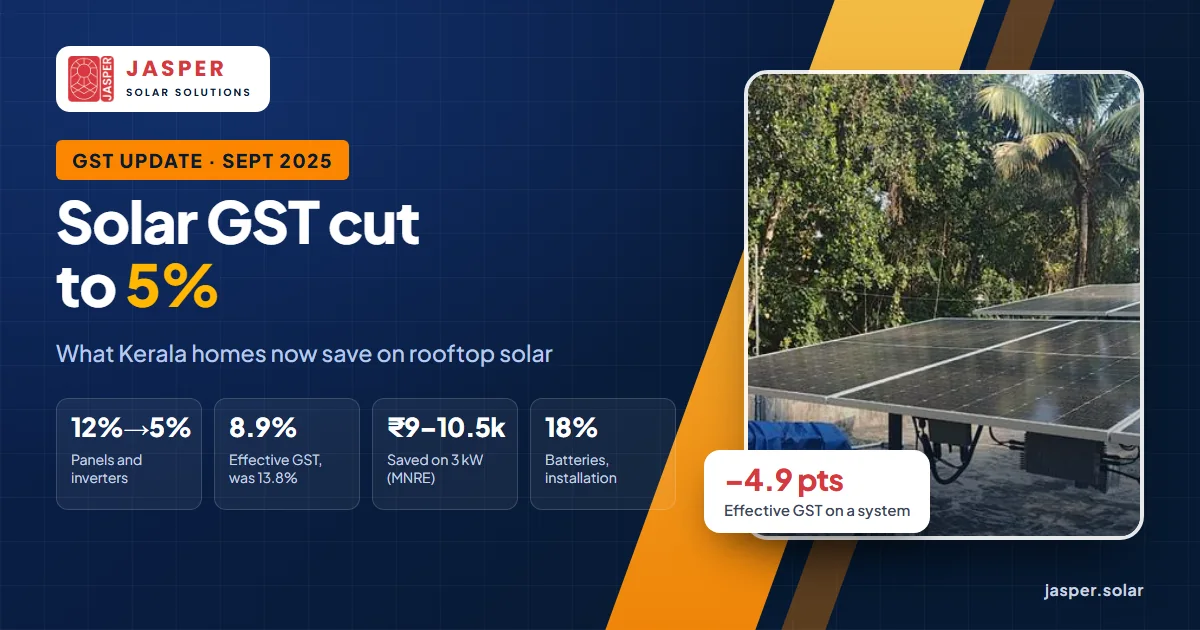
The September 2025 GST revision moved solar modules and solar inverters into the 5% slab. The rest of the system did not move.
| Part of the system | GST before 22 Sep 2025 | GST now |
|---|---|---|
| Solar panels (modules) | 12% | 5% |
| Solar inverters | 12% | 5% |
| Mounting structure, cables, ACDB/DCDB, earthing | 18% | 18% |
| Batteries | 18% | 18% |
| Installation, testing and commissioning | 18% | 18% |
The rate is the same across India, so a home in Thiruvananthapuram or Kollam pays the same GST as one in any other state.
Why the whole system is not 7% cheaper
A rooftop system is billed as one package of goods and services. For GST, the value is usually split 70:30: 70% is treated as goods (panels and inverter) and 30% as services and other parts at 18%.
- Before: 70% × 12% + 30% × 18% = 8.4% + 5.4% = 13.8%
- Now: 70% × 5% + 30% × 18% = 3.5% + 5.4% = 8.9%
That is a drop of 4.9 percentage points. On the final price, including GST, the system works out about 4.3% cheaper, not 7%.
How much a Kerala home saves
The Ministry of New and Renewable Energy (MNRE) estimates a typical 3 kW rooftop system costs about ₹9,000 to ₹10,500 less after the change. The table below uses round example prices before GST to show the effect. Your actual quote depends on panel brand, inverter type and your roof.
| System | Example price before GST | GST at 13.8% (old) | GST at 8.9% (now) | You save |
|---|---|---|---|---|
| 3 kW home | ₹2,00,000 | ₹27,600 | ₹17,800 | ₹9,800 |
| 5 kW home | ₹3,00,000 | ₹41,400 | ₹26,700 | ₹14,700 |
| 10 kW shop or office | ₹5,50,000 | ₹75,900 | ₹48,950 | ₹26,950 |
The GST saving comes on top of the PM Surya Ghar subsidy, which is a fixed amount per kW (up to ₹78,000 for 3 kW and above) and is paid separately into your bank account. See our subsidy guide for the steps.
Adding a battery? Expect a higher rate
Batteries stay at 18% GST. A hybrid system with a battery therefore has a larger share of 18% items, and its overall GST rate will be above 8.9%. If you mainly want lower bills rather than backup, an on-grid system gets the most from the GST cut. Our on-grid vs hybrid comparison explains the trade-off.
Faster payback and smaller loan EMIs
Payback is simply the net cost of the system divided by what you save on electricity each year. A lower starting price shortens it.
As a worked example, a 3 kW system in Thiruvananthapuram makes about 360 units a month. At an assumed ₹6 per unit, that is roughly ₹25,900 saved a year.
- Old GST: ₹2,27,600 − ₹78,000 subsidy = ₹1,49,600 net, so payback in about 5.8 years
- New GST: ₹2,17,800 − ₹78,000 subsidy = ₹1,39,800 net, so payback in about 5.4 years
If you finance the system, the lower price means a smaller loan. With the same rate and tenure, both the EMI and the total interest come down. The GST change does not affect the bank's interest rate or approval rules.
For businesses: input tax credit and depreciation
Shops, offices, schools and factories in Kerala gain in two different ways, depending on their tax position:
- If you can claim full input tax credit, GST is recovered anyway. The cut mainly means less cash locked up until the credit comes through.
- If credit is blocked or partial, for example when the plant is treated as part of the building, the lower GST is a direct cost saving.
- Accelerated depreciation is a separate income-tax benefit. Eligible businesses can write off a large share of the solar asset's value in the first year (40% on written-down value under current rules, halved if it runs less than 180 days that year). It is not a GST benefit and does not depend on the rate cut.
Credit and depreciation rules depend on how the asset is capitalised, so check the details with your chartered accountant before you invest.
How to check your quote uses the new rate
- Ask for a tax invoice that lists panels and inverter separately from the balance of system and installation.
- Check that panels and inverter show 5% GST, and the other items 18%.
- Make sure the panels are listed under HSN code 8541 (solar modules) and the GST number of the installer is printed on the invoice.
- If the quote shows a single GST figure for the whole system, ask how it was worked out. On an on-grid system it should come close to 8.9%.
Every Jasper Solar quote shows the GST split line by line, alongside the subsidy you are eligible for. Book a free site visit for an exact price for your roof.