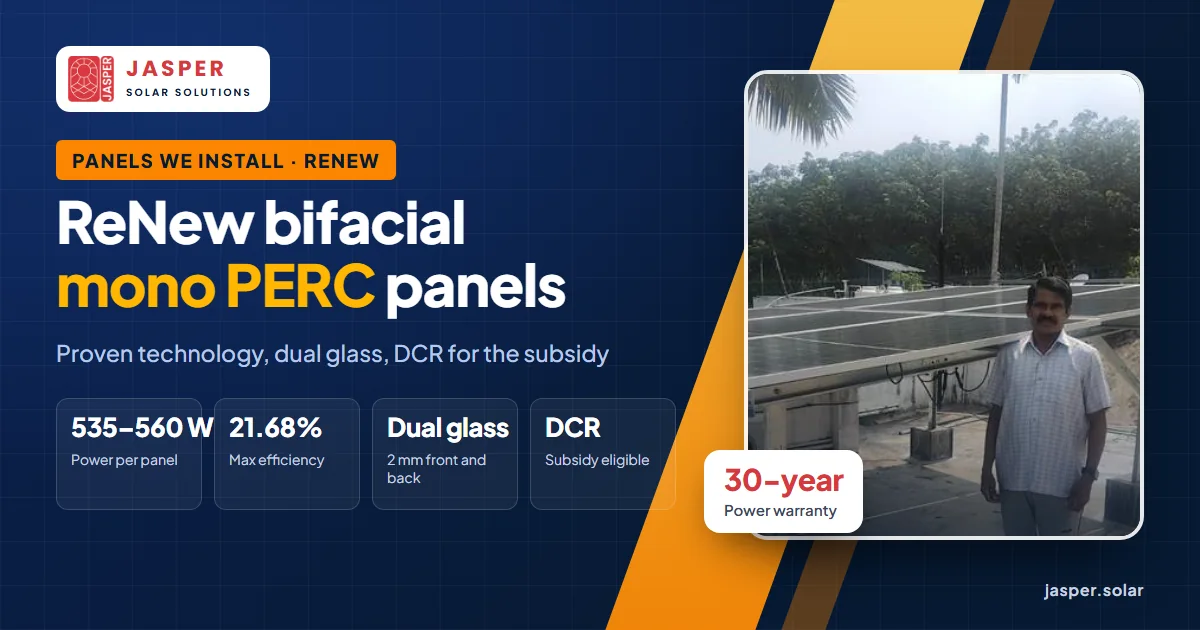
- The ReNew M10 bifacial mono PERC panel (535 to 560 W) is one of the panels Jasper Solar installs on Kerala homes. It is available as a DCR panel, so it qualifies for the PM Surya Ghar subsidy.
- Mono PERC is the proven workhorse of rooftop solar: a mature technology with years of field performance behind it, and strong value for money.
- It is built as a dual-glass panel, with 2 mm glass front and back, an IP68/IP67 junction box and a 30-year power warranty.
- Six 540 W ReNew panels make a 3.24 kW system, which gets the full ₹78,000 subsidy.
ReNew is one of India's largest renewable energy companies, and it makes solar cells and panels in India. Its M10 bifacial mono PERC panel is a dependable choice for Kerala homes that want proven technology at a fair price. This guide explains the panel, what its datasheet means for a Kerala roof, and how it compares with newer TOPCon panels.
ReNew M10 bifacial panel at a glance
All figures are from ReNew's datasheet for the RPS2MH72BD series.
| Specification | ReNew M10 bifacial mono PERC |
|---|---|
| Power range | 535 W to 560 W |
| Module efficiency | 20.71% to 21.68% |
| Cells | 144 half-cut, M10, gallium-doped mono PERC, multi-busbar |
| Construction | Dual glass: 2 mm tempered front, 2 mm rear glass |
| Bifaciality | Up to 70% |
| Temperature coefficient of power | −0.32% per °C |
| NOCT | 43°C ± 2°C |
| Mechanical load | 5,400 Pa front, 2,400 Pa wind |
| Junction box | IP68 / IP67 |
| Size and weight | 2,278 × 1,134 × 30 mm, 32.5 kg |
| Warranty | 12-year product, 30-year power |
| Degradation | 2% in year one, then 0.45% a year; 84.95% guaranteed at 30 years |
The datasheet also lists ALMM approval, BIS registration, ISO 9001, 14001 and 45001 certified manufacturing, a Kiwa PVEL 2024 Top Performer mark and the BloombergNEF Tier 1 mark.
Why mono PERC is still a smart choice
- Proven over years in the field. PERC has been the mainstream panel technology for most of the last decade, so its long-term behaviour on real roofs is well understood.
- Gallium-doped cells. Gallium doping reduces light-induced degradation, a known weakness of older boron-doped PERC cells.
- Good low-light output. ReNew rates the panel for strong output in early morning, late evening and cloudy weather, which matters during Kerala's long monsoon.
- Value for money. A mature production process keeps PERC panels competitively priced for the power they deliver.
Mono PERC vs TOPCon: an honest comparison
Jasper Solar installs both. Here is how this ReNew PERC panel compares with the Premier Energies TOPCon panel we also fit, using each maker's datasheet:
| ReNew mono PERC | Premier TOPCon | |
|---|---|---|
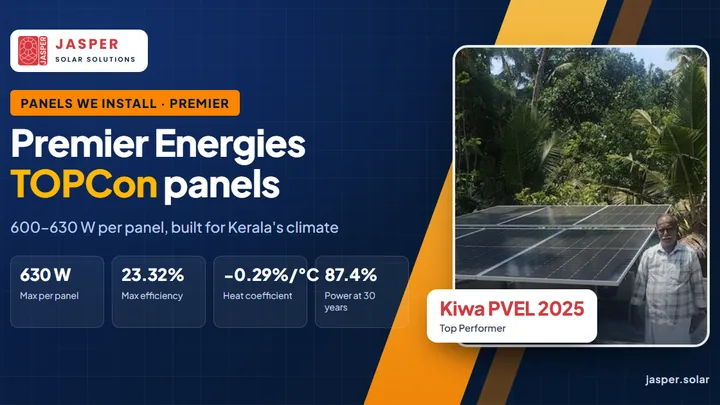
| Power | 535 to 560 W | 600 to 630 W |
| Efficiency | up to 21.68% | up to 23.32% |
| Temperature coefficient | −0.32% per °C | −0.29% per °C |
| Year-one degradation | 2% | 1% |
| Power at 30 years (warranted) | 84.95% | 87.4% |
| Technology maturity | Long field record | Newer, rapidly adopted |
On paper, TOPCon loses slightly less power in heat and degrades a little more slowly. PERC's strengths are its long track record and value. For most Kerala homes with enough roof space, both deliver excellent 25-year results. TOPCon makes most sense where roof space is tight and every watt per square foot counts. Read about the Premier Energies TOPCon panel.
What it means on a Kerala roof
- Heat: panels lose some output as they heat up. At −0.32% per °C, a panel running 25°C above test conditions on a hot afternoon gives up about 8% of its rated output, which is normal for this technology and already built into our generation estimates.
- Humidity and monsoon: dual glass protects the cells from moisture better than a plastic backsheet, and the IP68/IP67 junction box keeps water out.
- Wind: the panel is rated for 2,400 Pa of wind load. We mount it on hot-dip galvanized structures designed to IS 875 Part 3.
- Bifacial gain: on an elevated structure over a light-coloured terrace, the rear side collects reflected light for extra output. The gain depends on height and roof colour.
How many ReNew panels do you need?
| System | Panels (540 W) | Capacity | Approx. monthly units |
|---|---|---|---|
| 2 kW | 4 | 2.16 kW | ~260 |
| 3 kW | 6 | 3.24 kW | ~390 |
| 5 kW | 10 | 5.4 kW | ~650 |
Monthly units use about 120 units per kW a month, typical for Thiruvananthapuram. Each panel is about 2.3 m long and 32.5 kg, so the structure must be designed for it. See how to size your system from your KSEB bill.
Subsidy and DCR
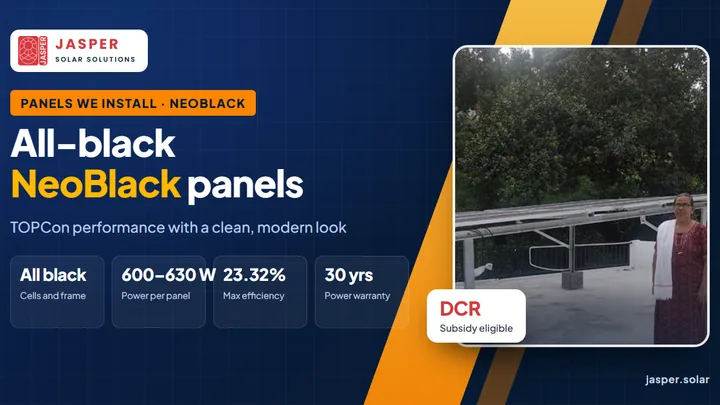
ReNew offers this panel as a DCR module, made with Indian cells. DCR panels are required for the PM Surya Ghar subsidy of up to ₹78,000. For every subsidy project we fit the DCR version and share its certificate with you. Read our subsidy guide for the steps.
How Jasper Solar installs ReNew panels
- Site survey and shade check, then a 3D design with the panel layout.
- An IIT/NIT certified hot-dip galvanized structure, elevated where it helps bifacial gain.
- Installation with proper earthing and lightning protection to IEC 62305.
- KSEB net metering and the subsidy claim, handled for you.
Common questions
Is mono PERC outdated?
No. TOPCon is newer and slightly more efficient, but PERC remains a reliable, well-proven technology. A good PERC panel will serve a home well for 25 years and more.
Does a bifacial panel work on a sloped roof?
It works, but the rear side gains little when the panel sits flat against the roof. Bifacial panels give most extra output on elevated terrace structures.
What does the 30-year power warranty cover?
ReNew guarantees at least 98% of rated power after year one and 84.95% after 30 years. The 12-year product warranty covers manufacturing defects. See ReNew's warranty document for the full terms.
Want ReNew panels on your roof? Book a free site visit and we will design your system and quote it with the subsidy worked out. Compare panel types in our guide to choosing solar panels.