- For a home claiming the PM Surya Ghar subsidy, the panels must be DCR (made with Indian cells). That one rule narrows the choice before anything else.
- Most panels sold in India now use TOPCon cells, which are more efficient than the older mono PERC type. Bifacial panels add a little extra output on elevated structures.
- In Kerala's heat, humidity and coastal air, look past the wattage: check the temperature coefficient, salt-mist rating and the warranty terms.
- Compare panels by their datasheet and warranty documents, not the brochure. A 25-year linear performance warranty is the standard to expect.
Solar panels are the part of the system you live with longest: 25 years or more. Two panels with the same wattage can perform quite differently on a Kerala roof. This guide explains the panel types, the rules that decide which panels qualify for the subsidy, and the datasheet figures worth checking.
Start with the rules: DCR and ALMM
- DCR (Domestic Content Requirement): panels made with solar cells manufactured in India. The PM Surya Ghar subsidy requires DCR panels. Non-DCR panels can cost less, but a home using them loses the subsidy of up to ₹78,000.
- ALMM (Approved List of Models and Manufacturers): MNRE's list of approved panel models and makers. From 1 June 2026, government-backed and net-metered projects must also use cells from approved Indian manufacturers (ALMM List-II).
In practice, this means asking your installer for the DCR certificate of the exact panel model to be fitted. For how the subsidy works, see our subsidy guide.
Panel types compared
| Type | What it is | Good to know |
|---|---|---|
| Mono PERC | The mainstream technology of recent years | Proven and affordable, being replaced by TOPCon |
| TOPCon | An improved cell design, now the most common in India | Higher efficiency and better heat performance than PERC |
| Bifacial | Panels that also collect light reflected onto the back | Extra output on elevated structures over a light-coloured terrace |
| Heterojunction (HJT) | A premium cell design | Very good heat performance, at a higher price |
Higher efficiency means more watts from the same roof area. If your terrace is small, an efficient panel can fit the system size you need. If space is not a constraint, a well-made panel at a fair price matters more than the last percent of efficiency.
What Kerala's climate asks of a panel
- Heat: panels lose output as they get hotter. The temperature coefficient of power on the datasheet shows how much; a smaller number, closer to zero, is better.
- Humidity: look for PID (potential induced degradation) resistance, which protects output in hot, humid conditions.
- Coastal air: homes near the coast should choose panels tested for salt-mist corrosion (IEC 61701), and a heavily galvanized structure.
- Monsoon rain and wind: an IP68 junction box keeps water out, and the frame and glass should pass the mechanical load tests in IEC 61215.
Reading a panel datasheet
| Datasheet item | What to look for |
|---|---|
| Rated power (Wp) | Common home panels are now 540 W and above |
| Module efficiency | Higher is better if roof space is tight |
| Temperature coefficient of Pmax | Closer to zero is better in Kerala's heat |
| Power tolerance | Positive only (for example 0 to +5 W) |
| Certifications | BIS (IS 14286), IEC 61215 and IEC 61730; IEC 61701 near the coast |
| Product warranty | Covers manufacturing defects; check the years |
| Performance warranty | 25 years or more, with a linear yearly degradation limit |
How many panels do you need?
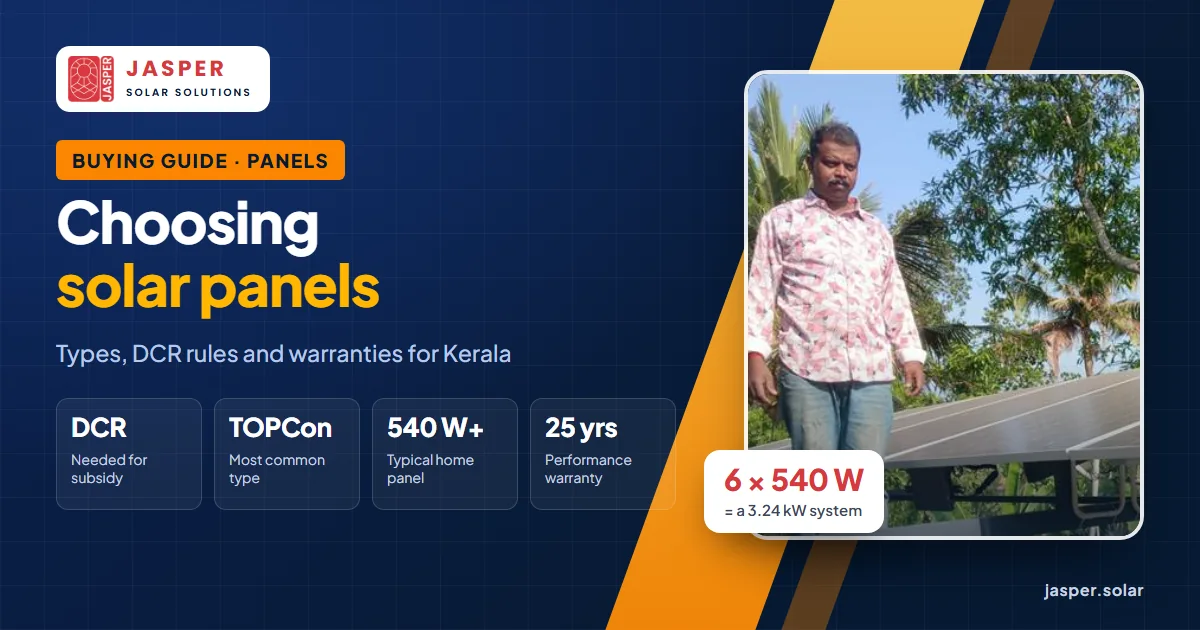
Divide the system size by the panel wattage. A 3 kW system uses six 540 W panels (3.24 kW), and a 5 kW system uses ten (5.4 kW). Each panel needs roughly 25 to 30 sq ft, so plan for about 80 to 100 sq ft of shade-free roof per kW, including access space. To work out your system size, see how to size solar from your KSEB bill.
The panels Jasper Solar installs
We fit DCR panels from two Indian manufacturers, so every home system qualifies for the subsidy:
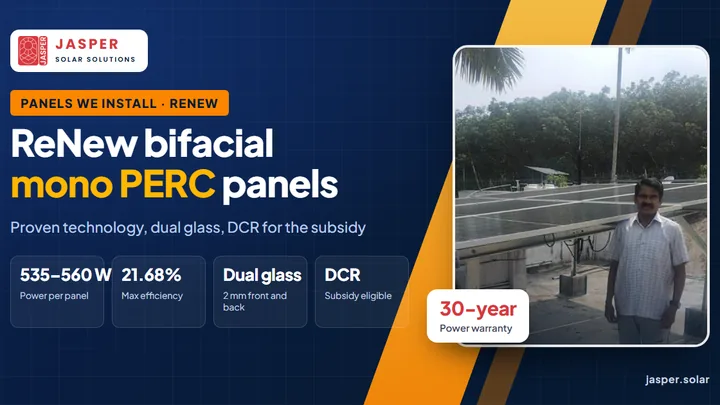
- ReNew bifacial mono PERC, 535 to 560 W: proven technology, dual glass and a 30-year power warranty, at excellent value.
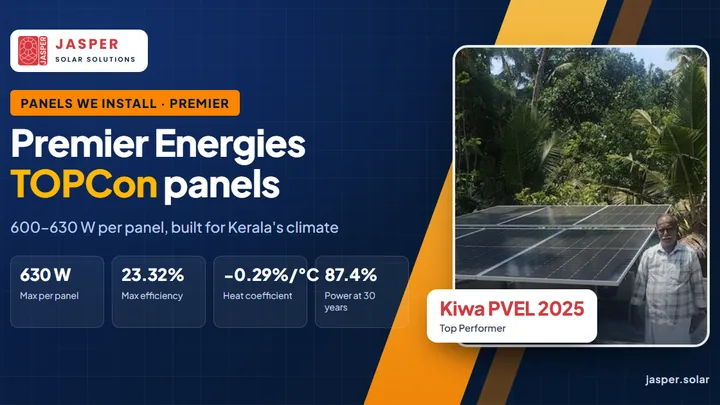
- Premier Energies TOPCon, 600 to 630 W: up to 23.32% efficiency and a −0.29% per °C temperature coefficient, for the most power from a small roof.
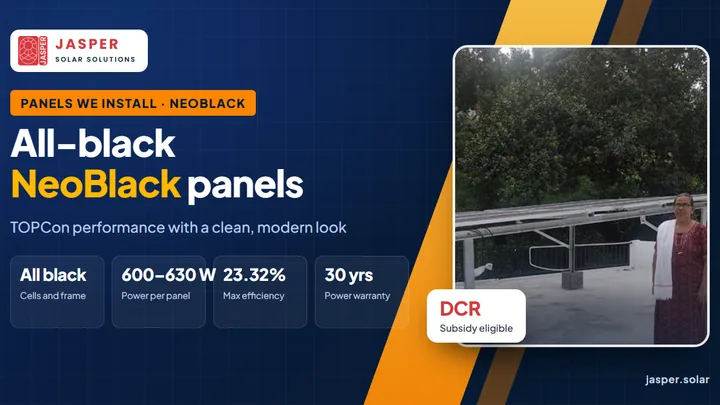
- Premier NeoBlack all-black: the same TOPCon performance with a uniform black finish for modern homes.
Mistakes to avoid
- Choosing by wattage alone, without checking the DCR certificate for a subsidy project
- Mixing panel models or wattages in one string, which drags all of them down to the weakest
- Accepting a quote that says "Tier 1 panels" without naming the make and model
- Ignoring shade: even the best panel underperforms in the shadow of a water tank. Panel-level optimizers such as SolarEdge can help on shaded roofs
Common questions
Are imported panels better than Indian panels?
Not automatically. Quality depends on the manufacturer and model. For a subsidy project you need DCR panels anyway, and several Indian manufacturers now make TOPCon DCR panels.
Do bifacial panels make sense on a Kerala terrace?
They help most on an elevated structure over a light-coloured roof, where reflected light reaches the back of the panel. On a low frame over a dark roof the gain is small.
How long do solar panels last?
A good panel keeps producing for 25 years or more, with a slow decline in output that the performance warranty limits each year.
Not sure which panel suits your roof? Book a free site visit and we will recommend panels for your roof, budget and subsidy eligibility, with the datasheets to back it up. For prices, see our 2026 cost guide.