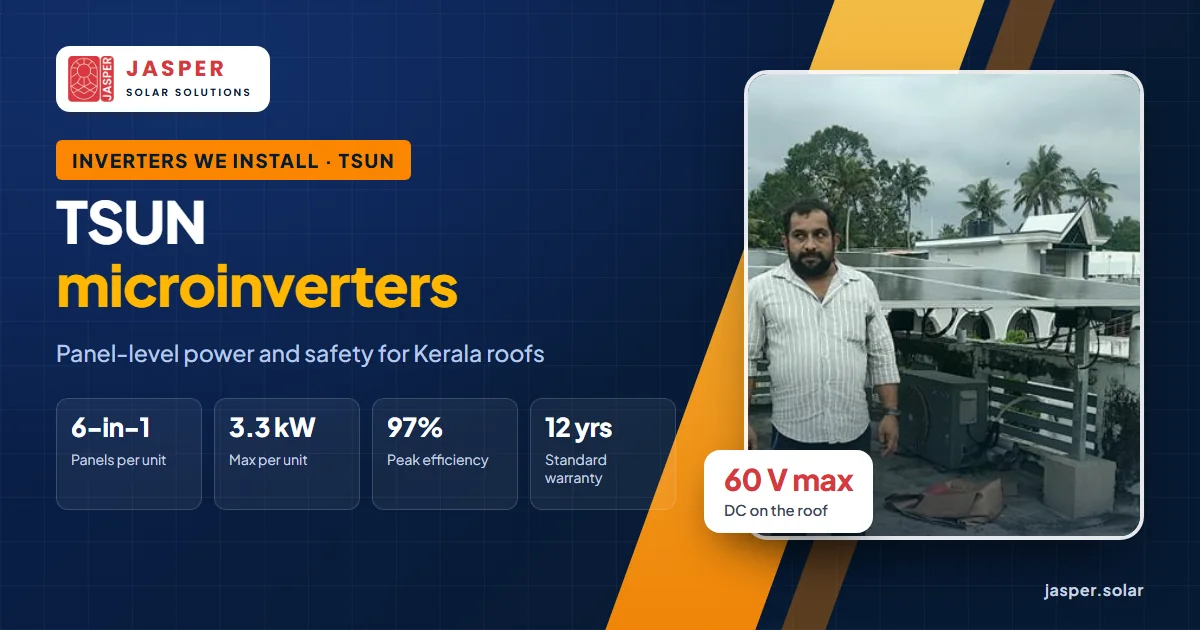
- The TSUN GEN3 6-in-1 microinverter connects up to six panels, each with its own maximum power point tracker, and outputs 2,400 W to 3,300 W of AC power depending on the model.
- DC voltage on the roof never exceeds 60 V, far below the several hundred volts of a typical string system, which makes it a safer design.
- Each panel works independently, so shade, dust or a fault on one panel does not drag down the others. It suits Kerala roofs with trees, tanks or several roof faces.
- It is sealed to IP67, cooled without fans, monitored over Wi-Fi and Bluetooth, and carries a 12-year standard warranty.
Most rooftop systems use one central string inverter. A microinverter takes a different approach: it converts power right next to the panels, so each panel works on its own. TSUN's GEN3 6-in-1 puts six of these independent converters in one compact box, which makes it a neat fit for a 3 kW home system. This guide explains how it works and when it is the right choice in Kerala.
How a microinverter works
In a string system, panels are wired in series to reach several hundred volts DC, and one inverter converts it all. If one panel is shaded, the whole string suffers.
With a microinverter, each panel connects to its own input with its own MPPT (maximum power point tracking). The microinverter converts the DC power to grid-ready AC on the roof, so only AC power travels down to your distribution board. One shaded panel affects only itself.
TSUN GEN3 6-in-1 at a glance
Figures are from TSUN's datasheet for the GEN3 Microinverter 6-in-1 (TSOL-MS series).
| Model | MS2400 | MS2500 | MS2700 | MS3000 | MS3300 |
|---|---|---|---|---|---|
| Continuous AC output | 2,400 W | 2,500 W | 2,700 W | 3,000 W | 3,300 W |
| Max output current | 12 A | 12.5 A | 13.5 A | 15 A | 15.9 A |
| Specification | All GEN3 6-in-1 models |
|---|---|
| Panels per unit | 1 to 6, each on its own input |
| Recommended panel power | 400 W to 700 W and above |
| Max DC voltage per input | 60 V |
| Max input current per input | 18 A |
| Peak / EU efficiency | 97.0% / 96.7% |
| MPPT efficiency | 99.9% |
| Night-time consumption | Under 50 mW |
| Protection | IP67, natural convection cooling, HF isolation |
| Operating temperature | −40°C to +65°C (derates above 40°C ambient) |
| Monitoring | Wi-Fi and Bluetooth app; RS485 optional |
| Size and weight | 380 × 313 × 49 mm, 7.5 to 8.2 kg |
| Warranty | 12 years standard |
Why it suits Kerala homes
- Safer roofs. With a maximum of 60 V DC per input, there is no high-voltage DC cable running across your terrace. That reduces the risk of DC arcing, a known cause of solar fires in high-voltage string systems.
- Shade tolerance. Coconut trees, water tanks and neighbouring buildings shade parts of many Kerala roofs. Each panel's own MPPT keeps the unshaded panels producing at full power.
- Mixed roof faces. Panels on different slopes or directions can share one microinverter, because each input is tracked separately.
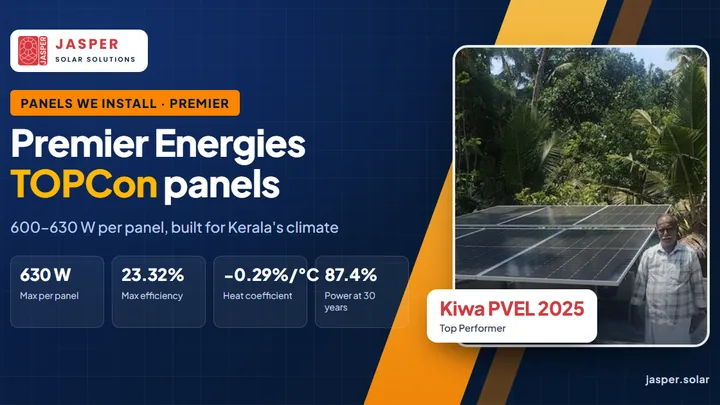
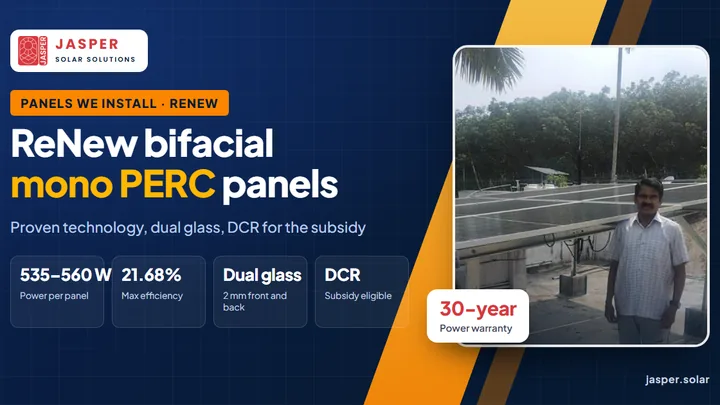
- Large modern panels. Each input takes up to 18 A, so it works with today's 540 W to 630 W panels, including the ReNew and Premier Energies panels we install.
- Built for humidity. IP67 sealing, die-cast housing and potting compound protect the electronics from Kerala's monsoon moisture.
- Live monitoring. The app shows generation from your phone over Wi-Fi or Bluetooth.
Microinverter, SolarEdge or string inverter?
| String inverter | SolarEdge optimizers | TSUN microinverter | |
|---|---|---|---|
| Panel-level tracking | No | Yes | Yes |
| DC voltage on roof | Several hundred volts | 1 V per panel when off | 60 V maximum |
| Where conversion happens | Central inverter | Central inverter | On the roof, next to panels |
| Best for | Open, unshaded roofs | Shaded or complex roofs, larger systems | Shaded or complex home roofs up to about 3 kW per unit |
| Cost | Lowest | Higher | Higher |
For a full comparison of panel-level electronics with string inverters, read SolarEdge vs string inverters.
A 3 kW system with one TSUN unit
A single TSOL-MS3000 handles six panels. With six 540 W panels (3.24 kW), it makes a complete 3 kW home system that qualifies for the full ₹78,000 PM Surya Ghar subsidy and produces around 390 units a month at about 120 units per kW. On very hot afternoons, the microinverter may hold output slightly below its peak, because it derates above 40°C ambient, so we mount it where it gets shade and airflow behind the panels.
Approvals and the subsidy
Every grid-connected inverter used on a KSEB net-metered or PM Surya Ghar project must meet India's certification rules, including BIS. We confirm the certification for the exact TSUN model before installation and handle the KSEB net metering and subsidy paperwork. See our subsidy guide for the steps.
Common questions
Does a microinverter work during a power cut?
No. Like every grid-tied inverter, it shuts down when KSEB supply fails, for the safety of line workers. For backup, see our hybrid solar guide.
What if one panel fails?
Only that panel stops producing. The other panels on the unit keep working, and the app shows which one needs attention.
Can I add panels later?
Yes, up to six panels per unit. For bigger systems, more units can be connected on the same AC branch, within the limits in TSUN's datasheet.
Shaded roof, or want the safest DC design? Book a free site visit and we will check whether a TSUN microinverter, SolarEdge or a string inverter suits your roof best.