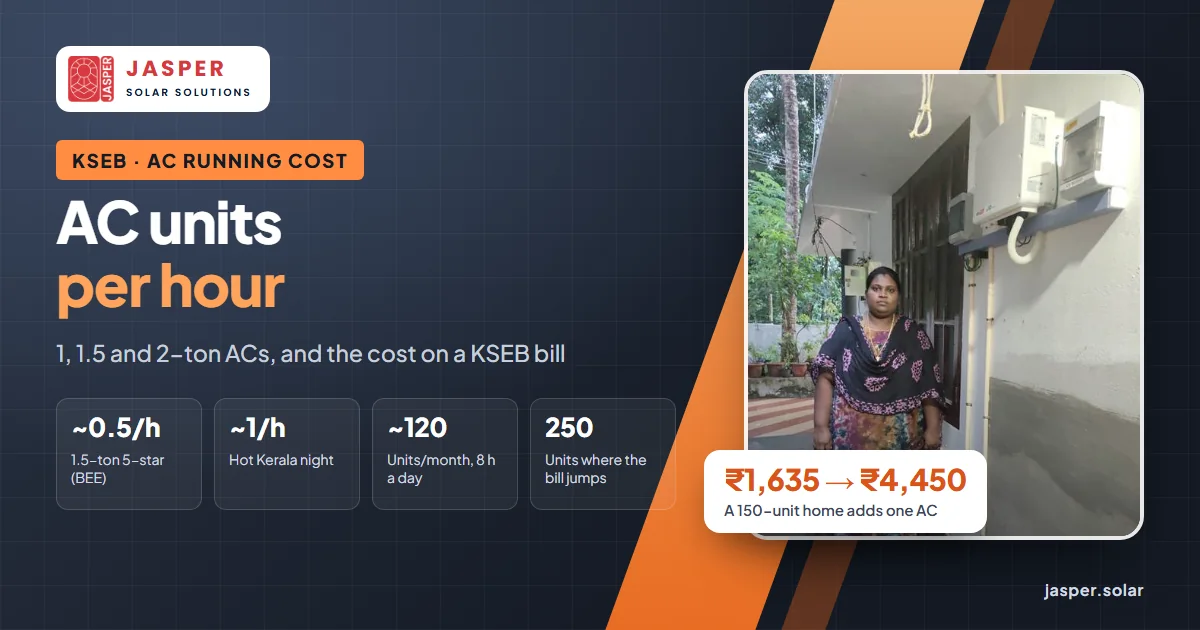
- A 1.5-ton 5-star inverter AC uses about 0.45 to 0.55 units an hour on the BEE label basis. A 3-star model uses about 0.55 to 0.7, and a 1-ton 5-star about 0.3 to 0.4.
- On a hot, humid Kerala night, or while it first cools a hot room, the same 1.5-ton AC can use about 1 unit an hour.
- Eight hours a night adds roughly 120 units a month for a 1.5-ton 5-star AC, and up to about 240 with heavy use.
- Because of KSEB's 250-unit rule, the first AC in a home can cost far more than its units suggest: a 150-unit home that adds one 5-star 1.5-ton AC goes from about ₹1,635 to about ₹4,450 a bill.
"How many units does an AC use per hour?" sounds like a question with one answer, but it has two: what the BEE star label says, and what the AC actually uses in a Kerala bedroom in April. This guide gives both, for 1-ton, 1.5-ton and 2-ton inverter ACs, and then works out what that does to a KSEB bill on the 2025 to 2027 domestic tariff.
How many units does an AC use per hour?
A unit on your KSEB bill is one kilowatt-hour (kWh). On the BEE label basis, a 1.5-ton 5-star inverter AC uses about half a unit an hour. Real use in Kerala is often higher: about 1 unit an hour on a hot, humid night, in a large room or with the temperature set low.
| Inverter AC | Label units a year | Units an hour (label basis) | Units an hour (heavy use) |
|---|---|---|---|
| 1 ton, 5-star | about two-thirds of a 1.5 ton | about 0.3 to 0.4 | about 0.65 |
| 1.5 ton, 5-star | about 700 to 850 | about 0.45 to 0.55 | about 1 |
| 1.5 ton, 3-star | about 900 to 1,100 | about 0.55 to 0.7 | about 1.25 |
| 2 ton, 5-star | roughly a third more than a 1.5 ton | about 0.6 to 0.75 | about 1.3 |
The 2-ton figures are scaled from the 1.5-ton ones by cooling capacity, so check the label of the model you are looking at. Older fixed-speed (non-inverter) ACs switch their compressor fully on and off, and usually use more than an inverter AC of the same size and star rating.
How to read your AC's BEE label
- Find the yearly figure. The BEE star label shows the units the AC uses in a year. BEE works this out for 1,600 hours of cooling a year.
- Divide by 1,600. That gives the average units an hour on the label basis. An AC labelled 800 units a year averages 0.5 units an hour.
- Compare models on the same size. More stars means fewer units for the same cooling. A 5-star inverter AC can use 20 to 30% less than a 3-star.
- Treat the label as a floor. It assumes standard test conditions. Kerala's humidity, a west-facing room, a low setting or a door left open all push real use up.
Units a month at 8 hours a day
Most Kerala homes run an AC through the night. At 8 hours a day for 30 days, that is 240 hours a month:
| AC, 8 hours a day | Units a month (label basis) | Units a month (heavy use) |
|---|---|---|
| 1 ton, 5-star | about 85 | about 160 |
| 1.5 ton, 5-star | about 120 | about 240 |
| 1.5 ton, 3-star | about 150 | about 300 |
| 2 ton, 5-star | about 160 | about 320 |
What one AC adds to a KSEB bill
KSEB bills every two months. These bills are worked out on the LT-I domestic tariff for 1 April 2025 to 31 March 2027, with 10% electricity duty and the fixed charge for a single-phase home, before fuel surcharge and meter rent, exactly as in our KSEB bill calculator:
| Home uses (no AC) | AC added, 8 hours a day | Units a month with AC | Two-monthly bill before | Two-monthly bill after |
|---|---|---|---|---|
| 150 units a month | 1 ton, 5-star (85 units) | 235 | about ₹1,635 | about ₹3,191 |
| 150 units a month | 1.5 ton, 5-star (120 units) | 270 | about ₹1,635 | about ₹4,450 |
| 150 units a month | 1.5 ton, 5-star, heavy use (240 units) | 390 | about ₹1,635 | about ₹7,341 |
| 200 units a month | 1.5 ton, 5-star (120 units) | 320 | about ₹2,496 | about ₹5,830 |
| 200 units a month | 1.5 ton, 3-star (150 units) | 350 | about ₹2,496 | about ₹6,332 |
In the second row, 120 extra units a month add about ₹2,815 to each two-monthly bill: close to ₹12 for every extra unit, far above any single slab rate. The reason is the next section.
Why the first AC costs more than you expect
Up to 250 units a month, KSEB charges each block of units at its own rate, so the first units stay cheap. From 251 units a month, every unit is charged at one higher rate, from ₹6.75 up to ₹9.20, and the fixed charge rises too. An AC is usually what pushes a Kerala home over that line, so it raises the price of all the units the home was already using, not just its own. Our bill calculator explains the 250-unit jump in detail.
Two things follow. A 5-star AC saves more than its label suggests if it keeps you nearer 250 units. And once you are above 250, every unit you avoid saves the full higher rate plus 10% duty, about ₹7.40 to ₹10.10 a unit.
How to cut what your AC uses
- Set it to 24 to 26°C. Each degree lower makes the compressor work harder for longer.
- Use sleep mode or a timer so the AC eases off in the cooler hours before dawn.
- Close the room and shade it. Curtains on west and south windows, and a closed door, cut the heat the AC has to remove.
- Clean the filters every few weeks in heavy use, and keep the outdoor unit shaded and free of leaves.
- Use a ceiling fan with the AC. Moving air feels cooler, so you can set the AC a degree or two higher.
- Size it to the room. A 1-ton AC suits a small bedroom; an oversized AC in a small room cycles wastefully, and an undersized one runs flat out all night.
Running your ACs on solar
A grid-connected rooftop system pays for AC units through net metering: the surplus it exports in the day is set off against the units your AC draws at night. A 3 kW system in Kerala makes about 400 units a month, enough for one 1.5-ton AC through the night plus the rest of a typical home. Our guide to how many ACs a 3 kW solar system can run works through one AC, two ACs and when you need a bigger system, and the KSEB solar bill calculator shows what your bill becomes with solar.
Planning to add ACs? Size the solar system for them now. Book a free home visit and send a photo of your KSEB bill: we work out the units your ACs add and the system that covers them.
Common questions
How many units does a 1.5-ton AC use per hour?
About 0.45 to 0.55 units an hour for a 5-star inverter model and 0.55 to 0.7 for a 3-star, on the BEE label basis. On a hot, humid Kerala night, about 1 unit an hour is a safer figure to plan with.
How many units does a 1-ton AC use in a night?
A 1-ton 5-star inverter AC uses about 0.3 to 0.4 units an hour on the label basis, so about 2.5 to 3 units over an 8-hour night, and up to about 5 units in heavy use.
How do I find the exact figure for my AC?
Take the yearly units printed on its BEE star label and divide by 1,600, the hours of use BEE assumes in a year. The result is the average units an hour on the label basis.
How much does one AC add to my KSEB bill?
It depends on where your home starts. A home using 150 units a month that adds a 1.5-ton 5-star AC for 8 hours a night goes from about ₹1,635 to about ₹4,450 a two-monthly bill, because it crosses 250 units a month and every unit moves to a higher rate.
Is a 5-star AC worth the higher price in Kerala?
Usually, if you run it most nights. It uses 20 to 30% fewer units than a 3-star of the same size, and above 250 units a month each unit saved is worth about ₹7.40 to ₹10.10 including duty.
Sources
- Bureau of Energy Efficiency, Schedule 24: star labelling for room air conditioners (1,600 hours of cooling a year)
- Kerala State Electricity Regulatory Commission, LT-I domestic tariff, 1 April 2025 to 31 March 2027 (bill figures, worked out as in our KSEB bill calculator)
- Jasper Solar, average generation of installed 3 kW systems in Kerala (about 400 units a month)

Er. Akhil S.TFounder and Project Engineer, Jasper Solar Solutions
Founder of Jasper Solar Solutions and a project engineer with 7 years in the solar field and more than 400 completed solar projects. Akhil designs and oversees rooftop installations for homes and businesses, from site survey to KSEB commissioning.