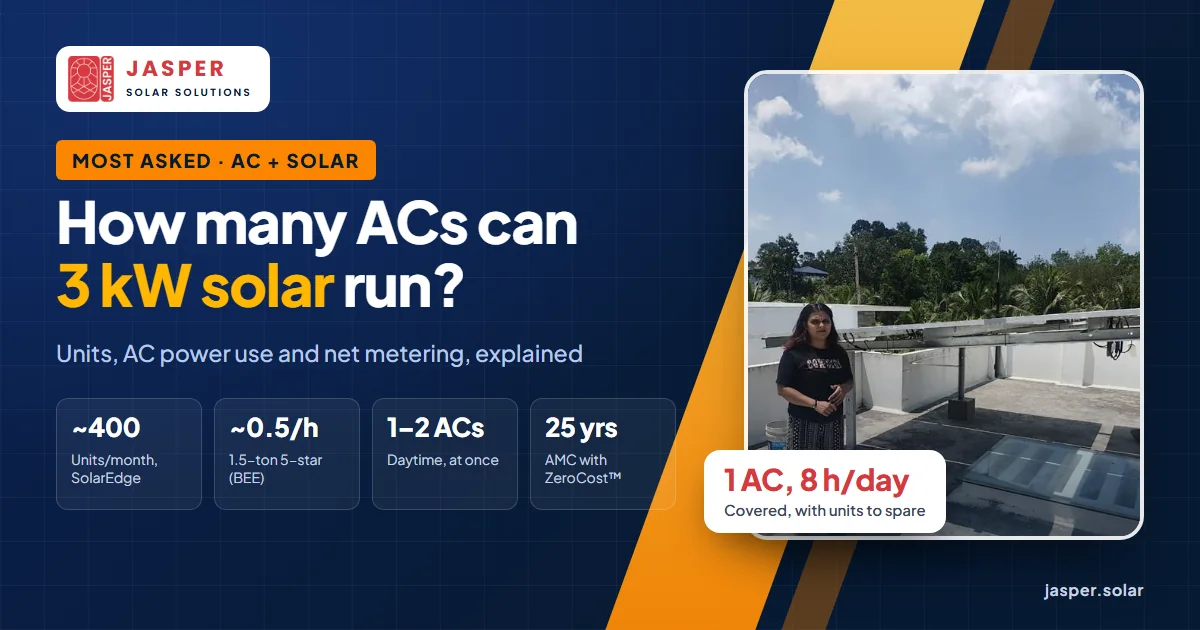
- Short answer: a 3 kW solar system comfortably covers one 1.5-ton inverter AC used about 8 hours a day, plus the rest of a typical home's daily use. With careful use, it can cover two.
- At midday, a 3 kW system can run one or two inverter ACs directly while the sun is up. ACs used at night are covered through net metering, by the units you exported during the day.
- Jasper Solar's SolarEdge 3 kW installations average about 400 units a month, more than the 360 units a typical 3 kW string system makes in Thiruvananthapuram.
- Choose a 5-star inverter AC and set it to 24–26°C. A 5-star 1.5-ton AC uses roughly half a unit an hour on the BEE label basis.
"How many ACs can I run on 3 kW solar?" is one of the most common questions we hear in Kerala, especially from families planning to add air conditioning. The honest answer depends on two different things: how much power the system delivers at any moment, and how many units it makes over a month. This guide works through both, with the numbers.
Two questions in one: power and energy
- Power (kW): how much the system can supply at one moment. A 3 kW system produces up to about 3 kW around midday on a clear day, and less in the morning, evening and on cloudy days.
- Energy (units, or kWh): how much it makes over a day or a month. This is what your KSEB bill counts, and what decides how many hours of AC you can cover.
An AC needs both: enough power while it runs, and enough units across the month. A grid-connected system handles the power side with help from the grid, so in practice the monthly units are what matter.
How much power does an AC use?
India's BEE star label shows an AC's yearly consumption, worked out for 1,600 hours of use a year. Published figures for 1.5-ton split inverter ACs are roughly:
| AC | Label units a year | Units an hour (label basis) |
|---|---|---|
| 1.5 ton, 5-star inverter | about 700 to 850 | about 0.45 to 0.55 |
| 1.5 ton, 3-star inverter | about 900 to 1,100 | about 0.55 to 0.7 |
| 1 ton, 5-star inverter | roughly two-thirds of a 1.5 ton | about 0.3 to 0.4 |
Sources: Onida's BEE label guide and Airtel's star rating comparison. For your own AC, divide the yearly figure on its BEE label by 1,600.
Real use varies. On a hot, humid Kerala night, in a large room or with the temperature set low, an AC can use noticeably more than its label figure. When it first cools a hot room, an inverter AC runs its compressor at full speed and can draw 1.5 kW or more for a while, then settles much lower. To be safe, the table below also shows a "heavy use" figure of about 1 unit an hour for a 1.5-ton AC.
How many units does a 3 kW system make?
- Typical 3 kW string system: about 120 units per kW a month in Thiruvananthapuram, so roughly 360 units a month.
- Jasper Solar's SolarEdge 3 kW systems: about 400 units a month on average across our installations. Each panel works at its own best with a SolarEdge power optimizer, and the SE3000H inverter accepts up to 4,500 W of panels, so a 3 kW system can carry 3.24 kW of panels. See SolarEdge vs string inverters for how it works.
So, how many ACs?
Here is what common AC use costs in units each month, against the 400 units a SolarEdge 3 kW system makes:
| AC use, 8 hours a day | Units a month (label basis) | Units a month (heavy use) | Left from 400 units |
|---|---|---|---|
| One 1 ton, 5-star | ~85 | ~160 | 240 to 315 |
| One 1.5 ton, 5-star | ~120 | ~240 | 160 to 280 |
| One 1.5 ton, 3-star | ~150 | ~300 | 100 to 250 |
| Two 1.5 ton, 5-star | ~240 | ~480 | 160 left, or 80 short |
The answer for most homes:
- One AC: a 3 kW system covers one 1.5-ton AC for 8 hours a night with room to spare for lights, fans, the fridge, the pump and the TV.
- Two ACs: possible with 5-star models used moderately, but heavy use of two ACs will use up most of the solar output, and the rest of the home will draw from KSEB.
- Three or more ACs: plan a bigger system, about 5 kW or more.
Can it run ACs at night?
Solar panels only produce in daylight, but most homes run ACs at night. With an on-grid system and a KSEB net meter, this works out: the surplus your panels export in the daytime is credited against the units the AC draws from the grid at night. Over the billing period, the solar units pay for the night-time AC.
During a KSEB power cut, an on-grid system shuts down, so it cannot run the AC. A battery can keep fans, lights and the fridge going, but running an AC from a home battery drains it very quickly. Our guide to hybrid systems explains what a battery can realistically back up.
How to get the most AC from your solar
- Buy a 5-star inverter AC. It can use 20 to 30% less power than a 3-star for the same cooling.
- Set it to 24–26°C. Each degree lower makes the compressor work harder.
- Use the timer or sleep mode so the AC eases off in the cooler early-morning hours.
- Pre-cool in the afternoon while the sun is still producing, if someone is at home.
- Keep the filters clean and the outdoor unit shaded and well ventilated.
- Plan ahead. If you will add ACs in the next few years, size the system for them now. Our sizing guide shows how, and the 2026 cost guide shows what a larger system costs.
Subsidy and long-term care
A 3 kW home system gets the full PM Surya Ghar subsidy of ₹78,000, the maximum for homes. Above 3 kW, the subsidy stays at ₹78,000, so each extra kW is paid in full. See the subsidy guide for the steps.
An AC-heavy home depends on the solar system producing steadily for decades. Jasper Solar's ZeroCost™ Solar Savings Plan is built around your electricity bill, with 25 years of maintenance (AMC), repairs and replacement support, and an app to track your generation live. Eligibility, guarantee terms and maintenance scope depend on system size and are confirmed at your free site visit.
Common questions
Can a 3 kW solar system run a 1.5-ton AC directly?
Yes, in the daytime. An inverter AC typically runs on about 0.5 to 1.5 kW, within what a 3 kW system produces around midday. At night, the AC runs on grid power that your daytime exports have already paid for through net metering.
Will my electricity bill be zero with ACs?
With one AC used sensibly, a 3 kW system can cover most of a typical home's use. KSEB fixed charges remain, and heavy use of two or more ACs will need either a bigger system or some units from the grid.
Is a 1-ton AC enough for a Kerala bedroom?
For a small bedroom, usually yes, and it uses about a third less power than a 1.5-ton AC. Larger or sun-facing rooms generally need 1.5 tons.
How big a system do I need for two ACs?
For two 1.5-ton ACs used most nights, plus normal household use, plan for about 4 to 6 kW, depending on how heavily the ACs are used. Your bills and habits decide the exact size.
Planning solar around your ACs? Book a free site visit and we will size a SolarEdge or string system to your ACs and bills, with the units, subsidy and payback worked out.