"Is there a last date for the solar subsidy?" is one of the questions we hear most. The honest answer has three parts: what is known, what is not, and what you should do about it. This guide covers each, with the dates as they stand in November 2026.
Is there a last date to apply?
No last date for new applications has been announced. The national portal is open, and any home with a KSEB connection and a suitable roof can apply.
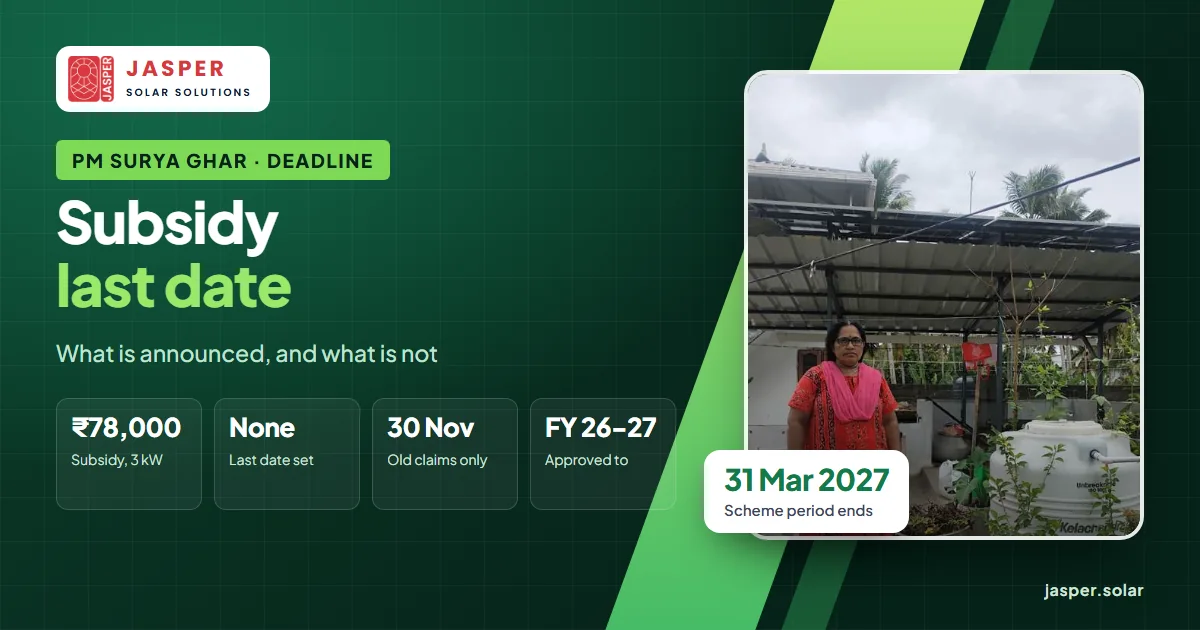
What is fixed is the scheme period. When the Union Cabinet approved PM Surya Ghar: Muft Bijli Yojana in February 2024, it set a budget of ₹75,021 crore and a target of one crore homes, to be met by the financial year 2026-27. That year ends on 31 March 2027.
The dates that matter
| Date | What it is | Does it affect a new applicant? |
|---|---|---|
| February 2024 | Scheme approved and launched | Start of the scheme |
| 30 November 2026 | Last date for subsidy claims on older applications under Phase II of the earlier Rooftop Solar Programme | No |
| 31 March 2027 | End of financial year 2026-27, the scheme's approved period | Yes. Plan to be commissioned before this date |
| After March 2027 | Not announced | Unknown |
What the 30 November 2026 date means
Reports in September 2026 said the subsidy deadline had been extended to 30 November 2026. That refers to an office memorandum from the Ministry of New and Renewable Energy dated 31 August 2026. It covers applications from the earlier Phase II rooftop programme that had already reached the installed or inspected stage, and gives them until 30 November 2026 to have their claim received. It is not a cut-off for homes applying under PM Surya Ghar today.
If you installed a system under the older programme and your subsidy is still pending, ask your installer or KSEB about your claim now.
What happens after March 2027?
Nobody outside the government knows yet. The scheme could be extended as it is, extended with a lower subsidy, or closed. We have seen no official statement on any of these. Any website that gives a firm answer today is guessing.
What we can say is that subsidy amounts are not guaranteed for the future, and that the subsidy is paid on systems that are installed and commissioned, not on applications.
Why you should not wait for the last month
An application is only the first step. Before the subsidy is paid, each of these has to happen:
- Registration and application on the national portal
- KSEB feasibility approval
- Installation by a registered vendor
- KSEB inspection and the net meter
- Commissioning certificate on the portal
- Your bank details and the subsidy claim
Together these take several weeks, and longer when many homes apply at once. Net meters were in short supply in parts of Kerala during 2026, which delayed some commissioning. A home that starts in March 2027 is unlikely to be commissioned in March 2027. Our step-by-step guide to applying explains each stage.
How much subsidy you get today
| System size | Subsidy | Jasper Solar price | Net cost |
|---|---|---|---|
| 1 kW | ₹30,000 | ₹90,000 | ₹60,000 |
| 2 kW | ₹60,000 | ₹1,65,000 | ₹1,05,000 |
| 3 kW | ₹78,000 | ₹2,15,000 | ₹1,37,000 |
| 5 kW | ₹78,000 | ₹3,20,000 | ₹2,42,000 |
The subsidy is ₹30,000 a kW for the first 2 kW and ₹18,000 for the third, and stops at ₹78,000. See the Kerala solar subsidy guide for who qualifies and the 3 kW price guide for what the most popular size costs.
Is there a separate KSEB solar scheme?
Not with its own subsidy. KSEB's older "Soura" scheme has given way to PM Surya Ghar for home systems. KSEB's part today is the feasibility approval, the inspection and the net meter, and the central subsidy comes to your bank account through the national portal. Kerala does not add a state subsidy on top.
What to do now
- If you have decided to go solar: apply now and aim to be commissioned by January or February 2027, which leaves room for delays.
- If you are still deciding: get a site visit and a quote this month, so the decision is yours and not the calendar's.
- If you plan to use a loan: start the bank paperwork alongside the application. See solar panel financing in Kerala.
- If you are an NRI: the process can be done from abroad with a local contact. See PM Surya Ghar for NRIs.
Common questions
What is the last date for the PM Surya Ghar subsidy?
No last date for new applications has been announced as of 17 November 2026. The scheme's approved period runs to 31 March 2027, the end of financial year 2026-27.
Is the solar subsidy ending in 2026?
No. The 30 November 2026 date is only for pending claims under the earlier Phase II rooftop programme. New applications under PM Surya Ghar are still open.
Will the subsidy continue after March 2027?
That has not been announced. It may be extended, changed or closed, so do not plan on it.
Is the subsidy paid on the application date or the installation date?
It is paid after the system is installed, inspected and commissioned by KSEB, and the claim is made on the portal. An application alone does not secure it.
How long does it take from application to subsidy?
Several weeks from application to commissioning, and the subsidy is credited some weeks after the claim. Timings vary with KSEB's workload and net meter supply.
Is there a KSEB solar subsidy scheme in Kerala?
For homes, the subsidy is the central PM Surya Ghar subsidy of up to ₹78,000. KSEB handles the approvals and the net meter but does not pay a separate subsidy.
Dates and rules can change with a single government order. We check the portal before every quote. Book a free home visit and we will tell you where things stand on the day.
Sources
- Ministry of New and Renewable Energy, PM Surya Ghar national portal
- Press Information Bureau, PM Surya Ghar: Muft Bijli Yojana background note (budget, target and scheme period)
- Energetica India, report on the MNRE office memorandum of 31 August 2026 (30 November 2026 claim deadline for Phase II applications)
- Onmanorama, report on the net meter shortage, September 2026

Er. Akhil S.TFounder and Project Engineer, Jasper Solar Solutions
Founder of Jasper Solar Solutions and a project engineer with 7 years in the solar field and more than 400 completed solar projects. Akhil designs and oversees rooftop installations for homes and businesses, from site survey to KSEB commissioning.