
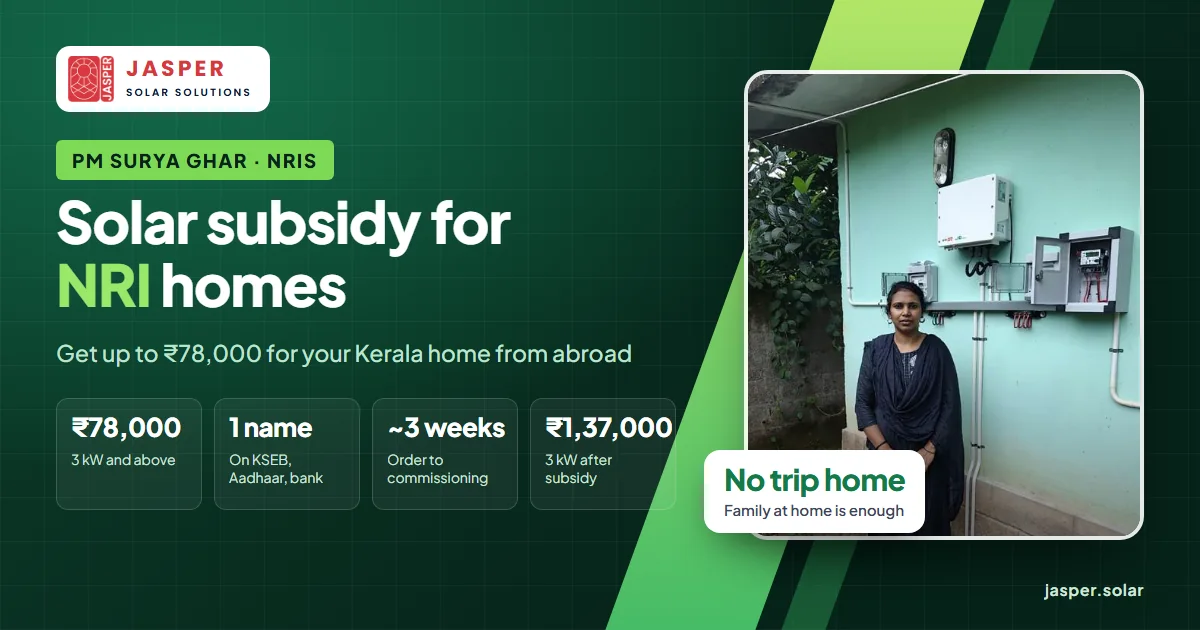
Many Kerala families have a member working in the Gulf, Europe or elsewhere, and a home here with a large KSEB bill. Rooftop solar with the PM Surya Ghar subsidy suits these homes well, but the paperwork raises questions: can an NRI apply, whose name should it be in, which bank account gets the money, and can it be done from abroad? This guide answers them. For the subsidy itself, see our Kerala solar subsidy guide.
Can NRIs get the PM Surya Ghar subsidy?
Yes. The scheme is for Indian citizens with a residential electricity connection, and NRIs are Indian citizens. What matters is not where you live, but whose name the house, the KSEB connection and the bank account are in. The subsidy is the same as for anyone else:
| System size | Subsidy |
|---|---|
| 1 kW | ₹30,000 |
| 2 kW | ₹60,000 |
| 3 kW and above | ₹78,000 (maximum) |
People of Indian origin who hold another country's citizenship, including OCI cardholders, are not Indian citizens, so the subsidy should be claimed by a family member who is, in whose name the connection is or can be put.
Whose name should the application be in?
The name must match across three things: the KSEB connection, the Aadhaar used on the portal, and the bank account the subsidy is paid into. A mismatch is the most common reason a claim is held up.
- Connection in your name: apply in your own name, with your Aadhaar and a bank account in your name.
- Connection in a parent's or spouse's name, and they live in the house: the simplest route is to apply in their name, with their Aadhaar and their bank account. The subsidy then goes to them.
- Connection in the name of someone who has passed away or moved: transfer the connection at your KSEB section office first, then apply.
Aadhaar, mobile number and bank account
- Aadhaar: the portal and the subsidy payment use Aadhaar. If you do not have one, apply in the name of a family member who does.
- Mobile number: you log in with the mobile number registered with KSEB and receive OTPs on it. Keep an Indian number active, or apply in the name of a family member at home.
- Bank account: the subsidy is paid into an Indian bank account in the applicant's name. NRE accounts are meant for money earned abroad, so before you claim, ask your bank whether your NRO, NRE or resident account can receive government subsidy credits.
Installing solar while you are abroad
You do not need to fly home. A typical installation for an NRI family works like this:
- Video call or WhatsApp: share your KSEB bill and a few roof photos. We suggest a size and send a quote.
- Free home visit: our engineer visits with a family member at home, checks the roof and shading, and sends you a 3D layout.
- Portal registration: done in the applicant's name; the OTP comes to the registered mobile.
- Installation: usually a day or two on the roof, with photos and updates sent to you.
- KSEB net meter and commissioning: we follow up with your KSEB section office; someone at home lets the KSEB staff in for the inspection.
- Subsidy claim: the bank details are added and the subsidy is paid to the applicant's account.
The whole process takes about three weeks for a typical home, most of it waiting for KSEB.
Paying for the system from abroad
You pay the full price first, and the subsidy comes after commissioning. A 3 kW system costs ₹2,15,000, or ₹1,37,000 after the subsidy. You can pay the installer from your Indian bank account. If you plan to take a solar loan, note that bank loans under the scheme have their own eligibility rules, so check with the bank whether they lend to non-residents. See solar panel cost in Kerala 2026 for prices by size.
Is solar worth it for an NRI home?
It depends on who lives there. Net metering credits your exports against your use, so a system sized to the family's actual use pays back in about three years. If the house is empty for long periods, the system will export more than the home uses, and surplus units left at the end of the settlement year are paid at a low rate. In that case, a smaller system often makes more sense. Our KSEB solar bill guide explains how this works.
Common questions
Can an NRI apply for PM Surya Ghar?
Yes, if you are an Indian citizen, own the house, and the KSEB connection, Aadhaar and bank account are in your name.
Can my parents apply instead of me?
Yes, if the KSEB connection is in their name and they apply with their own Aadhaar and bank account. The subsidy is then paid to them.
Do I need to be in Kerala for the installation?
No. A family member at home can be there for the site visit and the KSEB inspection, and the installer handles the KSEB paperwork.
Can the subsidy go to an NRE account?
The subsidy is paid to an Indian account in the applicant's name. Ask your bank whether your NRE or NRO account can receive government subsidy credits before you claim.
Can OCI cardholders get the subsidy?
The scheme is for Indian citizens, so a family member who is an Indian citizen should apply, with the connection in their name.
Jasper Solar can keep you updated on WhatsApp from survey to subsidy while you are abroad. Subsidy rules are set by MNRE and can change, so we confirm the current position when we quote.
Sources
- Ministry of New and Renewable Energy, PM Surya Ghar national portal
- Press Information Bureau, Cabinet approves PM-Surya Ghar: Muft Bijli Yojana, 29 February 2024
- Kerala State Electricity Board, eKiran solar rooftop portal

Er. Akhil S.TProject Engineer, Jasper Solar Solutions
Project engineer with 7 years in the solar field and more than 400 completed solar projects. Akhil designs and oversees rooftop installations for homes and businesses, from site survey to KSEB commissioning.


