Families in Thiruvananthapuram who want more than a basic string inverter usually end up choosing between these two: a TSUN microinverter or a SolarEdge inverter with power optimisers. Both are panel-level systems, and we install both. This post puts the 3 kW versions side by side, figure by figure, from the manufacturers' own datasheets, with the wiring drawings and photos from our sites.
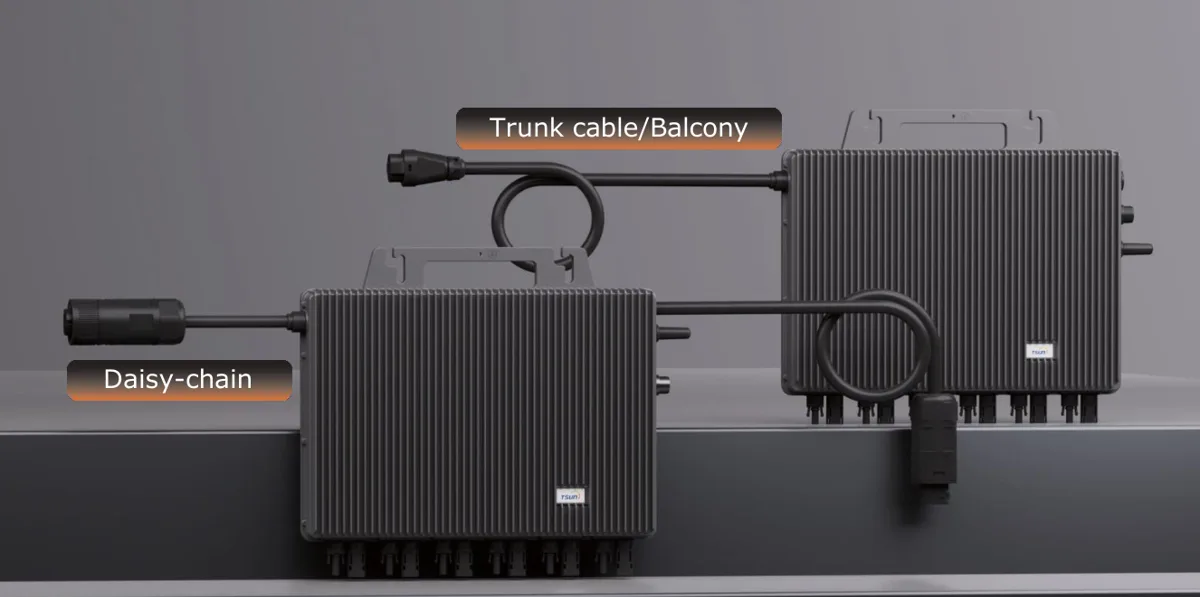
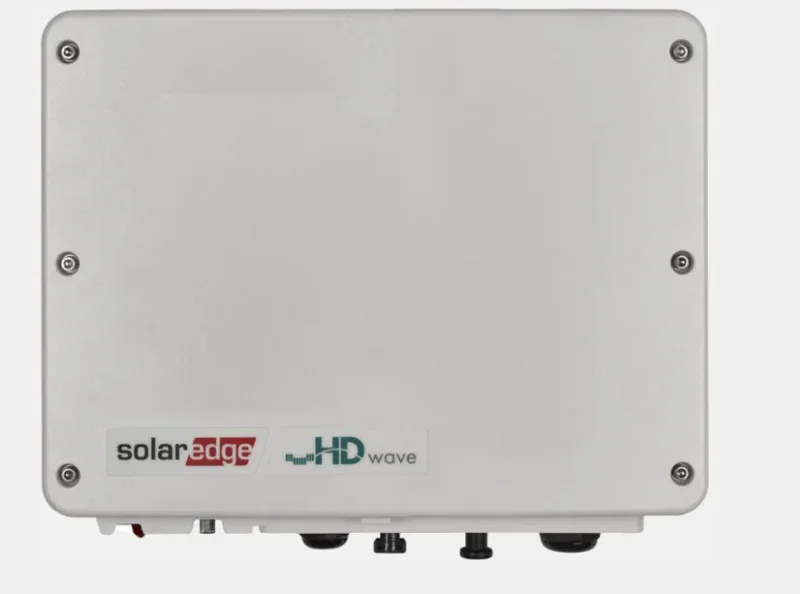
The two 3 kW systems
Both systems below run six 550 Wp panels (3.3 kWp) and feed 3 kW into a single-phase KSEB connection. They are the setups in our reference single line diagrams.
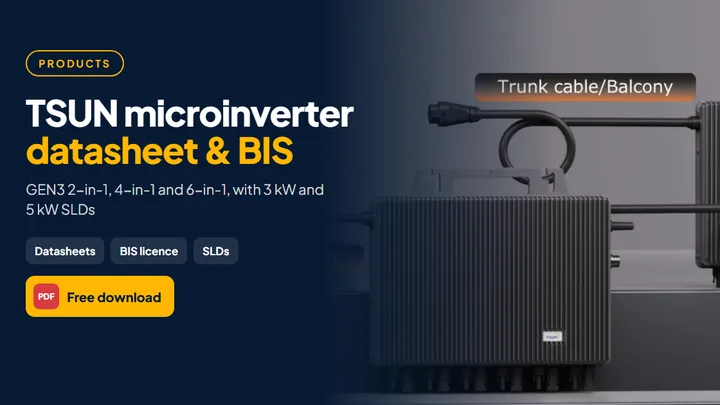
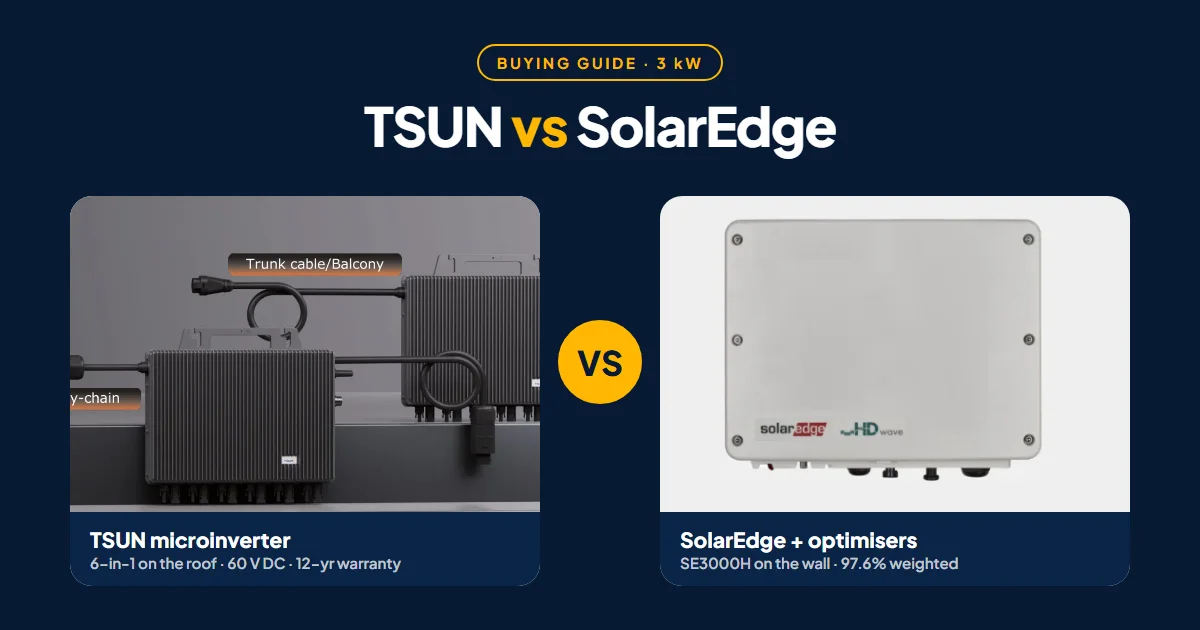
- TSUN: one TSOL-MS3000 6-in-1 microinverter on the roof, with six panels plugged straight into it. It sends 230 V AC down to the AC distribution board.
- SolarEdge: six S-Series power optimisers on the roof, one under each panel, wired as one string. The DC goes down to a DC distribution box (DCDB) and into one SE3000H inverter on the wall, which then feeds the AC distribution board.

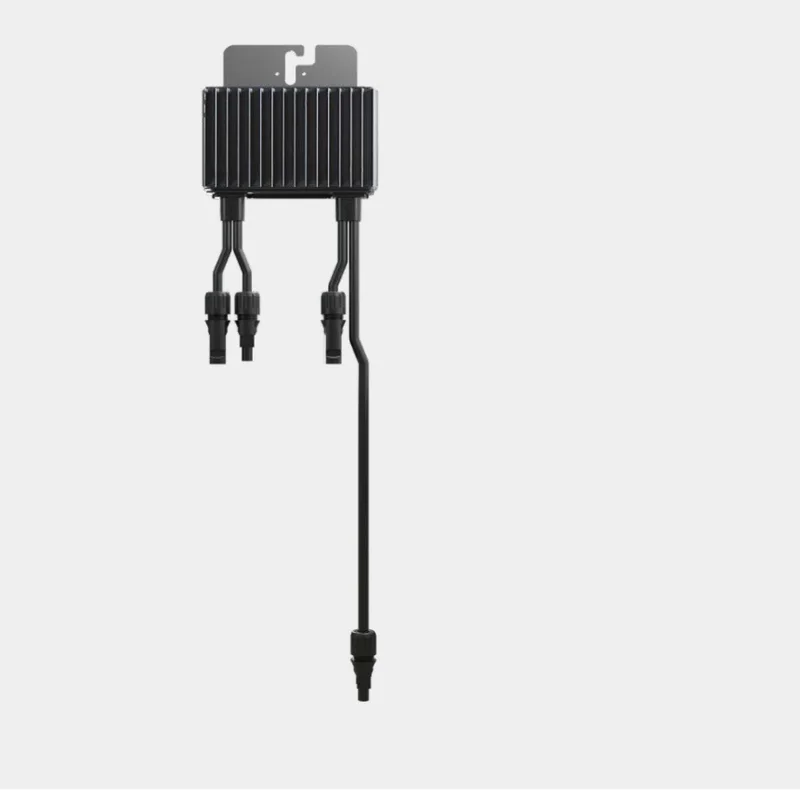
TSUN vs SolarEdge 3 kW: the full comparison
Figures are from the TSUN GEN3 6-in-1 datasheet, the SolarEdge Home Wave inverter datasheet for India and the SolarEdge S1000 optimiser datasheet for India (all July 2025 or later, downloads above).
| What you compare | TSUN TSOL-MS3000 | SolarEdge SE3000H + S1000 |
|---|---|---|
| What goes on the roof | 1 microinverter for 6 panels | 6 optimisers, 1 under each panel |
| What goes on the wall | Nothing (only the AC board) | The SE3000H inverter and a DCDB |
| Where DC becomes AC | On the roof | At the inverter on the wall |
| Panel-level tracking | Yes, 6 MPPT inputs | Yes, 1 optimiser per panel |
| DC voltage on the roof | 60 V max per input | About 380 V in operation, 480 V max |
| DC voltage when shut down | No DC string (60 V max per panel) | 1 V per optimiser (SafeDC) |
| DC cable down the building | None | Yes, with a DCDB (fuses, isolator, surge protection) |
| AC output | 3,000 W, 15 A | 3,000 VA, 14 A |
| Panel size supported | 400–700+ Wp, up to 18 A | Up to 1,100 W per optimiser, 15 A, 125 V |
| Peak efficiency | 97.0% | 99.5% (optimiser) and 99.2% (inverter) |
| Weighted efficiency | 96.7% (EU) | 98.8% each, about 97.6% together |
| Monitoring | Built-in Wi-Fi and Bluetooth, per panel | Ethernet, RS485, optional Wi-Fi, per panel |
| Arc fault protection | Not listed (low-voltage DC) | Built in, user configurable |
| Enclosure | IP67 | IP65 inverter, IP68 optimisers |
| Operating temperature | −40 to +65 °C, derates above 40 °C | Inverter −40 to +60 °C, full power to 50 °C |
| Weight | 7.5–8.2 kg, one box | 7.8 kg inverter + 6 × 1.06 kg optimisers |
| Warranty (India) | 12 years | 8 years inverter, 8 years optimisers |
| BIS registration | Licence R-41303356 (MS3000 listed) | IS 16221 (Part 2) and IS 16169 |
| If one panel is shaded | Only that panel loses output | Only that panel loses output |
| If the electronics fail | The MS3000 runs all 6 panels, so the plant stops | An optimiser: one panel stops. The inverter: the plant stops |
| Servicing | On the roof, under the panels | Inverter at hand height; optimisers on the roof |
Safety: the DC voltage on your roof
This is the clearest difference between the two. Solar panels make DC, and a long string of panels in series can reach several hundred volts. A microinverter avoids the string altogether: each TSUN input sees one panel, at no more than 60 V. SolarEdge does run a string, held at a fixed 380 V or so by the inverter while it works, but its SafeDC feature drops each optimiser to 1 V when the inverter or the grid shuts down, so a six-panel string falls to about 6 V.
Both are safe when installed to code. SolarEdge adds arc fault protection, which watches the DC cabling for the sparking a loose connector can cause. TSUN's datasheet does not list arc fault detection, because at 60 V a sustained arc is much less likely. The practical difference for you: a TSUN roof has no high-voltage DC cable to run, protect or fuse, while a SolarEdge roof needs a properly rated DC cable and a DCDB, as in the drawing further down.
Efficiency: how much sunlight reaches your meter
SolarEdge converts a little more. Its optimiser and inverter are each 98.8% efficient on the weighted (real-world) measure, about 97.6% together. TSUN's weighted figure is 96.7%. On a 3.3 kWp Kerala roof making about 4,500 units a year, the 0.9-point gap is roughly 40 units a year.
That gap is small next to what shade and panel direction do to a roof, which is where both systems already beat a string inverter. Our SolarEdge vs string inverter post works through those losses.
How they are wired: the two single line diagrams
The single line diagram (SLD) goes with your KSEB registration and shows every part between the panels and the grid. Put the two side by side and the difference in parts is plain to see.
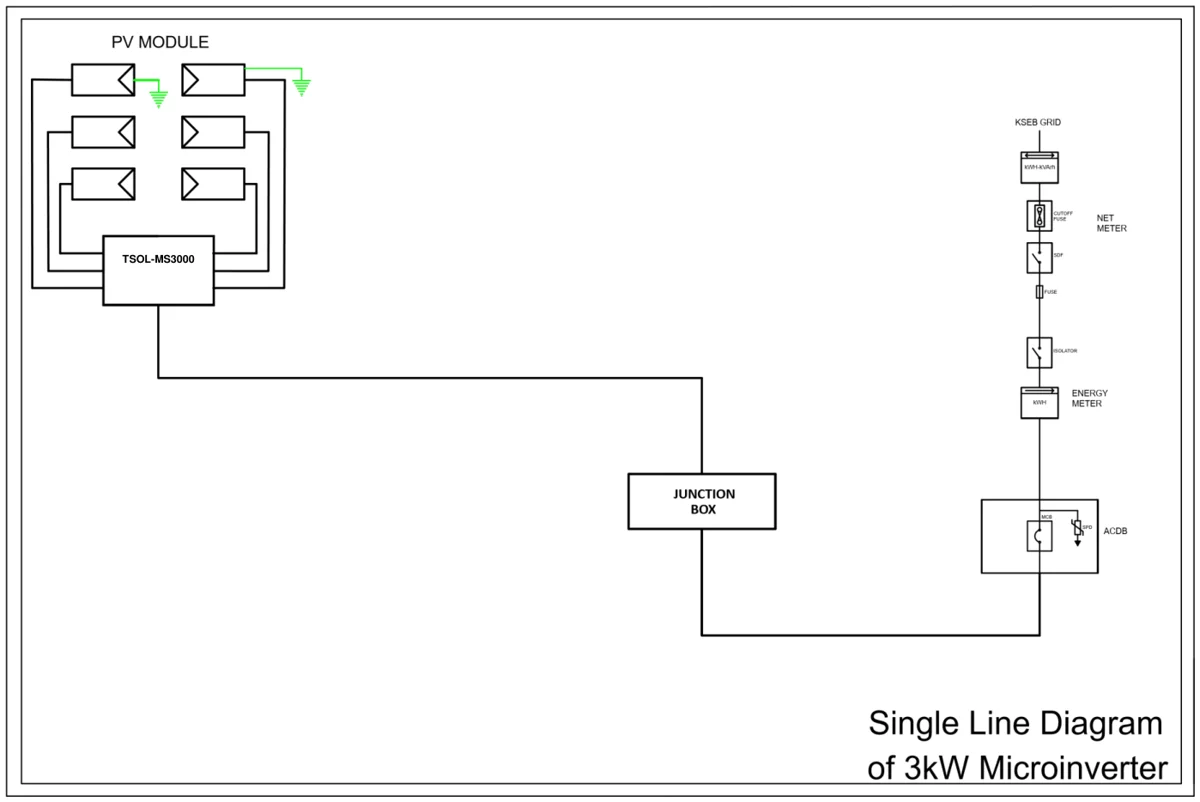
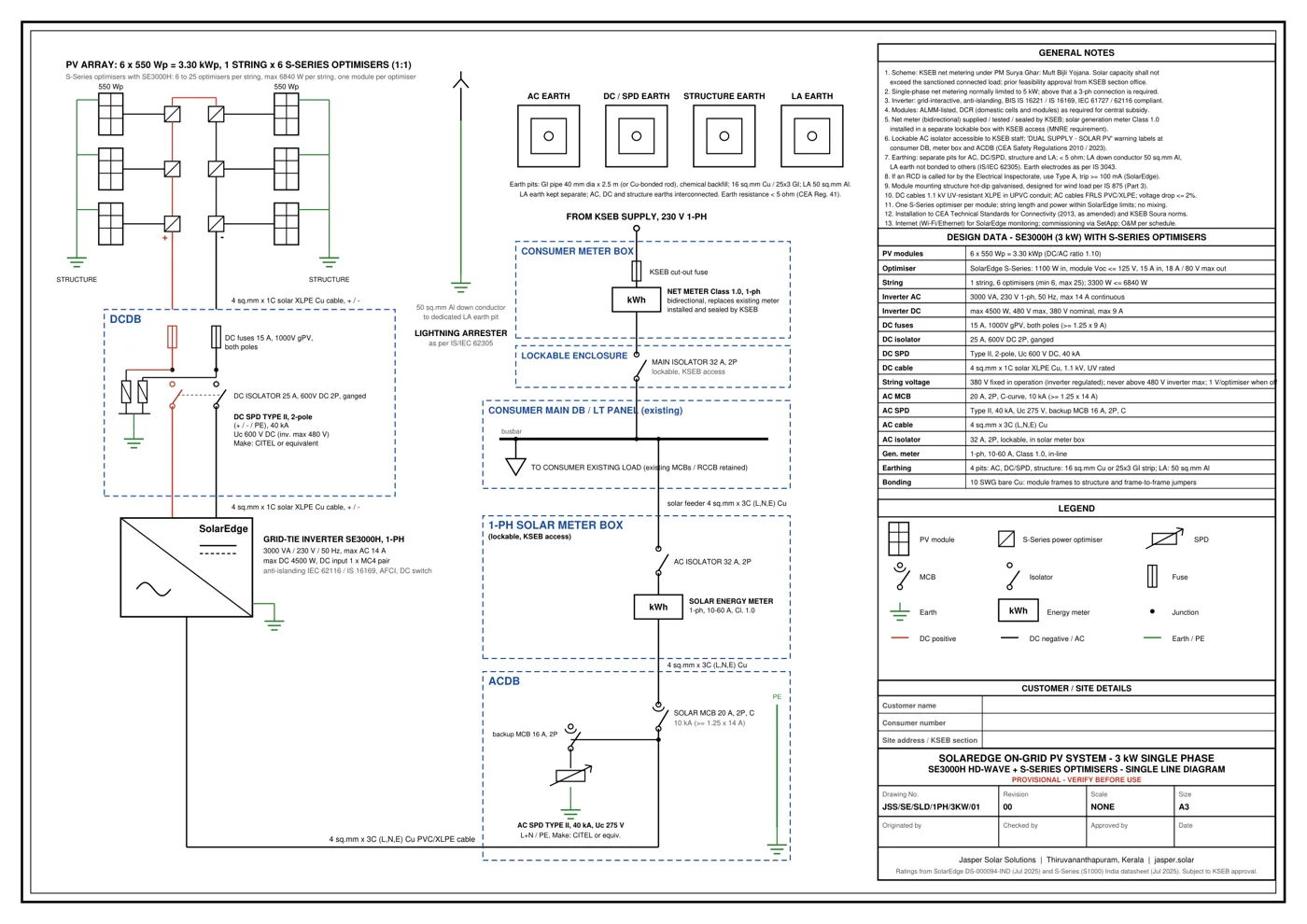
From the inverter onwards the two drawings are the same: AC distribution board with MCB and surge protection, solar generation meter, lockable isolator, KSEB net meter. The SolarEdge drawing adds the DC section: a 4 sq.mm DC cable from the roof, the DCDB and a separate DC earth. Both drawings are free to download above, and our SolarEdge single line diagram post explains each symbol.
On the wall: what a SolarEdge install looks like
With SolarEdge, the inverter is the part you see every day. We mount it on a shaded wall near the meter, with the DC and AC boxes beside it, so the status lights and switches are at hand height.
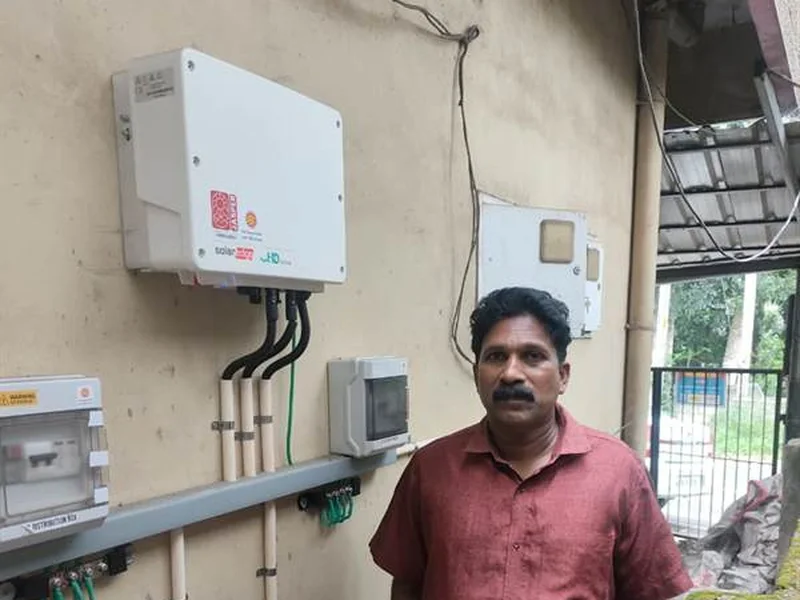
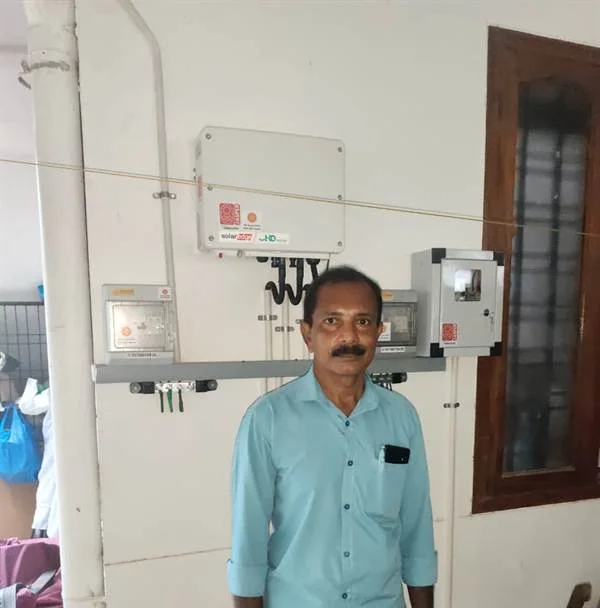
A TSUN system has no inverter on the wall. The microinverter sits on the mounting rail under the panels, shaded from the sun, and only an AC cable comes down to the AC distribution board. You check it on the TSUN app over Wi-Fi.

Reliability, warranty and service
- Warranty: TSUN states 12 years as standard. SolarEdge's India datasheets give 8 years for both the inverter and the optimisers, under its India limited warranty.
- What a fault takes out: the TSUN MS3000 runs all six panels, so in a 3 kW plant one unit is the whole plant, just as the SE3000H is for SolarEdge. With SolarEdge, a failed optimiser only takes out its own panel.
- Getting to it: the SolarEdge inverter is on the wall, so a swap does not need roof access. A TSUN unit, and SolarEdge's optimisers, are under the panels.
- Heat: TSUN derates above 40 °C, which is why it goes in the shade of the panels. The SE3000H keeps full power up to 50 °C on a shaded wall.
Which one should you choose?
Choose TSUN if you want the simplest wiring, no high-voltage DC on the roof, the longer 12-year warranty and nothing on your wall. It suits small roofs, terraces with panels facing different ways, and homes where the wall space near the meter is tight.
Choose SolarEdge if you want the highest conversion efficiency, arc fault protection, an inverter you can reach without climbing, and a fault in one optimiser to affect only one panel. It suits larger homes that may grow to 5 or 6 kW on one inverter, and owners who like SolarEdge's detailed monitoring portal.
Either way, both qualify for the PM Surya Ghar subsidy with DCR panels, because the subsidy depends on the plant size, not the inverter. For the TSUN papers in more detail, see our TSUN datasheet and BIS licence post and the TSUN microinverter guide. To find out which one fits your roof, book a free site survey and we will quote both.
Common questions
Is TSUN or SolarEdge better for a 3 kW home in Kerala?
Both give panel-level tracking. TSUN is simpler, keeps the roof at 60 V DC or less and has a 12-year warranty. SolarEdge is about one point more efficient, has arc fault protection and an inverter on the wall. The roof decides: shade, panel directions and where the inverter can go.
Is a microinverter safer than SolarEdge?
Both are safe when installed correctly. A TSUN microinverter never has more than 60 V DC per input. SolarEdge runs its string at about 380 V but drops to 1 V per optimiser when it shuts down, and adds arc fault detection.
Which is more efficient, TSUN or SolarEdge?
SolarEdge, slightly. Its optimiser and inverter are each 98.8% weighted, about 97.6% together. TSUN's 6-in-1 is 96.7% weighted (EU) and 97.0% peak.
What warranty do TSUN and SolarEdge give in India?
TSUN states a standard 12-year warranty. SolarEdge's India datasheets list 8 years for the SE3000H inverter and 8 years for the S1000 optimiser.
Do I need a DC distribution box with TSUN?
No. The panels plug straight into the microinverter on the roof and only AC comes down, so there is no DC cable, DC fuse or DCDB. SolarEdge needs a DCDB between the roof and the inverter.
Are both BIS registered for KSEB?
Yes. TSUN's BIS licence R-41303356 lists the TSOL-MS3000, and the SolarEdge Home Wave inverters are listed under IS 16221 (Part 2) and IS 16169.
Sources
- TSUNESS Co., Ltd, GEN3 Microinverter 6-in-1 (2400W–3300W) datasheet (download above)
- Bureau of Indian Standards, licence R-41303356 issued to TSUNESS Co., Ltd, 16 January 2025 (download above)
- SolarEdge, Home Wave single-phase inverter datasheet for India, SE2200H–SE6000H (download above)
- SolarEdge, S1000 power optimiser datasheet for India (download above)
- Jasper Solar, single line diagrams of 3 kW TSUN and SolarEdge systems (downloads above)

Er. Akhil S.TProject Engineer, Jasper Solar Solutions
Project engineer with 7 years in the solar field and more than 400 completed solar projects. Akhil designs and oversees rooftop installations for homes and businesses, from site survey to KSEB commissioning.