Before a microinverter goes on your roof, three papers matter: the datasheet that says what it can do, the BIS licence that lets it be connected to the KSEB grid, and the single line diagram that shows how your plant is wired. This page puts all three for TSUN's GEN3 range in one place, and walks through each one in plain English. For what a microinverter is and when it beats a string inverter, read our TSUN microinverter guide first.
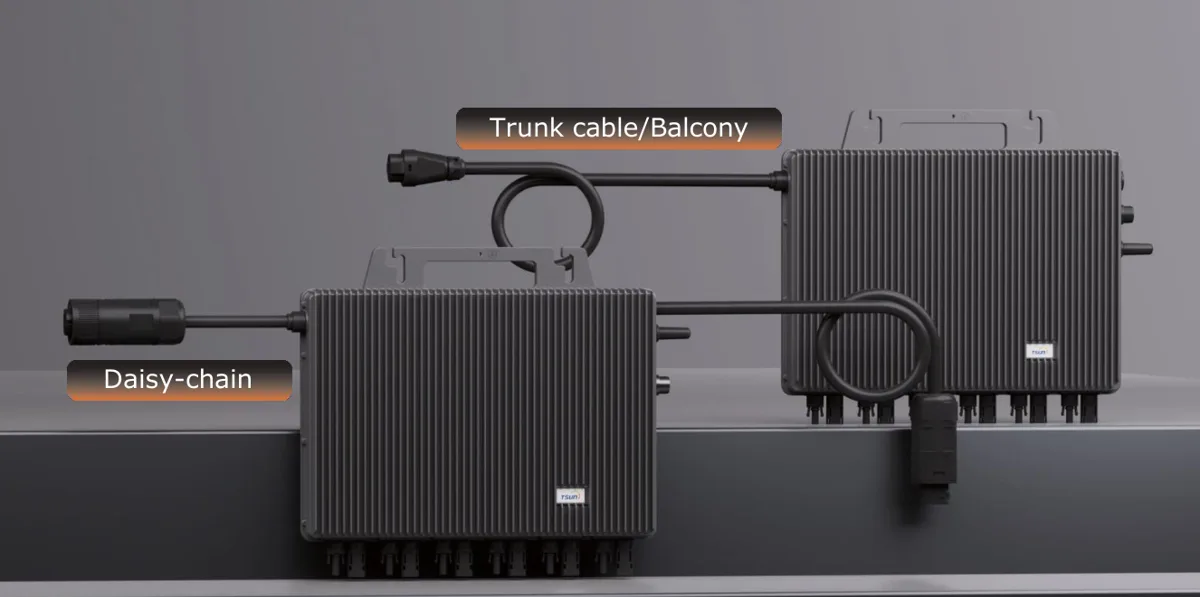
The TSUN GEN3 range at a glance
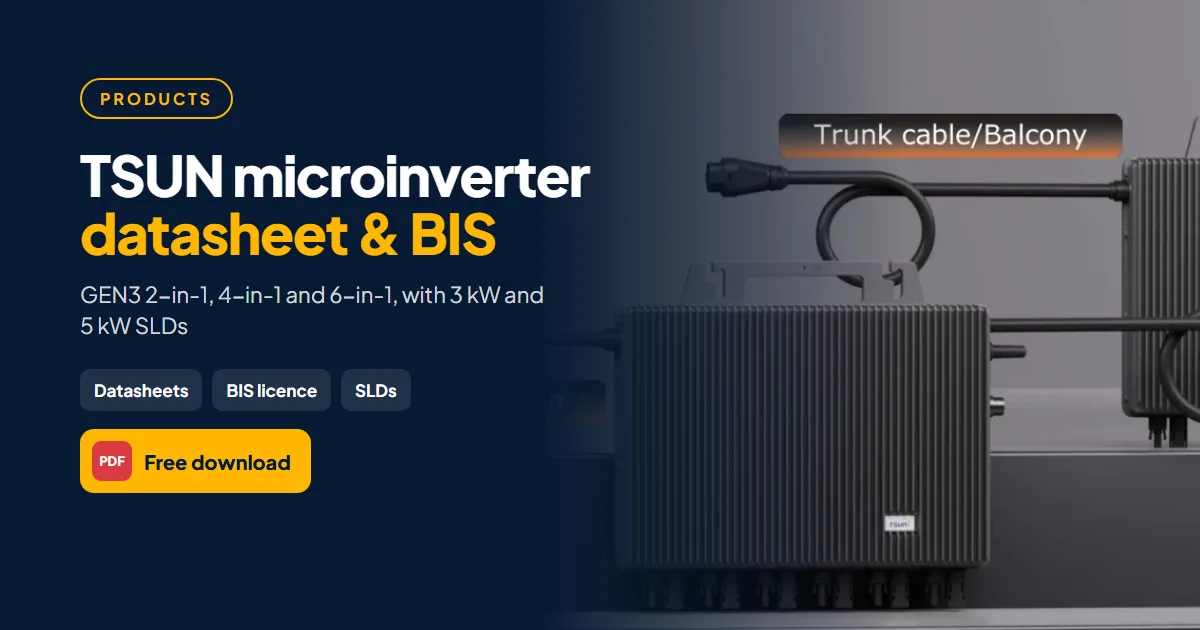
TSUN sells the GEN3 microinverter in three sizes, named by how many solar panels each unit takes. Every input has its own maximum power point tracker (MPPT), so one shaded or dirty panel does not drag down the others.
| Datasheet | Models | Panels per unit | Output | Peak efficiency |
|---|---|---|---|---|
| 2-in-1 | TSOL-MS600 to MS1000 | 1 to 2 | 600–1,000 W | 96.7% |
| 4-in-1 | TSOL-MS1600, MS1800, MS2000, MX2250 | 1 to 4 | 1,600–2,250 W | 96.7–97.0% |
| 6-in-1 | TSOL-MS2400 to MS3300 | 1 to 6 | 2,400–3,300 W | 97.0% |
For a Kerala home, the 6-in-1 is the usual choice: one TSOL-MS3000 runs six panels of 500 to 550 Wp and makes a 3 kW plant on its own. Bigger plants add a second unit, as in our 5 kW drawing below.
What the 6-in-1 datasheet says
These are the figures from the 6-in-1 datasheet (TSOL-MS2400 to MS3300) that matter on a Kerala roof:
| Spec | Value | What it means for you |
|---|---|---|
| Recommended panel power | 400–700+ Wp | Works with today's 500–600 Wp DCR panels |
| DC inputs | 6, one MPPT each | Each panel is tracked on its own |
| Max. DC voltage per input | 60 V | No high-voltage DC string on the roof |
| Max. input current per input | 18 A (short-circuit 25 A) | Suits large, high-current panels |
| MPPT voltage range | 16–60 V, start-up 22 V | Starts early in the morning light |
| AC output | 2,400–3,300 W, 220/230/240 V, 50/60 Hz | Single-phase connection, as for most homes |
| Power factor, distortion | >0.99 default, THD <3% | Clean power for the KSEB grid |
| Efficiency | 97.0% peak, 96.7% EU, MPPT 99.9% | Little energy lost in conversion |
| Protection | IP67, natural convection | Sealed against monsoon rain and dust, no fan |
| Operating temperature | −40 to +65 °C, derating above 40 °C | Mount it shaded under the panels |
| Size and weight | 380 × 313 × 49 mm, 7.5–8.2 kg | One compact box for six panels |
| Monitoring | Built-in Wi-Fi and Bluetooth, RS485 optional | Watch each panel on your phone |
| Warranty | 12 years standard | Longer than most string inverters |

The datasheet also sets how many units can share one AC branch circuit: three MS2400 or MS2500 units, or two MS2700 to MS3300 units, on a 12 AWG branch. Your installer sizes the AC cable and the MCB in the distribution board for this.
The 4-in-1 and 2-in-1 models
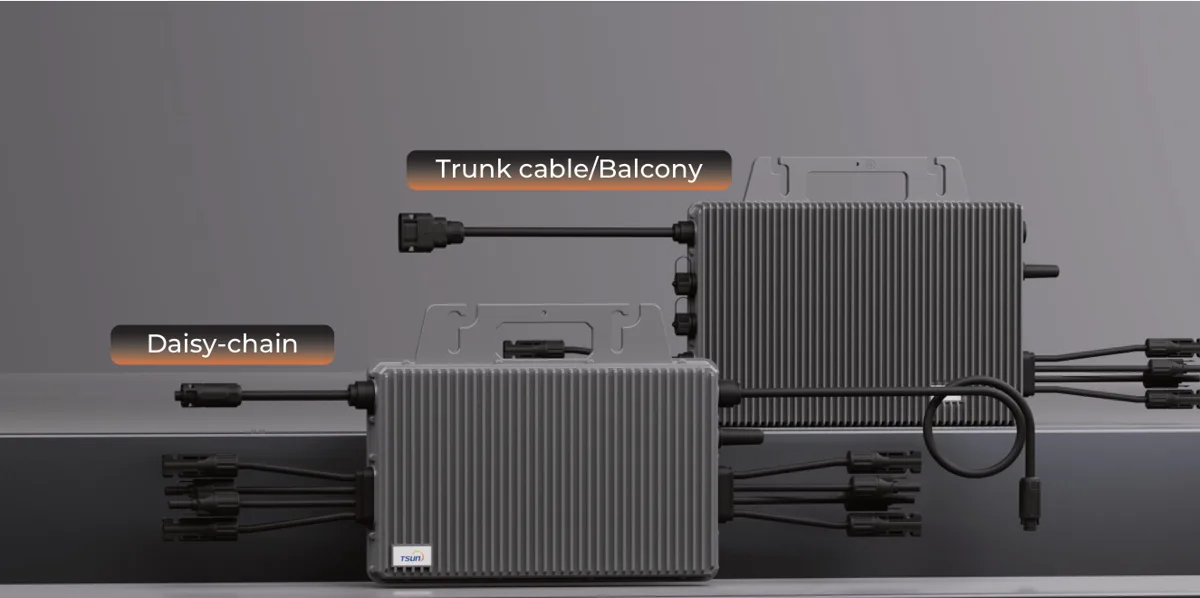
The 4-in-1 runs one to four panels of 400–700+ Wp, with 1,600 to 2,250 W of output, 96.7–97.0% peak efficiency, and a 331 × 261 × 44 mm body of 5 to 5.5 kg. It fits a 2 kW plant, or tops up a 6-in-1 for a 5 kW plant. The 2-in-1 runs one or two panels of 300–600+ Wp, with 600 to 1,000 W of output and 96.7% peak efficiency, in a box of about 250 × 223 × 30 mm. It is for small roofs or for adding one or two panels to an existing system.
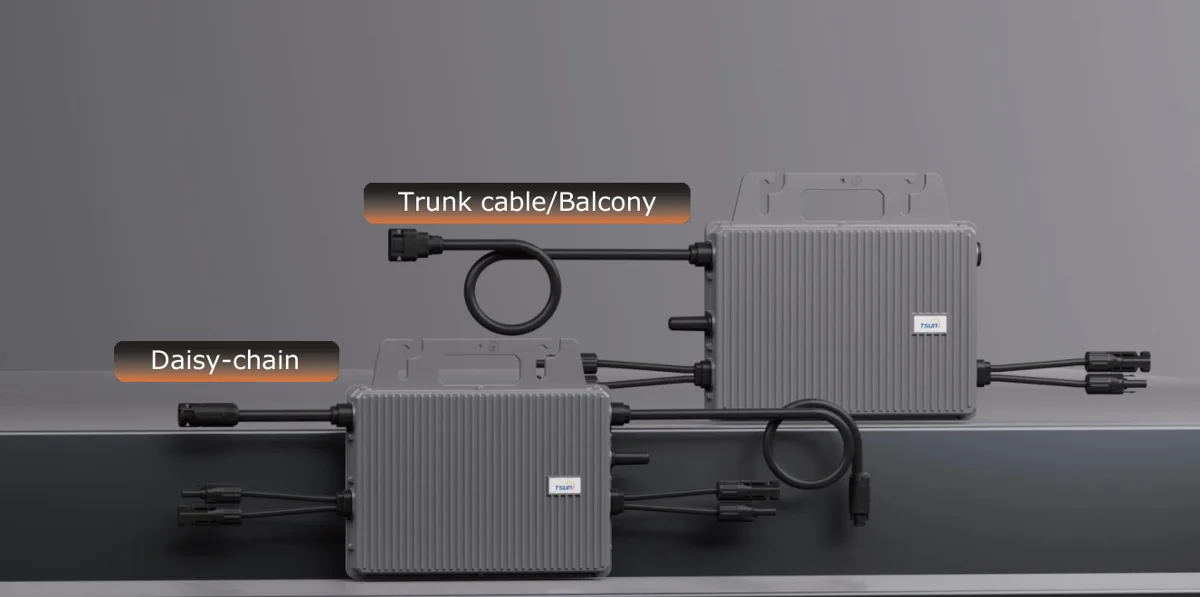
Three ways to wire the AC side
Every GEN3 datasheet lists three AC cabling options. On rooftop systems in Kerala we use the first two.

- Daisy-chain: each unit has an AC lead (up to 3.7 m on the 6-in-1) that plugs into the next, with a protective cap on the last one. Simple for one or two units.
- Trunk cable: a main AC cable runs along the array and each unit taps in with a short lead and a T connector. Neat for longer rows.
- Balcony: a 5 m AC cable with a European Schuko plug. This is for plug-in balcony kits in Europe and is not used for KSEB grid-connected rooftop plants.
The BIS licence: what it covers
In India, grid-tied solar inverters must be registered with the Bureau of Indian Standards (BIS). TSUN's licence is the document KSEB and the PM Surya Ghar portal expect to see for the inverter.
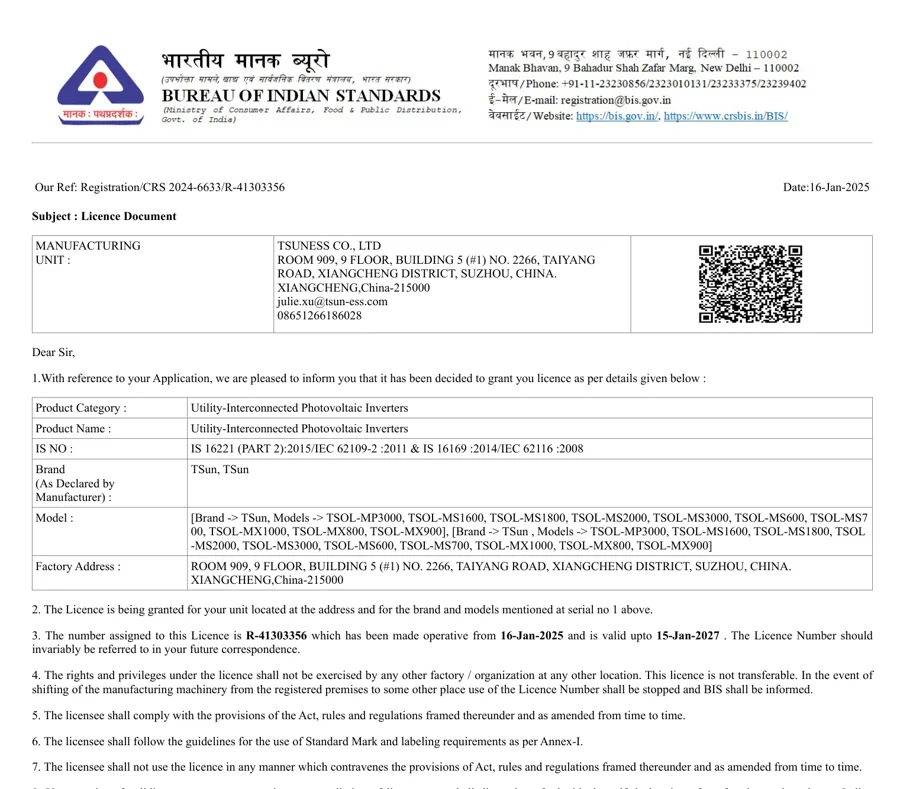
| Licence detail | As stated |
|---|---|
| Licence number | R-41303356 |
| Licence holder | TSUNESS Co., Ltd, Suzhou, China |
| Product | Utility-interconnected photovoltaic inverters |
| Standards | IS 16221 (Part 2):2015 / IEC 62109-2:2011 (inverter safety) and IS 16169:2014 / IEC 62116:2008 (islanding prevention) |
| Valid | 16 January 2025 to 15 January 2027 |
| Models listed | TSOL-MP3000, MS600, MS700, MS1600, MS1800, MS2000, MS3000, MX800, MX900, MX1000 |
| Indian representative | GPE Systems Private Limited, Hyderabad |
Check the model on your quote against this list. The 3 kW and 5 kW systems we install use TSOL-MS3000 and TSOL-MS2000, both on it. Some sizes in the datasheets, such as the MS2400, MS2700 and MS3300, are not on this licence, so ask for their own registration before you accept them. The licence page also carries a QR code that you can scan to check it on the BIS website.
The two standards are the ones that matter for safety on the grid. IS 16221 (Part 2) covers the inverter's electrical safety, and IS 16169 checks that it stops feeding power when the KSEB supply fails, so a lineman working on the line is not put at risk. The datasheet calls this LoM (loss of mains) protection.
Single line diagrams for 3 kW and 5 kW
The single line diagram (SLD) shows how the plant is wired, and goes with the KSEB registration application. With microinverters it is simpler than for a string inverter: there is no DC cable running down the building, because the panels connect straight to the unit on the roof.
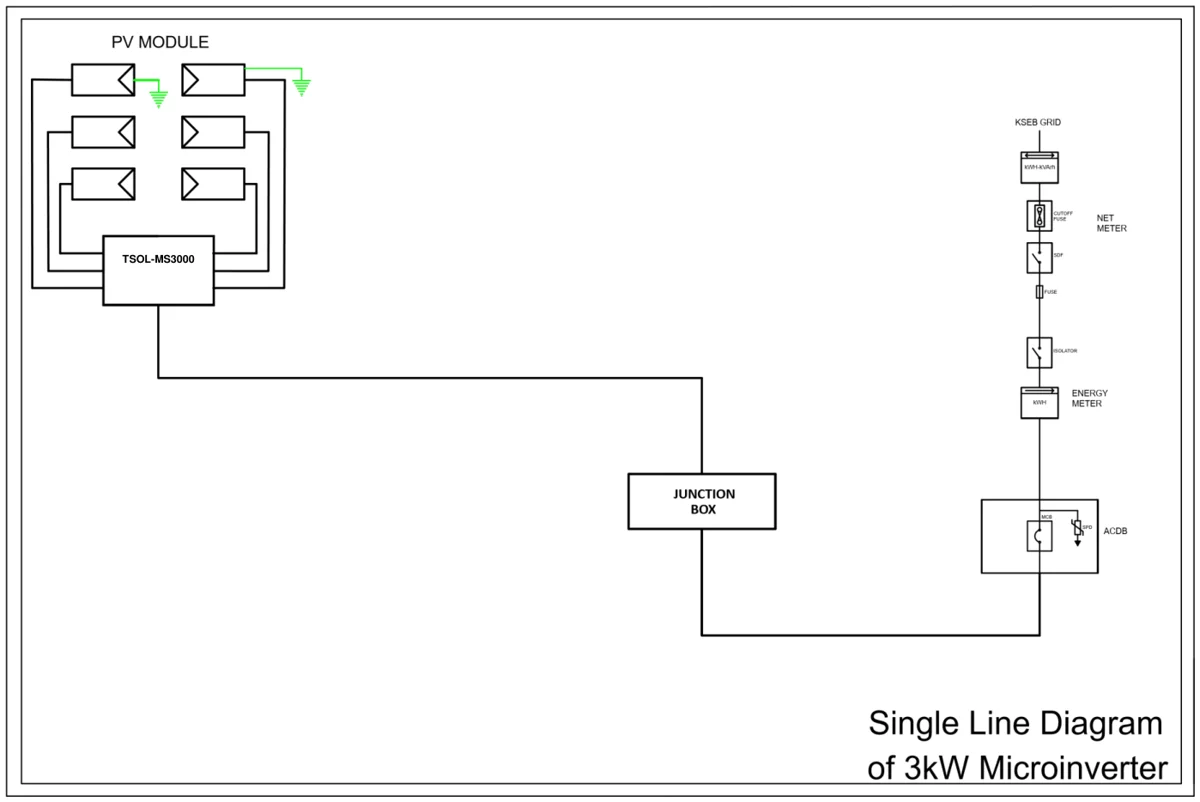
In the 3 kW drawing, six panels connect to one TSOL-MS3000. Its AC output runs to a junction box, then to the AC distribution board (ACDB) with its MCB and surge protection, the solar energy meter, an isolator, the net meter and the KSEB grid. Each panel frame is earthed.
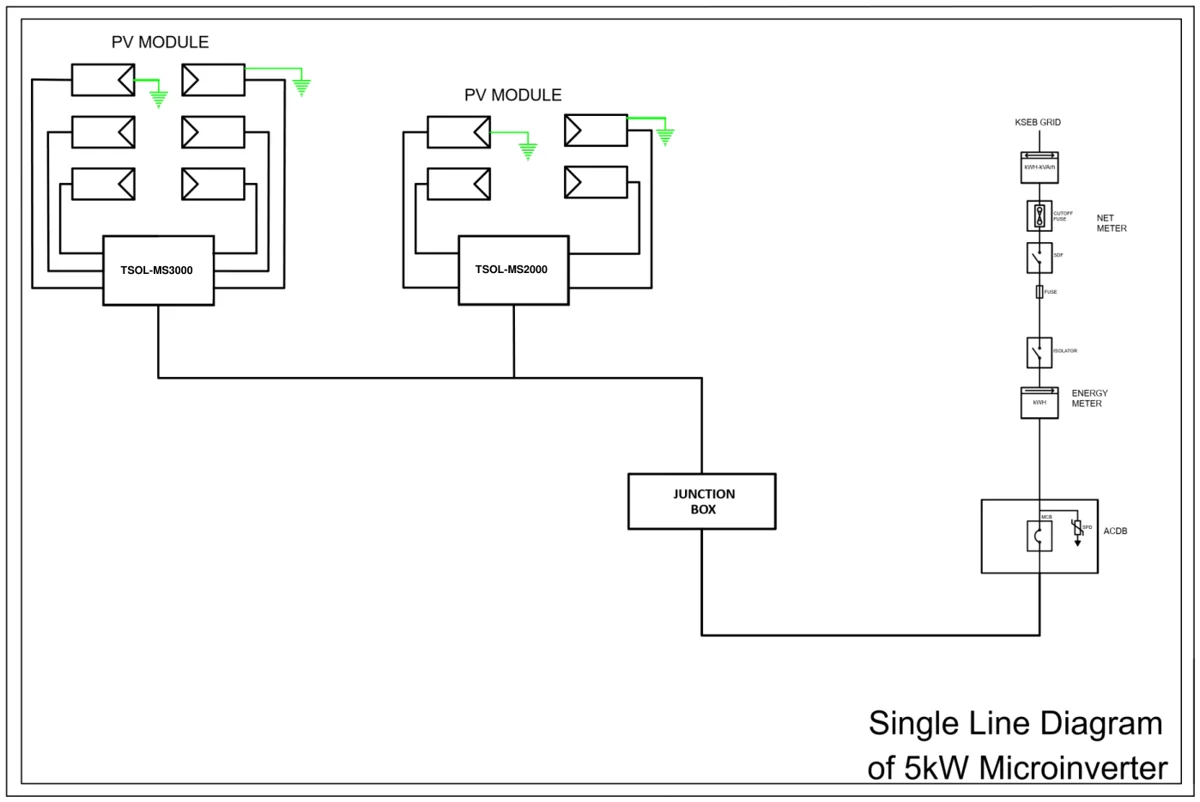
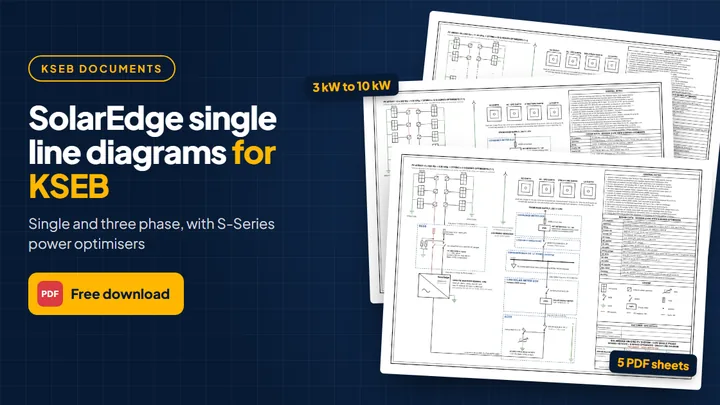
The 5 kW drawing adds a TSOL-MS2000 with four more panels. Both units feed the same junction box, and from there the AC side is the same as for 3 kW. These are reference drawings: the SLD submitted for your plant shows your own panels, cable sizes and protection. For the drawings KSEB itself issued, see our KSEB single line diagram post, and for an optimiser-based system, our SolarEdge single line diagrams.
Where these documents go in the KSEB process
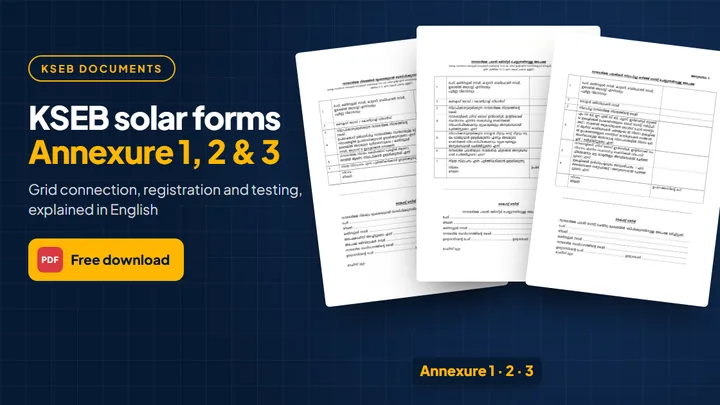
- Registration (Annexure 2): the inverter datasheet and the SLD are attached as the technical specifications and drawings.
- Testing (Annexure 3): KSEB asks for type test certificates of the inverter. The BIS licence shows the inverter is registered to the Indian standards.
- PM Surya Ghar portal: the inverter make and model are entered when the installation is uploaded, and the inspector checks the unit on the roof against them.
Our guide to the KSEB solar Annexure 1, 2 and 3 forms explains each form, and the PM Surya Ghar application guide covers the subsidy steps.
Is TSUN right for your roof?
Microinverters earn their place where panels face different directions, where a coconut tree or water tank shades part of the roof, or where you want to watch each panel and keep high-voltage DC off the terrace. On a large, unshaded roof facing one way, a good string inverter can cost less for the same output. Our SolarEdge vs string inverter comparison sets out the trade-offs.
Jasper Solar installs TSUN microinverters across Thiruvananthapuram, with the datasheet, BIS licence and SLD filed for every plant. To see whether your roof suits them, book a free home visit.
Common questions
Is the TSUN microinverter BIS certified?
Yes. TSUN holds BIS licence R-41303356 for utility-interconnected photovoltaic inverters under IS 16221 (Part 2) and IS 16169, valid from 16 January 2025 to 15 January 2027. It lists models including TSOL-MS3000, MS2000, MS1600, MS1800, MS600 and MS700.
How many panels can one TSUN microinverter run?
The GEN3 6-in-1 runs up to six panels, the 4-in-1 up to four and the 2-in-1 up to two. Each panel gets its own MPPT input.
What is the maximum DC voltage of a TSUN microinverter?
60 V per input. The panels connect straight to the unit, so there is no high-voltage DC string on the roof.
What warranty does TSUN give?
The GEN3 datasheets state a standard 12-year warranty.
Can I use a TSUN microinverter for the PM Surya Ghar subsidy?
Yes, with a BIS-registered model, DCR panels and an installer registered with KSEB on the national portal. The subsidy amount does not depend on the inverter type.
Sources
- TSUNESS Co., Ltd, GEN3 Microinverter 2-in-1 (600W–1000W), 4-in-1 (1600W–2250W) and 6-in-1 (2400W–3300W) datasheets (downloads above)
- Bureau of Indian Standards, licence R-41303356, ref. Registration/CRS 2024-6633, dated 16 January 2025 (download above)
- Jasper Solar, single line diagrams of 3 kW and 5 kW TSUN microinverter systems (downloads above)

Er. Akhil S.TProject Engineer, Jasper Solar Solutions
Project engineer with 7 years in the solar field and more than 400 completed solar projects. Akhil designs and oversees rooftop installations for homes and businesses, from site survey to KSEB commissioning.