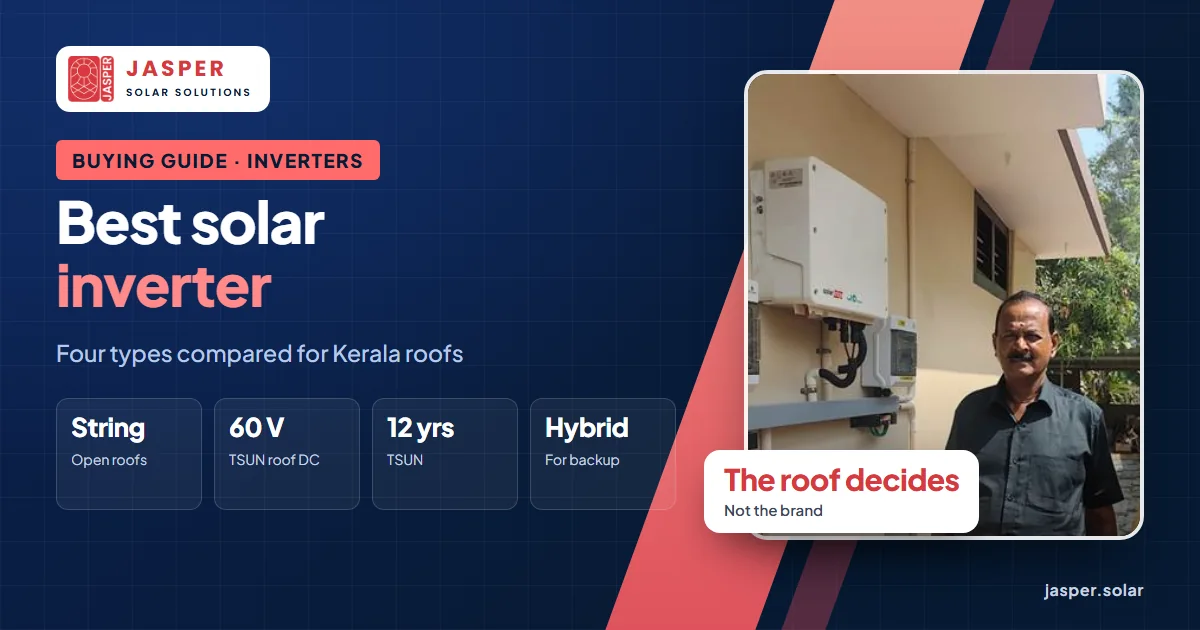
The inverter turns the DC power from your panels into the AC power your home and KSEB use. It is the hardest-working part of the system and usually the first to need service, so it deserves as much thought as the panels. This guide compares the four types and says plainly which suits which home.
The four types of home solar inverter
| String inverter | SolarEdge with optimisers | TSUN microinverter | Hybrid inverter | |
|---|---|---|---|---|
| How it works | Panels wired in a row to one inverter | An optimiser behind each panel, one inverter on the wall | Conversion on the roof, each panel on its own tracker | One inverter for panels, battery and grid |
| Effect of shade on one panel | Pulls down the whole row | Only that panel loses output | Only that panel loses output | As for a string inverter |
| Monitoring | Whole system | Each panel | Each panel | Whole system and battery |
| DC voltage on the roof | Several hundred volts | About 1 V per panel when the inverter is off | Never above 60 V | Several hundred volts |
| Works in a power cut | No | No | No | Yes, from the battery |
| Warranty on the electronics | Varies by brand; check the document | 8 years in India | 12 years | Varies by brand |
| Cost | Lowest | Higher | Higher | Highest, with the battery |
String inverter: best value on an open roof
If every panel gets the same sun all day, a string inverter does the job at the lowest cost, with the fewest parts on the roof. It is the standard inverter in most Kerala home systems and in our base price. Its weak point is mismatch: one shaded or dirty panel limits the others in its row.
Choose a single-phase or three-phase model to match your KSEB connection, from a brand with a service centre that covers Kerala.
SolarEdge: best for shade, with the inverter on the wall
SolarEdge fits a power optimiser behind every panel, so each one works at its own best point, and you see each panel's output in the app. When the inverter switches off, the roof wiring drops to about 1 V per panel, which is safer for anyone working on the roof. The Home Wave inverter for Indian homes comes in 3, 4 and 5 kW sizes and accepts up to 1.5 times its rating in panels, so the plant can grow later. Read SolarEdge vs string inverter.
TSUN microinverter: best for small and complex roofs
The TSUN GEN3 6-in-1 connects up to six panels, each on its own tracker, and converts to AC on the roof. DC voltage never exceeds 60 V. It is sealed to IP67, has no fan and carries a 12-year warranty. One unit suits a 3 kW home system neatly. Read the TSUN microinverter guide, or compare the two panel-level options in TSUN vs SolarEdge for 3 kW.
Hybrid inverter: the only choice for backup
Every on-grid inverter, of any brand, switches off when KSEB supply fails. That is a safety rule to protect line workers. If you want lights, fans, the fridge and Wi-Fi to run through a cut, you need a hybrid inverter and a battery. It costs more, and the battery gets no subsidy. Read hybrid solar systems in Kerala and on-grid vs hybrid vs off-grid.
Which inverter for your home?
| Your roof and needs | Our pick |
|---|---|
| Open terrace, no shade, lowest cost | String inverter |
| Coconut trees, a water tank or a neighbour's building shading part of the roof | SolarEdge or TSUN |
| Panels on two or more roof faces | SolarEdge or TSUN |
| Want to see each panel's output | SolarEdge or TSUN |
| Plan to add panels later, up to 5 or 6 kW | SolarEdge |
| Want the lowest voltage on the roof and the longest warranty | TSUN |
| Frequent power cuts, or someone at home who depends on powered equipment | Hybrid inverter with battery |
What to check on any inverter
- BIS registration. The PM Surya Ghar subsidy requires a BIS-registered inverter.
- The right size. The inverter's AC rating should suit the panel capacity. A 3 kW system normally uses a 3 kW inverter.
- Protection rating. IP65 or better if it is mounted outdoors, and a shaded, ventilated spot in any case. Heat shortens an inverter's life.
- Warranty in writing, with the number of years and who replaces a failed unit in Kerala.
- Monitoring. An app that you, and your installer, can both see.
- Surge protection on the DC and AC sides. Lightning is a common cause of inverter failure in Kerala.
Does the inverter change the subsidy or the price?
The subsidy depends on panel capacity, not on the inverter: up to ₹78,000 for 3 kW and above, whichever type you choose. The price does change. Our base prices, such as ₹2,15,000 for 3 kW, are for a string inverter; optimisers, microinverters and hybrid systems cost more, and the extra is not subsidised. We quote the options side by side so you can see the difference for your roof. See the 3 kW price guide.
Common questions
Which is the best solar inverter for a home in Kerala?
A string inverter for an open, unshaded roof; SolarEdge with optimisers or a TSUN microinverter for a roof with shade or several faces; a hybrid inverter if you need backup.
Is a microinverter better than a string inverter?
On a shaded or complex roof, yes, because each panel works on its own. On an open roof the gain is small and a string inverter gives better value.
Does a solar inverter work during a power cut?
An on-grid inverter does not. Only a hybrid inverter with a battery keeps supplying your home when KSEB power fails.
What size inverter do I need for a 3 kW solar system?
A 3 kW inverter, or one TSUN 6-in-1 microinverter with five or six panels.
How long does a solar inverter last?
Inverters have shorter warranties than panels: 8 years for SolarEdge in India and 12 years for TSUN. Expect to service or replace an inverter at least once in the 25 to 30-year life of the panels.
Does the inverter brand affect the PM Surya Ghar subsidy?
No. The subsidy is based on panel capacity. The inverter must be BIS registered.
The roof decides the inverter. Book a free home visit and we will check your roof for shade and quote the options that suit it.
Sources
- SolarEdge, Home Wave inverter single phase for India datasheet (PDF) and S1000 power optimiser datasheet (PDF)
- TSUN, GEN3 6-in-1 microinverter datasheet (PDF)
- Ministry of New and Renewable Energy, PM Surya Ghar national portal (subsidy and equipment requirements)

Er. Akhil S.TFounder and Project Engineer, Jasper Solar Solutions
Founder of Jasper Solar Solutions and a project engineer with 7 years in the solar field and more than 400 completed solar projects. Akhil designs and oversees rooftop installations for homes and businesses, from site survey to KSEB commissioning.