- Net metering lets a Kerala home send surplus solar power to KSEB and take it back later. You are billed only for import minus export.
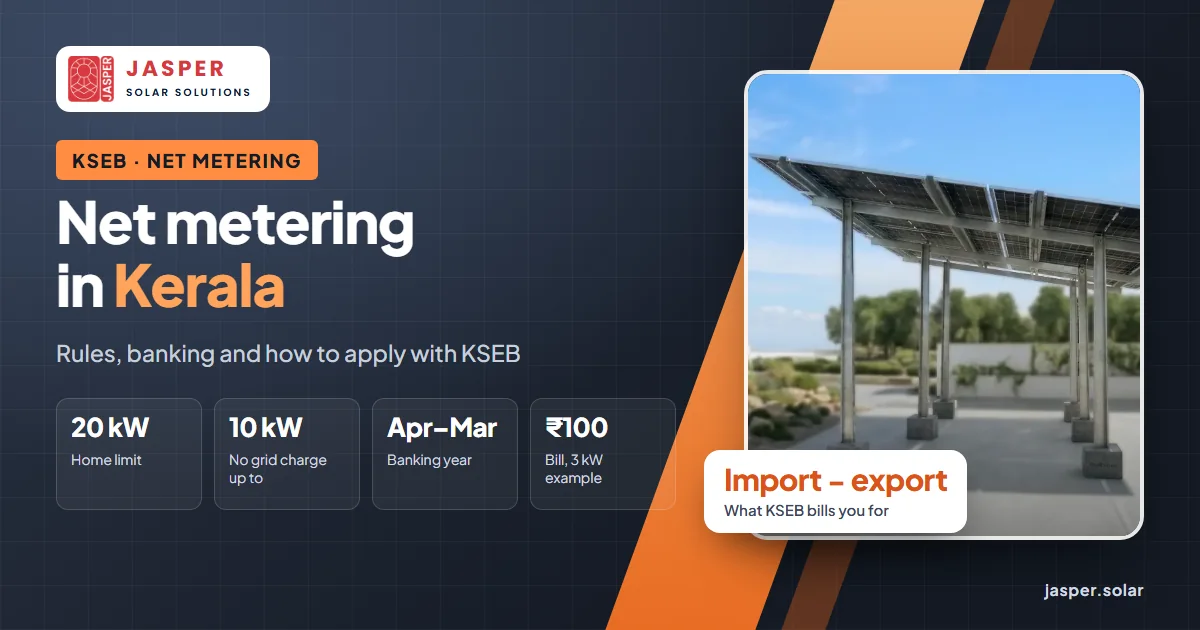
- Under KSERC's 2025 regulations, homes can use net metering for systems up to 20 kW. The rules took effect on 6 November 2025 and the new billing applies from 1 January 2026.
- Home systems up to and including 10 kW pay no grid support charge. That covers almost every house.
- Surplus units are banked through the April to March year. What is left at the end is paid at a low rate, so size the system to your own use.
Net metering is what makes rooftop solar work without a battery. Your panels make the most power at midday, when the house uses little, and none at night, when it uses the most. The net meter lets the KSEB grid hold the difference. This guide explains how it works in Kerala, the current rules, how to apply, and what it does to your bill.
What is net metering?
With rooftop solar, KSEB replaces your ordinary meter with a two-way net meter. It keeps two readings:
- Import: units you take from KSEB, mostly in the evening, at night and on rainy days.
- Export: units your panels send to KSEB when they make more than the house is using.
Your bill is worked out on the net units: import minus export. Units the house uses directly from the panels never reach the net meter at all. A second meter, the generation meter, records everything the panels make.
Net metering rules in Kerala today
Net metering in Kerala is governed by the Kerala State Electricity Regulatory Commission. Its Renewable Energy and Related Matters Regulations, 2025 came into force on 6 November 2025 and run to 31 March 2030, with the new billing arrangements applying from 1 January 2026. The points that matter for a home:
| Rule | What it says |
|---|---|
| Who can use net metering | Domestic consumers, for systems up to 20 kW |
| Apartments | Up to 500 kW on the common service connection of a multi-storey residential building |
| Other consumers | Industrial consumers up to 500 kW; agricultural consumers up to 3,000 kW |
| Grid support charge | None for systems up to and including 10 kW |
| Grid support charge above 10 kW | 50 paise a unit for the first 300 units a month and ₹1 a unit beyond that, only on night-time grid units set off against banked solar units |
| Banking | Surplus exports are carried forward within the April to March settlement year |
| Year-end surplus | Paid at a rate fixed by KSERC, far below what you pay for a unit |
The draft of these regulations, published in mid-2025, had proposed limiting net metering to 3 kW. The final version dropped that limit. If you read older articles saying homes above 3 kW lose net metering, they describe the draft, not the rules in force.
The regulations also provide for net billing and gross metering, mainly for larger plants, and set further conditions for bigger systems. If you plan more than 10 kW, ask us to check the current conditions for your connection before you finalise the size.
How banking and the yearly settlement work
- Each bill: KSEB subtracts export from import. If export is higher, the extra units are banked.
- Later bills: banked units are set off against your net use. This is how the surplus from January to April pays for the monsoon months, when the panels make less.
- End of the settlement year (31 March): any units still banked are paid for at the rate KSERC fixes. KSERC kept ₹3.26 a unit for surplus banked up to 31 March 2025; the rate for later years is set by its orders.
Compare that surplus rate with the ₹6.75 to ₹9.20 a unit that homes above 250 units a month pay KSEB. A unit you use yourself is worth two to three times a unit you sell. That is why a system matched to your yearly use gives the best return, and an oversized one does not. See how to size solar from your KSEB bill.
What net metering does to your bill
| Home using 400 units a month | Without solar | With 3 kW solar and net metering |
|---|---|---|
| Net units billed a month | 400 | 0 |
| Energy charge and duty | ₹3,498 | ₹0 |
| Fixed charge | ₹260 | ₹50 |
| Two-monthly bill | ₹7,516 | ₹100 |
You still pay the fixed charge every month, even at zero net units. The full slab working, with a second example for a 600-unit home, is in our KSEB solar bill guide.
How to apply for net metering with KSEB
Net metering is not a separate scheme you join later. It is part of connecting the solar plant to the grid, and your installer normally handles it.
- Apply for feasibility. For a subsidised home system, register on the PM Surya Ghar national portal with your KSEB consumer number. KSEB checks whether your connection and the local transformer can take the plant.
- Register the plant with its technical details: panel and inverter specifications and the single line diagram.
- Install the system through a registered vendor and a licensed electrical contractor.
- Safety inspection and testing. The plant is inspected, and KSEB tests it.
- Sign the connection agreement. KSEB fits the net meter and generation meter and connects the plant.
- Claim the subsidy on the national portal once the plant is commissioned.
The KSEB paperwork is explained in our guide to the KSEB solar Annexure forms, the drawing in our KSEB single line diagram guide, and the portal steps in how to apply for the PM Surya Ghar subsidy.
Documents KSEB asks for
- Your latest KSEB bill, with the consumer number and connected load
- Identity proof of the consumer, in the same name as the connection
- Technical specifications and test certificates of the panels and inverter
- Meter details, if you are buying the meters yourself
- The single line diagram of the plant
- The safety certificate after installation
The connection must be in the applicant's name. If the bill is still in a previous owner's or a late parent's name, change the ownership with KSEB first; it is the most common cause of delay.
Six things to know before you rely on net metering
- An on-grid system stops in a power cut. For the safety of KSEB line workers, the inverter shuts down when the grid is off. Backup needs a hybrid system with a battery.
- Your phase limits the size. A single-phase connection supports a smaller plant than a three-phase one. We check this at the site visit.
- Feasibility depends on the transformer. If many plants are already connected to your local transformer, KSEB may limit the capacity it approves.
- Off-grid systems do not get net metering or the PM Surya Ghar subsidy. See on-grid, hybrid and off-grid compared.
- The fixed charge stays. A zero-unit bill is not a zero-rupee bill.
- Rules are set by KSERC and can change. We check the regulations and tariff in force when we quote.
Common questions
Is net metering available in Kerala?
Yes. Under KSERC's 2025 regulations, domestic consumers can use net metering for rooftop solar systems up to 20 kW.
What is the net metering limit for homes in Kerala?
20 kW for a domestic consumer. Systems up to and including 10 kW also pay no grid support charge.
Did Kerala limit net metering to 3 kW?
No. A 3 kW limit was proposed in the 2025 draft regulations, but the final regulations dropped it and allow net metering for homes up to 20 kW.
Does KSEB pay for the extra units I export?
Exported units are first set off against what you import and banked for later bills. Only the surplus left at the end of the April to March year is paid for, at a low rate fixed by KSERC.
How do I apply for a KSEB net meter?
Apply for feasibility through the PM Surya Ghar portal or your KSEB section office, register the plant, install it, and have it inspected and tested. KSEB then signs the connection agreement and fits the net meter. Your installer usually handles this.
Is there a grid support charge for home solar in Kerala?
Not for systems up to and including 10 kW. Above 10 kW it is 50 paise a unit for the first 300 units a month and ₹1 a unit beyond that, on night-time grid units set off against banked solar units.
Do I need a battery for net metering?
No. With net metering the grid takes your daytime surplus and gives it back at night, so a standard home system needs no battery.
Jasper Solar is a KSEB-authorised, MNRE-empanelled installer. We handle feasibility, the Annexure forms, the single line diagram, testing and the net meter for you. Book a free site visit to start.
Sources
- Kerala State Electricity Regulatory Commission, KSERC (Renewable Energy and Related Matters) Regulations, 2025, in force from 6 November 2025
- BioEnergy Times, Kerala State Electricity Regulatory Commission notifies KSERC Regulations, 2025 (capacity limits, grid support charge, dates)
- Kerala State Electricity Board, eKiran solar rooftop portal
- Ministry of New and Renewable Energy, PM Surya Ghar national portal

Er. Akhil S.TFounder and Project Engineer, Jasper Solar Solutions
Founder of Jasper Solar Solutions and a project engineer with 7 years in the solar field and more than 400 completed solar projects. Akhil designs and oversees rooftop installations for homes and businesses, from site survey to KSEB commissioning.