
- A 3 kW solar system in Kerala generates about 13 units (kWh) a day on average. That is about 400 units a month and 4,800 units a year.
- Output changes with the season: roughly 14 to 15 units a day from January to March, and 10 to 12 units a day in the monsoon months.
- A 3 kW system uses 5 or 6 panels of 540 to 605 W and needs about 270 sq ft of shade-free roof.
- 400 units a month covers a typical home with one inverter AC, and takes a ₹7,516 two-monthly KSEB bill down to about ₹100.
The most common question we hear about a 3 kW system is how much electricity it actually makes. The honest answer is one average and a range, because a solar plant makes more in February than in June. This guide gives both, month by month, and shows what those units mean for your KSEB bill.
How many units does a 3 kW solar system generate per day?
About 13 units a day, averaged over the year. In Kerala, 1 kW of rooftop solar makes about 4.4 units a day, so 3 kW makes about 13.3. That figure is the average of the 3 kW systems we have installed, and it already includes the monsoon months.
| System size | Units a day | Units a month | Units a year |
|---|---|---|---|
| 1 kW | about 4.4 | about 133 | about 1,600 |
| 2 kW | about 9 | about 267 | about 3,200 |
| 3 kW | about 13 | about 400 | about 4,800 |
| 5 kW | about 22 | about 667 | about 8,000 |
| 10 kW | about 44 | about 1,330 | about 16,000 |
One unit is one kilowatt-hour (kWh), the same unit KSEB bills you in. On a clear summer day a 3 kW system can make 15 units or more; on a day of steady rain it may make only a few.
3 kW solar generation month by month
The table below is an independent estimate from PVGIS, the European Commission's solar calculator, for a 3 kW system in Thiruvananthapuram facing south at a 10° tilt, with 14% system losses. It uses satellite weather data from 2005 to 2023.
| Month | Units a day | Units in the month |
|---|---|---|
| January | 14.1 | 437 |
| February | 15.1 | 422 |
| March | 14.7 | 455 |
| April | 13.3 | 398 |
| May | 11.7 | 362 |
| June | 10.7 | 322 |
| July | 10.8 | 335 |
| August | 11.6 | 359 |
| September | 12.1 | 363 |
| October | 11.6 | 360 |
| November | 10.8 | 324 |
| December | 11.9 | 370 |
| Year | 12.3 average | 4,506 total |
The PVGIS estimate of 12.3 units a day is a little below our installed average of about 13, because it assumes 14% losses. Well-designed systems with good panels and no shade usually beat it. Use the two figures as a range: 12 to 13 units a day, or 4,500 to 4,800 units a year.
How much does a 3 kW system make in the rainy season?
About 10 to 12 units a day on average from June to November, which is 320 to 360 units a month. That is roughly a quarter less than in the best months, not a collapse. Panels work on daylight, not only direct sun, so they keep producing under cloud.
Single days vary much more than the monthly average. A day of heavy, steady rain can give only a small fraction of a sunny day's output, and the next clear day makes up for it. With KSEB net metering, surplus units from the dry months are banked and set against the monsoon months, so you size a system on the yearly average. Our guide on solar at night and in the monsoon explains how that works.
What can 13 units a day run?
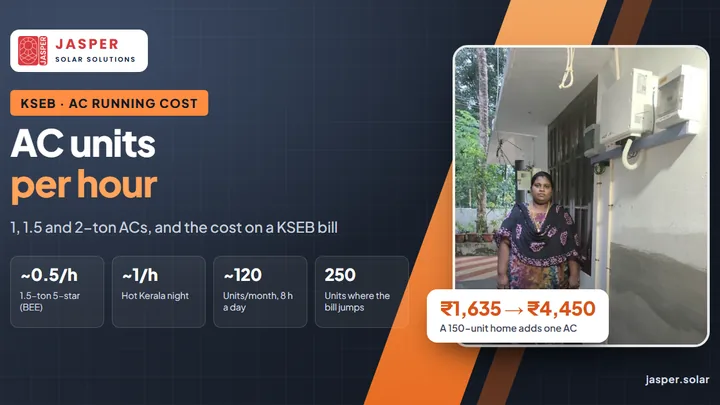
About 400 units a month covers the full use of a typical Kerala home with lights, fans, fridge, TV, washing machine, a water pump and one 1.5-ton inverter AC used for about 8 hours a day. For the appliance-by-appliance working, see how many ACs a 3 kW system can run.
The solar does not have to make each unit at the moment you use it. An on-grid system exports what you do not use in the daytime, and the net meter sets those units against what you take from KSEB at night.
What 400 units a month does to your KSEB bill
| Home using 400 units a month | Without solar | With 3 kW solar |
|---|---|---|
| Units billed a month | 400 | 0 |
| Two-monthly KSEB bill | ₹7,516 | about ₹100 |
| Saving a year | about ₹44,500 |
The bill falls to the fixed charge because the home's net units are zero. The slab working is in our KSEB solar bill guide, and the savings calculator does it for your own bill.
How many panels and how much roof does 3 kW need?
- Panels: 5 or 6. Today's home panels are 540 to 605 W each, so six 550 W panels make 3.3 kW and five 600 W panels make 3.0 kW.
- Roof area: about 270 sq ft of shade-free space, or roughly 90 sq ft per kW including access space.
- Direction: south-facing at a low tilt is best in Kerala. East and west faces work with a small loss.
- Structure: an elevated structure keeps the terrace usable underneath and lifts the panels above parapet shade.
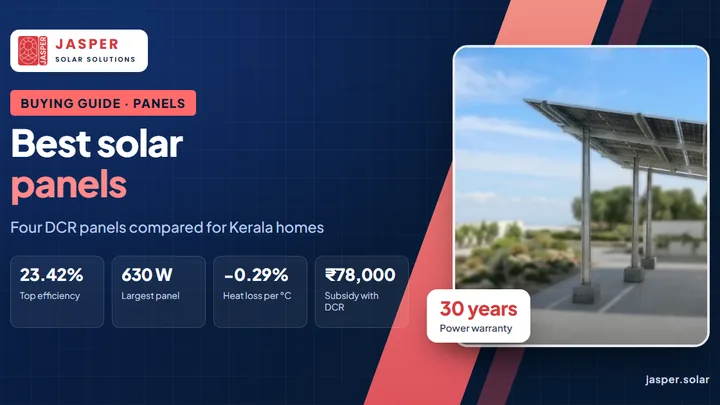
For panel choices, see how to choose solar panels for a Kerala home.
Why two 3 kW systems can give different units
- Shade: a coconut palm, water tank or neighbouring building that shades even one panel can pull down a whole string. Optimisers or microinverters limit the loss to the shaded panel.
- Direction and tilt: a north-facing slope or a steep tilt makes less.
- Heat: panels lose a little output as they get hot. Panels with a better temperature coefficient lose less.
- Dust and droppings: dirty glass blocks light, mostly in the dry months. See our solar panel cleaning guide.
- Power cuts: an on-grid system stops when the KSEB supply is off, so frequent daytime outages cost units.
- Panel age: output falls slowly over the years, within the limits of the 25 to 30-year performance warranty.
How to check your own system's units
- Inverter app: shows today's units, each month's total and the lifetime total.
- Generation meter: the separate meter KSEB fits records everything the panels make.
- KSEB bill: shows the generation, import and export readings for the billing period.
Compare a full month with the table above, not a single day. If a clear-weather month is well below the estimate, ask your installer to check for shade, dirt or a fault.
Is 3 kW the right size for your home?
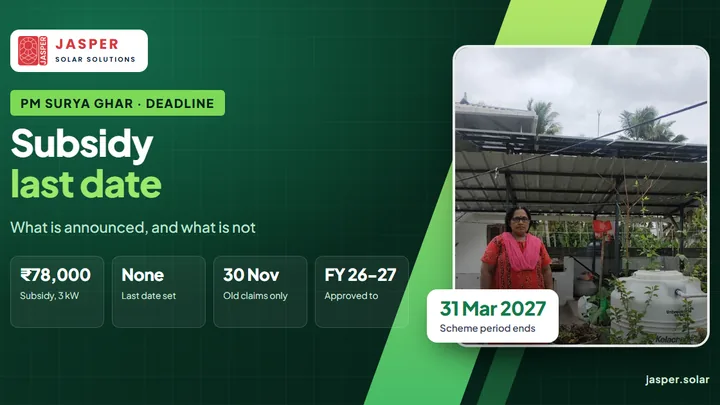
A 3 kW system suits a home using about 350 to 450 units a month. It is also the size where the PM Surya Ghar subsidy reaches its maximum of ₹78,000. If you use less, 2 kW may be enough; if you run two or more ACs, look at 5 kW. Our guide to sizing solar from your KSEB bill shows the method, and solar panel cost in Kerala 2026 gives the price for each size.
Common questions
How many units does a 3 kW solar panel system produce per day?
About 13 units a day on average in Kerala. It ranges from about 10 to 11 units a day in the wettest months to about 15 in February and March.
How many units does a 3 kW solar system generate per month?
About 400 units a month on average, or about 4,800 units a year.
How many units does a 3 kW system make per day in the rainy season?
About 10 to 12 units a day on average from June to November. Individual days of heavy rain can be much lower, and clear days in between are higher.
How many solar panels are required for 3 kW?
5 or 6 panels of 540 to 605 W each, depending on the panel model.
What area is required for a 3 kW solar system?
About 270 sq ft of shade-free roof, including space to walk around the panels.
How much electricity does a 1 kW solar panel system produce?
About 4.4 units a day, or about 133 units a month, averaged over the year in Kerala.
Is a 3 kW solar system enough for a home?
Yes, for a home using up to about 400 units a month, including one 1.5-ton inverter AC used for about 8 hours a day.
Want to know what your own roof would generate? Book a free site visit. We check shade and direction, design the system in 3D and give you the expected units month by month before you decide.
Sources
- European Commission Joint Research Centre, PVGIS photovoltaic performance calculator, PVGIS-ERA5 data 2005–2023, Thiruvananthapuram (8.52°N, 76.94°E), 3 kWp, 10° tilt facing south, 14% losses; retrieved 17 November 2026
- Jasper Solar, average generation of installed 3 kW systems in Kerala (about 4.4 units per kW a day)
- Kerala State Electricity Regulatory Commission, domestic tariff order (bill figures)

Er. Akhil S.TFounder and Project Engineer, Jasper Solar Solutions
Founder of Jasper Solar Solutions and a project engineer with 7 years in the solar field and more than 400 completed solar projects. Akhil designs and oversees rooftop installations for homes and businesses, from site survey to KSEB commissioning.