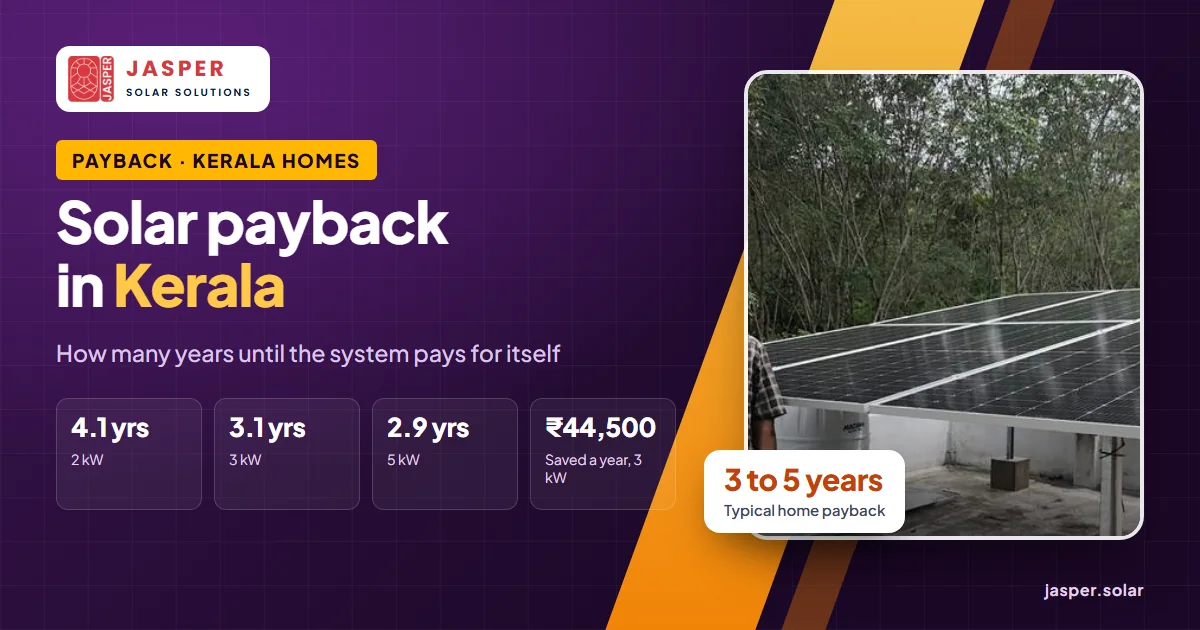
- A home solar system in Kerala usually pays for itself in 3 to 5 years, when it is sized to the home's use and gets the PM Surya Ghar subsidy.
- A 3 kW system costs ₹1,37,000 after subsidy and saves about ₹44,500 a year for a home using 400 units a month: a payback of about 3.1 years.
- Heavy users pay back fastest, because solar removes units billed at KSEB's highest slab rates. Light users can take 7 years or more.
- Panels carry a 25 to 30-year performance warranty, so after payback the system keeps cutting the bill for two decades.
The payback period is the number of years your electricity savings take to cover what you paid for the system. In Kerala it is short for one reason: KSEB charges heavy users a high rate on every unit, and solar removes exactly those units. This guide works the numbers for 2, 3 and 5 kW systems and shows what makes payback faster or slower.
How to calculate solar payback
The formula is simple:
Payback (years) = net cost of the system ÷ yearly saving on the KSEB bill
- Net cost is the price you pay, including GST, minus the subsidy.
- Yearly saving is your KSEB bill for a year without solar minus the bill with solar.
The saving is not simply units multiplied by an average rate. Above 250 units a month, KSEB charges every unit at one higher rate, so cutting your net units can drop the whole bill into cheaper slabs. Our KSEB solar bill guide shows the slab working.
Payback for 2 kW, 3 kW and 5 kW systems
Each example is a home whose monthly use matches what the system generates (133 units per kW a month), on the current KSEB domestic tariff, with our 2026 plant prices.
| 2 kW | 3 kW | 5 kW | |
|---|---|---|---|
| Home's use a month | 267 units | 400 units | 667 units |
| Plant cost | ₹1,65,000 | ₹2,15,000 | ₹3,20,000 |
| Subsidy | ₹60,000 | ₹78,000 | ₹78,000 |
| Net cost | ₹1,05,000 | ₹1,37,000 | ₹2,42,000 |
| Monthly bill without solar | about ₹2,200 | about ₹3,760 | about ₹7,060 |
| Monthly bill with solar | about ₹50 | about ₹50 | about ₹50 |
| Saving a year | about ₹25,800 | about ₹44,500 | about ₹84,100 |
| Payback | about 4.1 years | about 3.1 years | about 2.9 years |
The 2 kW home pays back more slowly because its units are billed at a lower rate: ₹6.75 a unit against ₹7.95 for the 400-unit home and ₹9.20 for the 667-unit home.
Why heavy users pay back faster
KSEB's domestic tariff climbs with use. Up to 250 units a month, each block of units has its own rate. Above 250, every unit is charged at a single higher rate, up to ₹9.20 above 500 units. Solar wipes out the most expensive units first, so the more you use, the more each solar unit is worth.
The opposite is also true. Take a home using only 200 units a month that installs 2 kW:
| Home using 200 units a month, 2 kW system | |
|---|---|
| Monthly bill without solar | about ₹1,250 |
| Monthly bill with solar | about ₹50 |
| Saving a year | about ₹14,400 |
| Net cost | ₹1,05,000 |
| Payback | about 7 years |
The system makes 67 more units a month than this home uses. Surplus left at the end of the yearly settlement is paid at a low rate set by KSERC, so those units earn very little. A smaller system would suit this home better.
What makes payback shorter
- The right size. Match the system to your yearly use. See how to size solar from your KSEB bill.
- The full subsidy. The subsidy reaches its ₹78,000 maximum at 3 kW. Below that it is ₹30,000 per kW for the first 2 kW.
- A shade-free roof. Shade cuts generation, and every lost unit is a lost saving.
- Clean panels. Dust in the dry months lowers output. See our panel cleaning guide.
- Rising use. If you add an AC, an induction cooker or an electric vehicle, the solar offsets units at a higher slab.
What makes payback longer
- An oversized system. Extra units are worth little once your own use is covered.
- A loan. Interest adds to the cost. On an SBI loan a 3 kW system costs about ₹38,400 more over 10 years, which adds a little under a year to the payback. See solar panel financing in Kerala.
- A battery. A hybrid system costs more and the battery is not subsidised, so it pays back more slowly. It is bought for backup, not for payback. See hybrid solar systems.
- Premium equipment. Optimisers or microinverters add cost. On a shaded roof they earn it back in extra units; on a clear roof they lengthen payback slightly.
After payback: 20 years of low bills
Payback is only the first few years of a long life. Panels carry a 25 to 30-year performance warranty. For the 3 kW home above, savings of about ₹44,500 a year at today's tariff add up to about ₹11 lakh over 25 years, against a net cost of ₹1,37,000.
Two things move that figure. Panel output falls slowly with age, which lowers it a little. KSEB tariffs have been revised upward over the years, which raises it. Expect to replace the inverter once in that period.
Payback for a business
Businesses get no subsidy, but they use their solar power in the daytime at commercial tariff rates and can claim 40% depreciation. In our worked example, a 10 kW plant at ₹6,00,000 saves about ₹1,44,000 a year, a payback of about 4.2 years before the tax saving. See solar for businesses in Kerala and the solar depreciation calculator.
Work out your own payback
Enter your two-monthly KSEB bill in our solar savings calculator. It suggests a system size and shows the price, subsidy, yearly saving and payback using the same KSEB tariff as this guide.
Common questions
What is the payback period for solar panels in Kerala?
Usually 3 to 5 years for a home system that is sized to the home's use and gets the PM Surya Ghar subsidy. A 3 kW system for a home using 400 units a month pays back in about 3.1 years.
How do I calculate the solar payback period?
Divide the net cost of the system, after subsidy, by the amount it saves on your KSEB bill each year.
Is solar worth it in Kerala for a small bill?
It still saves money, but more slowly. A home using 200 units a month takes about 7 years to pay back a 2 kW system, because its units are billed at KSEB's lower slab rates.
Does a solar loan change the payback?
Yes, slightly. The interest adds to the cost: about ₹38,400 over 10 years on a 3 kW system with an SBI loan. The EMI is usually still smaller than the bill it replaces.
How long do solar panels last after payback?
Panels carry a 25 to 30-year performance warranty, so a system that pays back in 3 to 5 years keeps saving for 20 years or more.
What is the payback for a 5 kW solar system in Kerala?
About 2.9 years for a home using about 667 units a month: a net cost of ₹2,42,000 against a saving of about ₹84,100 a year.
We put the payback in every quote. Book a free site visit and we will size the system from your bills and show the cost, subsidy, yearly saving and payback for your roof.
Sources
- Kerala State Electricity Regulatory Commission, LT-I domestic tariff, 1 April 2025 to 31 March 2027 (slab rates, fixed charges, 10% electricity duty)
- Ministry of New and Renewable Energy, PM Surya Ghar: Muft Bijli Yojana national portal (subsidy amounts)
- Jasper Solar, 2026 home plant prices and average generation of 133 units per kW a month

Er. Akhil S.TFounder and Project Engineer, Jasper Solar Solutions
Founder of Jasper Solar Solutions and a project engineer with 7 years in the solar field and more than 400 completed solar projects. Akhil designs and oversees rooftop installations for homes and businesses, from site survey to KSEB commissioning.