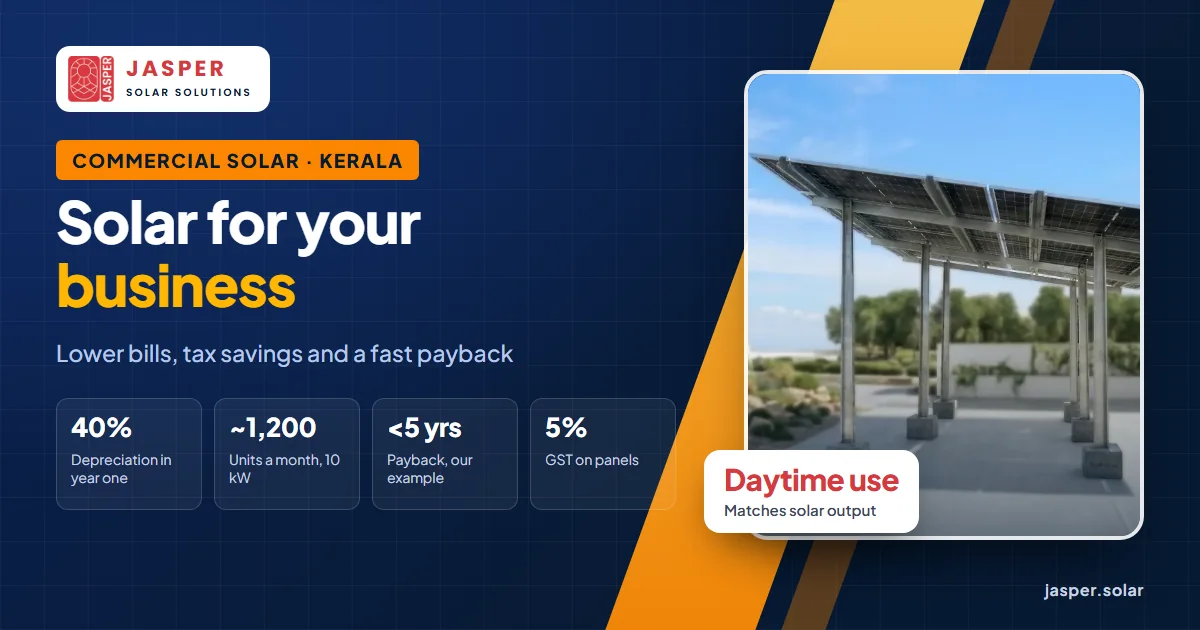
- Businesses use most of their power in daytime, exactly when solar produces, so most of the generation replaces units you would otherwise buy from KSEB.
- A registered business can claim 40% depreciation on a solar plant in the first year, against 15% for normal plant and machinery, which cuts the tax bill on top of the power savings.
- In our worked example, a 10 kW system for a shop or office pays for itself in under five years from bill savings alone.
- The PM Surya Ghar subsidy is only for homes and housing societies. Commercial premises do not get it, but the tax benefits usually more than make up for that.
Electricity is one of the few costs a Kerala business can cut for 25 years with a single decision. Shops, clinics, schools, offices and small factories run their heaviest loads, from air conditioning to computers and machines, between 9 AM and 6 PM. That is also when a rooftop solar plant is producing. This guide explains the benefits, the tax rules, and the numbers for a typical business.
Why solar suits businesses better than most homes
A home uses much of its power in the evening, so a large share of its solar output is exported to the grid and credited back. A business uses its power during the day, so most of the solar output is used directly on site. Every unit used directly replaces a unit you would otherwise buy at KSEB's commercial tariff, which is higher than the domestic tariff.
That daytime match is why commercial systems often pay back faster than home systems of the same size, even without a subsidy.
8 benefits for your business
- Lower power bills from the first month. In Thiruvananthapuram, 1 kW of solar produces about 120 units a month, so a 10 kW plant makes around 1,200 units a month.
- Accelerated depreciation. Solar plants qualify for 40% depreciation on written-down value under the Income Tax Act. Normal plant and machinery gets 15%. If the plant runs for less than 180 days in its first year, half the rate applies that year.
- Lower GST on the main equipment. Since September 2025, panels and inverters carry 5% GST instead of 12%. A GST-registered business may also be able to claim input tax credit, depending on how the plant is capitalised. Our GST guide covers the details.
- Credits for surplus power. On Sundays and holidays, surplus units are exported to KSEB through the net meter and credited on your bill. We handle the approvals.
- Predictable costs. Once installed, your solar units cost nothing more for decades, which shields that share of your consumption from future tariff revisions.
- Low running costs. A grid-connected plant has no fuel and few moving parts. Periodic cleaning and an annual check keep it producing.
- Unused roof space put to work. A flat terrace, a factory shed or a parking area becomes a power plant. Elevated structures leave the space below usable.
- A visible green commitment. Customers, tenants and corporate clients increasingly ask suppliers about their energy use. A rooftop plant answers that question.
A worked example: 10 kW for a shop or office
The figures below use round example numbers to show the method. Your quote depends on your roof, load and the equipment you choose.
| Item | Example figure |
|---|---|
| System size | 10 kW |
| Example price, including GST | ₹6,00,000 |
| Generation (120 units per kW a month) | 14,400 units a year |
| Assumed tariff saved | ₹9 per unit |
| Yearly bill saving | about ₹1,29,600 |
| Simple payback from bill savings | about 4.6 years |
| Year-one depreciation (40% of ₹6,00,000) | ₹2,40,000 deduction |
| Tax saved on that deduction at a 25% rate | about ₹60,000 |
The tax saving comes on top of the bill savings and shortens the payback further. The actual benefit depends on your tax rate, how the asset is capitalised and when it is commissioned, so confirm the figures with your chartered accountant.
Which businesses gain the most
| Premises | Why solar fits |
|---|---|
| Shops and showrooms | Lights, fans and AC run all day, six or seven days a week |
| Offices | Computers and AC peak in working hours |
| Hospitals and clinics | Constant daytime load; a hybrid design can also back up critical circuits |
| Schools and colleges | Daytime use; holiday surplus is exported and credited |
| Factories and workshops | Large roofs and heavy daytime machine loads |
| Hotels and homestays | Steady loads from rooms, kitchens and pumps |
How big a system does a business need?
Start from your daytime consumption, not just the total on the bill. A plant sized to your daytime load uses almost all of its output on site, which gives the best return. As a rule of thumb, each kW needs about 80 to 100 sq ft of shade-free roof, so a 10 kW plant needs roughly 800 to 1,000 sq ft. For the basic sizing method, see how to size a system from your KSEB bill.
What about the subsidy?
The PM Surya Ghar Muft Bijli Yojana subsidy is only for residential homes and for housing societies' common facilities. Shops, offices, hospitals, schools and factories do not receive it. For a business, the lower GST, the 40% depreciation and the higher tariff saved usually make the numbers work without a subsidy.
Need backup as well as savings?
A standard on-grid plant switches off during a KSEB power cut. Clinics, cold storage and offices that cannot afford downtime can add a battery with a hybrid design, which keeps critical circuits running. Our guide to hybrid systems explains how it works, and for roofs with shade or several orientations, compare SolarEdge and string inverters.
How Jasper Solar works with businesses
- Load study: we review a year of bills and your working hours to size the plant to your daytime use.
- Site survey and design: shade mapping and a structural design on IIT/NIT certified hot-dip galvanized steel, built to IS 875 Part 3 wind-load standards.
- Installation and approvals: KSEB feasibility, net metering and commissioning, handled directly by our team with no middlemen.
- After-sales: proactive maintenance contracts to keep generation steady year after year.
Common questions
Can my business get the PM Surya Ghar subsidy?
No. It covers homes and housing societies only. Businesses benefit instead from 40% accelerated depreciation and the 5% GST on panels and inverters.
Can a rented premises install solar?
Usually yes, with the building owner's written consent to use the roof. We check the KSEB connection details and approvals needed during the site survey.
Will the plant run during a power cut?
Not an on-grid plant. Add a battery with a hybrid design if you need backup.
Who can claim the depreciation?
The business that owns and uses the plant. The rate and timing rules are set by the Income Tax Act, so check your case with your chartered accountant.
See what solar can do for your premises. Visit our commercial solar page or book a free site survey and we will size a plant to your daytime load, with the savings and payback worked out.