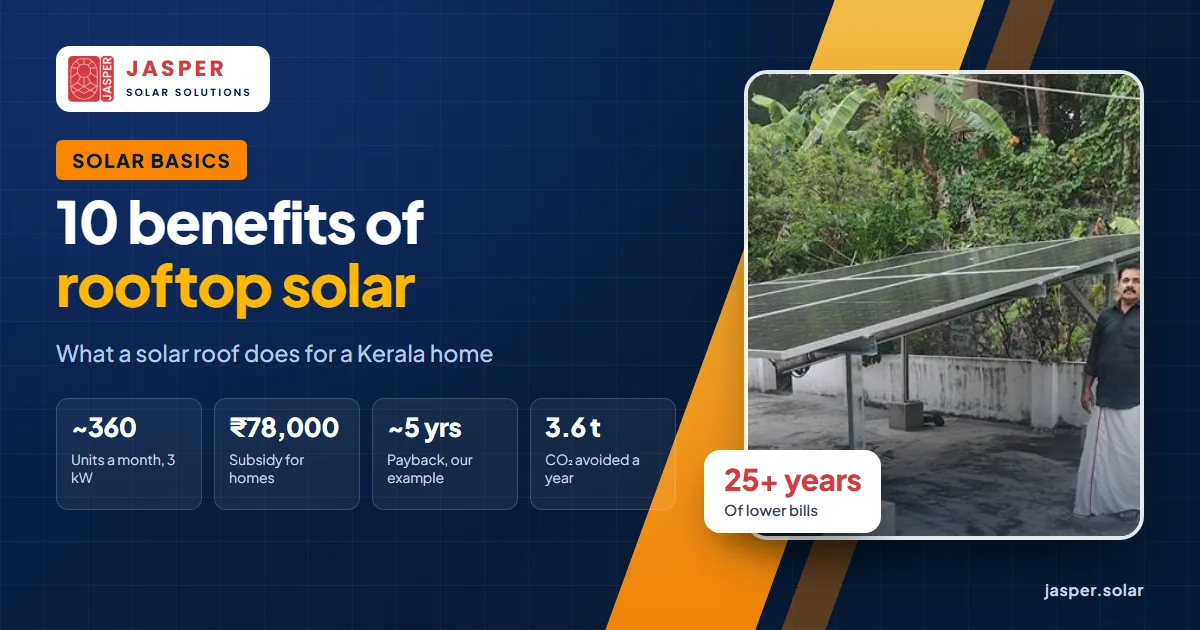
- A 3 kW rooftop system makes about 360 units a month in Thiruvananthapuram, which covers the use of many Kerala homes.
- With the PM Surya Ghar subsidy of up to ₹78,000 and GST on panels cut to 5%, a home system now pays for itself in about five years in our worked example.
- The panels keep producing for 25 years or more, so most of the system's life is pure savings.
- Solar also cuts your home's carbon footprint by about 3.6 tonnes of CO₂ a year for a 3 kW system, and can add backup for power cuts with a battery.
Kerala homes are well placed for rooftop solar: strong sunshine for most of the year, flat terraces on many houses, and a subsidy scheme that pays a large share of the cost. Here are ten benefits worth knowing before you decide, with the numbers behind each one.
1. Much lower electricity bills
In Thiruvananthapuram, 1 kW of solar produces about 4 units a day, or roughly 120 units a month. A 3 kW system makes around 360 units a month. Every unit you use directly is one you do not buy from KSEB, and that saving starts the month the system is commissioned.
2. Up to ₹78,000 back from the government
Under the PM Surya Ghar Muft Bijli Yojana, homes get ₹30,000 per kW for the first 2 kW and ₹18,000 for the third kW, up to ₹78,000. The money is credited straight to your bank account after commissioning. Our subsidy guide walks through the seven steps.
3. Solar now costs less to buy
Since September 2025, panels and inverters carry 5% GST instead of 12%. The overall GST on a home system fell from about 13.8% to 8.9%, which cuts roughly ₹9,000 to ₹10,500 from a typical 3 kW system. See the GST guide for the details.
4. Credit for every unit you export
On sunny afternoons your panels often make more than the house is using. With a KSEB net meter, that surplus is exported to the grid and credited against what you draw in the evening, so very little of your generation goes to waste.
5. A fast payback
Taking an example 3 kW system at ₹2,10,000, the subsidy brings your cost down to ₹1,32,000. Saving about 4,320 units a year at an assumed ₹6 per unit, that is about ₹25,900 a year, a payback of about five years. Our 2026 cost guide shows the full calculation.
6. Savings for 25 years and more
Good panels carry a 25-year performance warranty that limits how much their output can fall each year. If the system pays back in about five years, you have two decades of electricity at almost no cost after that.
7. Very little maintenance
A grid-connected system has no fuel and no moving parts on the roof. Kerala's monsoon washes the panels for months of the year. In the dry season, a rinse with plain water every few weeks and a yearly check of connections and earthing are usually all it needs.
8. Backup during power cuts, if you want it
A standard on-grid system shuts down when KSEB supply fails. Add a battery with a hybrid inverter and your fans, lights, fridge and Wi-Fi keep running through outages. Read how hybrid systems work to see if backup is worth it for your home.
9. A smaller carbon footprint
The Central Electricity Authority put the Indian grid's average emissions at 0.83 kg of CO₂ per unit in FY 2018-19 (CEA CO₂ Baseline Database). At that rate, the 4,320 units a 3 kW system makes each year avoid about 3.6 tonnes of CO₂. The grid is getting cleaner over time, so the exact figure will fall, but each solar unit still displaces power that is mostly made from coal.
10. Protection from future tariff changes
The units your panels produce are fixed in cost the day you install them. Whatever happens to electricity tariffs over the next 25 years, that share of your power is already paid for.
Is your home a good fit?
- Roof: about 80 to 100 sq ft of shade-free space per kW, on a terrace or a sloped roof
- Connection: a KSEB domestic connection in your name, for the subsidy
- Use: if your bimonthly bill shows 240 units or more, solar is likely to pay back well
To find the right size, see how to size a system from your KSEB bill, and for what happens after you sign, our step-by-step installation guide.
Common questions
Does solar work during the monsoon?
Yes, at lower output. Panels still produce on cloudy days, and the yearly average of about 120 units per kW a month already includes the monsoon months.
Will solar make my bill zero?
It can come close, but KSEB's fixed charges and any units used beyond your generation remain. Size the system to your use for the best result.
Is solar worth it for a small home?
Often yes. The subsidy is most generous on the first 2 kW, at ₹30,000 per kW, so even a 1 or 2 kW system gets a large share of its cost back.
See what solar would save in your home. Try the savings calculator, or book a free site visit for an exact design and quote.