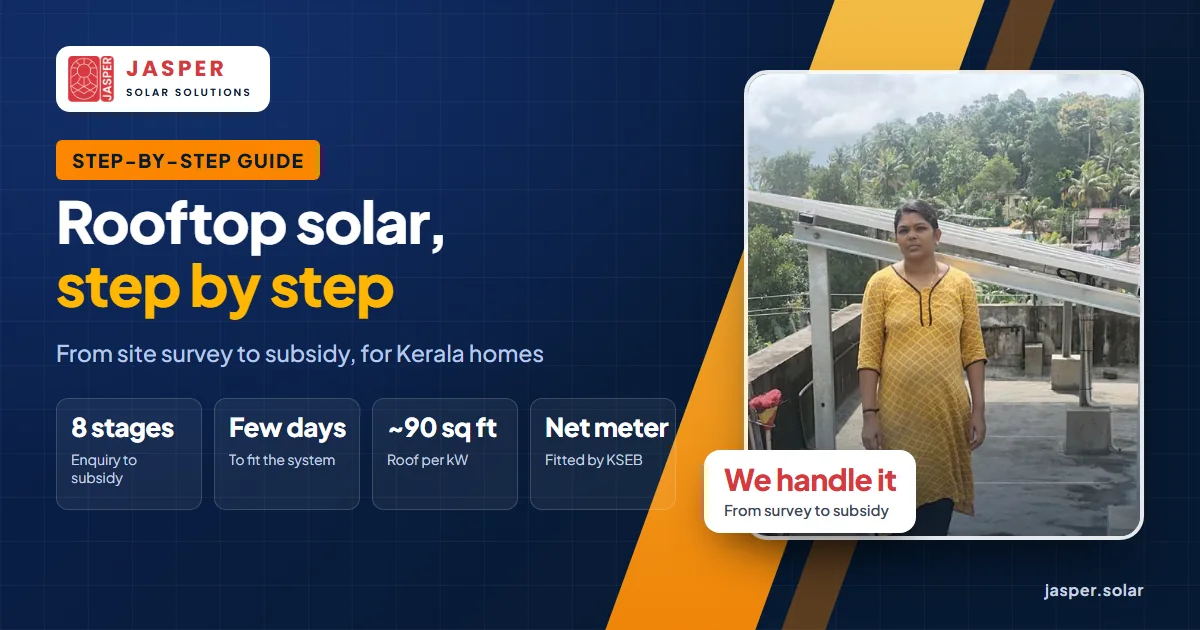
- A rooftop solar project in Kerala has eight stages, from site survey and design through KSEB feasibility, installation and the net meter to the subsidy reaching your bank.
- Fitting the panels takes only a few days. Most of the waiting is for KSEB feasibility, inspection and the net meter.
- Net meters have been in short supply in parts of Kerala in 2026, which can delay commissioning and the subsidy, so plan for some waiting time.
- Before you start, check three things: the KSEB connection is in your name, you have shade-free roof space, and you have your last few electricity bills.
Going solar is a one-time project that pays back for 25 years, so it helps to know exactly what happens and in what order. This guide walks through a typical home installation in Kerala, what the system includes, how long each stage takes, and what you need to do yourself.
Before you start: a quick checklist
| Check | Why it matters |
|---|---|
| KSEB connection in your name | The subsidy and net metering are tied to the consumer number |
| Shade-free roof space | About 80 to 100 sq ft per kW |
| Last 6 electricity bills | To size the system to your real use |
| Mobile and email linked to the consumer number | KSEB and the PM Surya Ghar portal send updates there |
| Bank account and a cancelled cheque | For the subsidy credit at the end |
The 8 stages, from enquiry to subsidy
- Site survey. An engineer checks the roof, shade from trees and tanks, the route for cables and the inverter location, and reviews your bills.
- Design and quote. You get a system size, a panel layout and an itemised quote: panel make and model, inverter, structure, cabling, protection and warranties.
- Portal registration. The application is registered on the PM Surya Ghar portal with your KSEB consumer number.
- KSEB feasibility. KSEB checks that your connection and the local transformer can take the system, and approves it.
- Installation. The structure, panels, inverter, protection devices and earthing are installed. For a typical home this takes a few days.
- Net meter application. The installation details are submitted so KSEB can schedule the inspection.
- Inspection and commissioning. KSEB inspects the system, fits the bidirectional net meter and issues the commissioning certificate. Your system now exports surplus power.
- Subsidy claim. Bank details are submitted on the portal, and the subsidy is credited directly to your account.
Jasper Solar handles stages 1 to 8 for you, including follow-ups with KSEB. For the subsidy amounts and the portal steps in detail, read our PM Surya Ghar subsidy guide.
What a rooftop system includes
| Component | What it does |
|---|---|
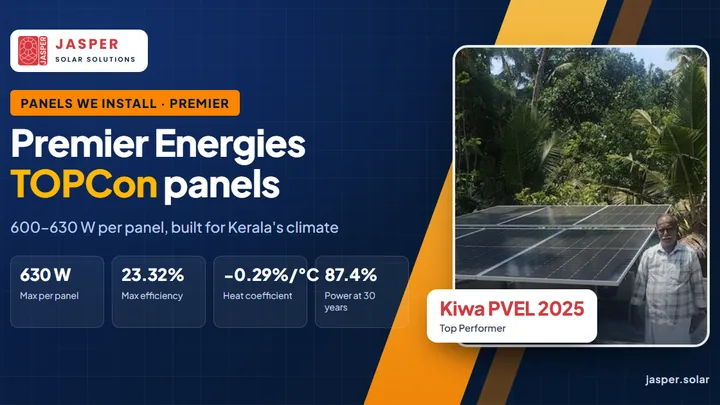
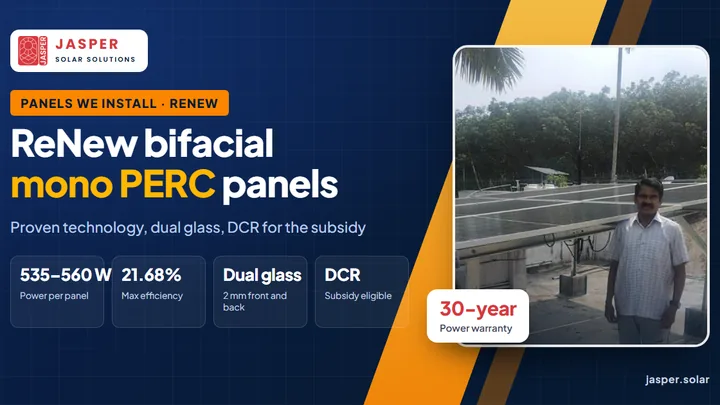
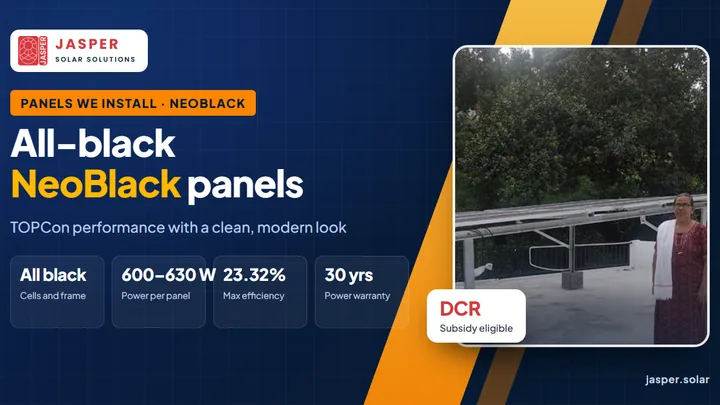
| Solar panels | Turn sunlight into DC electricity; DCR panels are required for the subsidy. We fit ReNew and Premier Energies DCR panels |
| Mounting structure | Holds the panels against Kerala's monsoon winds; hot-dip galvanized steel resists rust |
| Inverter | Converts DC to AC for your home and syncs with the grid |
| DC and AC distribution boxes | House the fuses, isolators and surge protection |
| Earthing and lightning arrester | Protect the system and your home from faults and lightning strikes |
| Cables and conduits | UV-resistant solar cable from roof to inverter and meter |
| Net meter | Records units imported and exported, fitted by KSEB |
Choosing the right panels makes a big difference over 25 years. Our guide to choosing solar panels for a Kerala home covers panel types, DCR rules and warranties.
How long does it take?
The physical installation is the quick part. The overall timeline depends mostly on KSEB's feasibility approval, the inspection and the availability of net meters. In 2026, net meter shortages have held up commissioning in parts of the state, and the subsidy is paid only after the system is commissioned. We give you a realistic timeline at the quote stage and keep you updated at each step.
Flat roof or sloped roof?
- Flat RCC terrace: the most common in Kerala. An elevated structure keeps the terrace usable for drying clothes, and lets air cool the panels from below.
- Sloped tile or sheet roof: panels can follow the slope on rails fixed to the roof structure, which suits homes without a usable terrace.
- Roofs with shade: trees, water tanks or a neighbour's taller building can be designed around, or handled with panel-level optimizers. See SolarEdge vs string inverters.
After installation
- Cleaning: monsoon rain does much of the work. In the dry months, rinse dust and leaves off with plain water every few weeks.
- Monitoring: check daily generation on the inverter app. A sudden drop usually means shade, dirt or a fault worth reporting.
- Maintenance: an annual check of connections, earthing and the structure keeps the system safe and productive.
Common questions
Do I need to be at home during installation?
Someone should be there on the first day to agree the inverter location and cable routing. After that, our team can work while you are out.
Will installation damage my roof?
A well-designed structure uses chemical anchors sealed against water, so the roof stays waterproof. Ask any installer how they fix the structure and seal the anchor points.
What size should I install?
Divide your monthly units by about 120 for a first estimate. Our sizing guide shows the method with examples.
Does the system work in a power cut?
A standard on-grid system shuts down when KSEB supply fails. For backup, consider a hybrid system with a battery.
Ready to start? Book a free site visit and we will survey your roof, design the system and take care of every step through to the subsidy.