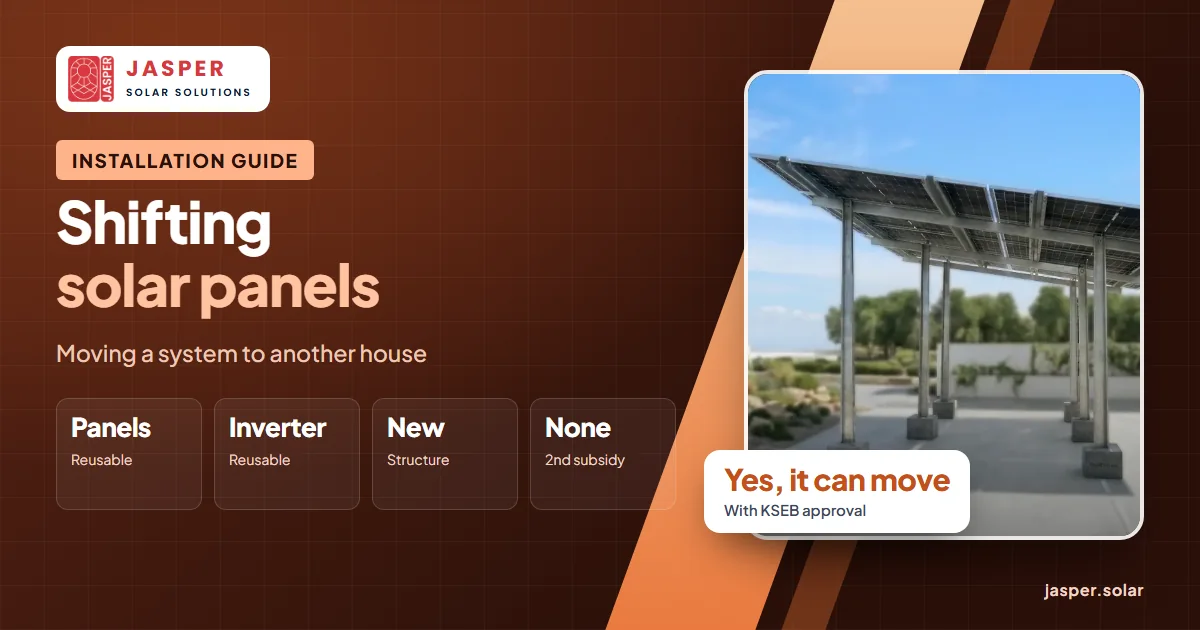
People ask about shifting solar panels when they build a new house, sell the old one, add a floor or re-lay a roof. The panels themselves are easy to move. The work is in everything around them: the structure, the wiring and the KSEB connection. This guide explains what is involved, what it does to your subsidy and warranty, and when moving is worth it.
What can be reused
| Part | Reusable? | Notes |
|---|---|---|
| Panels | Yes | If undamaged. They must be handled and packed properly; cells can crack without the glass showing it |
| Inverter, optimisers or microinverter | Yes | If the new connection is the same phase and the layout suits it |
| Mounting structure | Sometimes | It was built for the old roof. A different roof usually needs a new or modified structure, and anchors cannot be reused |
| DC and AC cables | Partly | Lengths rarely match the new site |
| Earthing and lightning protection | No | Installed new at the new site |
| Distribution boxes and breakers | Usually | After inspection |
| Net meter and solar meter | Ask KSEB | They belong with the old connection |
How a system is shifted
- Survey the new roof for space, shade, strength and the route to the meter.
- Apply to KSEB for the new premises, and inform KSEB about the plant at the old one.
- Shut down and disconnect the system, in the order the inverter maker specifies.
- Dismantle and pack the panels and electronics; note the serial numbers.
- Make good the old roof: remove or seal the anchors so the slab does not leak.
- Build the structure at the new house and install the panels, inverter, earthing and protection.
- Test, then KSEB inspection and the net meter at the new connection.
This is electrical work on a live system and work at height. It should be done by a qualified installer, not a general contractor.
The KSEB side
Your net-metering approval is tied to one consumer number at one address. A different house has a different consumer number, so the system cannot simply be plugged in there. Expect to go through feasibility, the connection agreement, inspection and metering again for the new premises, and to close out the solar connection at the old one.
KSEB's exact procedure and fees for a relocated plant are best confirmed with your section office before you start, because practice can differ from one case to the next. We handle this paperwork for systems we shift. For the rules on new connections, see net metering in Kerala.
What happens to the subsidy
- No second subsidy on the same system. The PM Surya Ghar subsidy was paid when the system was first commissioned. Moving it does not earn another.
- A new system at the new house may or may not qualify, depending on the scheme rules at the time and whether you have already received a subsidy. Check on the national portal before you plan around it.
- Keep your records: the invoice, commissioning certificate and panel serial numbers.
See the Kerala solar subsidy guide for the current rules.
What happens to the warranty
Panel and inverter warranties are given by the manufacturers, and each has its own terms on re-installation. Before moving, read the warranty documents or ask the maker. Have the work done by an authorised installer, keep the original invoice and serial numbers, and get a written record of the re-installation. Damage caused by handling during a move is not covered by a manufacturer's warranty.
Is it worth moving?
| Your situation | Usually better to |
|---|---|
| Selling the old house | Leave the system. It lowers the buyer's bills and adds to the value of the house |
| Renting out the old house | Leave it, if the tenant's use suits it |
| Old house will be demolished or left empty | Move it |
| System is only a few years old and the new roof suits it | Move it |
| System is old, or the new house needs a bigger one | Leave it and install a new system sized for the new house |
Shifting has real costs: dismantling, transport, a new structure, new cabling and earthing, and the KSEB charges. Set the quote for shifting against the price of a new system before deciding. A new 3 kW system costs ₹2,15,000 before any subsidy; see the 3 kW price guide.
If you are selling the house with the system
When the KSEB connection is transferred to the buyer's name, the solar agreement has to move with it. Give the buyer the invoice, warranty documents, commissioning certificate and the monitoring app login. Tell your installer, so the service records follow the system.
Moving panels on the same house
Adding a floor, re-laying the roof or waterproofing the terrace often means taking the panels down for a while and putting them back. This is simpler, because the consumer number and the KSEB approval stay the same. Still:
- Have the installer shut down, remove and store the panels; do not leave it to the building contractor.
- If the panels go back in a different place or on a higher floor, the structure and cables will need to change.
- If the plant will be off for a long time, or its capacity or position changes, check with KSEB whether anything needs to be reported.
- Have the system tested before it is switched on again.
Common questions
Can solar panels be shifted to another house?
Yes. The panels and inverter can be moved and reused. The new house needs a suitable roof, a new or modified structure, and its own KSEB approval and net meter.
Will I get the subsidy again if I move my solar system?
No. The subsidy is paid once on a system, when it is first commissioned.
Can I use the same net meter at the new house?
The net-metering approval belongs to the old consumer number. The new house needs its own approval and metering; ask your KSEB section office what applies to the meter itself.
Does moving solar panels void the warranty?
It depends on the manufacturer's terms. Use an authorised installer, keep the serial numbers and invoice, and check the warranty document before the move.
Should I take my solar panels when I sell my house?
Usually not. A working system adds value for the buyer, and moving it costs money. Leave it, and install a new system sized for your new home.
Can panels be removed and refitted for roof repairs?
Yes. Have your installer remove, store and refit them, and test the system before it is switched back on.
Planning a move, a renovation or a new house? Contact us and we will tell you whether shifting or a new system makes more sense, or book a free home visit for the new roof.
Sources
- Kerala State Electricity Regulatory Commission, renewable energy and net metering regulations
- Ministry of New and Renewable Energy, PM Surya Ghar national portal
- Panel and inverter manufacturers' warranty documents. Check the terms for your own equipment.
- Jasper Solar service team, installation practice in Thiruvananthapuram and Kollam

Er. Akhil S.TFounder and Project Engineer, Jasper Solar Solutions
Founder of Jasper Solar Solutions and a project engineer with 7 years in the solar field and more than 400 completed solar projects. Akhil designs and oversees rooftop installations for homes and businesses, from site survey to KSEB commissioning.