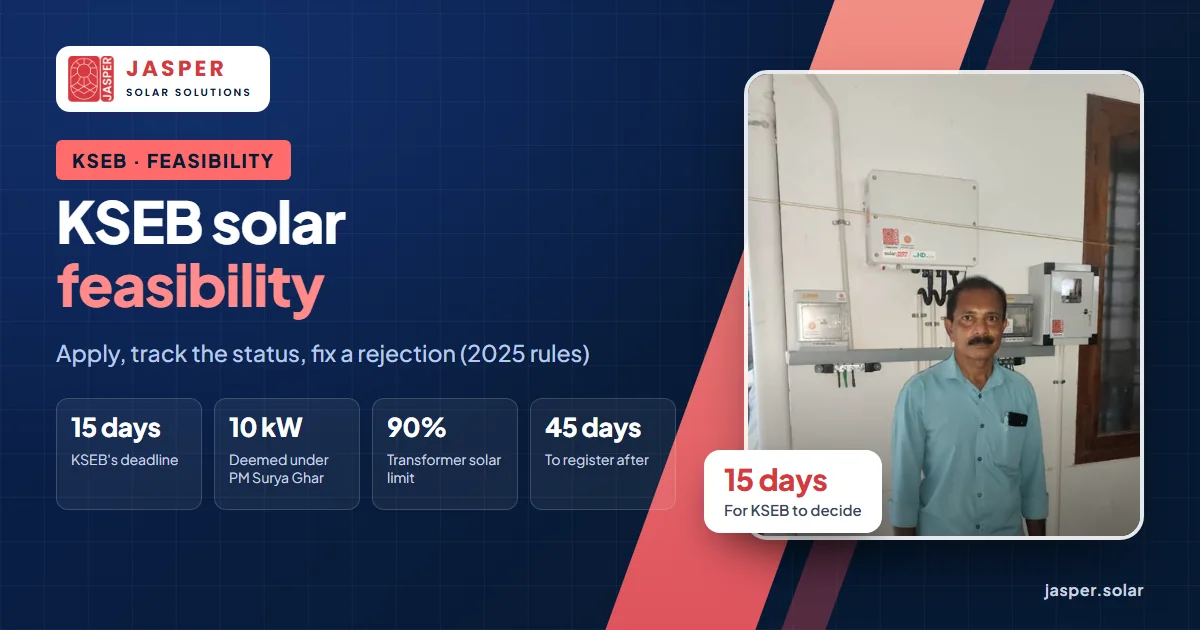
- Feasibility is KSEB's check that the transformer and line serving your home can take your solar plant. Under KSERC's 2025 regulations, KSEB must decide within 15 days of a complete online application.
- If KSEB misses that deadline on a complete application, feasibility is deemed granted. PM Surya Ghar systems up to 10 kW get deemed feasibility after online checks of transformer capacity, your connected load and the inverter.
- Track the application online with the reference number KSEB sends the same day. After feasibility, you have 45 days to apply for registration.
- The usual reasons for rejection: the transformer is already full, the plant is bigger than your sanctioned load, or a single-phase inverter above 3 kW.
Every rooftop solar plant in Kerala that connects to the grid starts with a feasibility approval from KSEB. It is also the step people most often get stuck on, because the decision depends on the transformer outside your home, not on your roof. This guide explains the process as the Kerala State Electricity Regulatory Commission (KSERC) set it out in its Renewable Energy and Related Matters Regulations, 2025, notified on 5 November 2025.
What KSEB checks for feasibility
KSEB checks whether the distribution transformer and feeder that serve your home can safely take the power your plant will send back to the grid. If they can, KSEB issues a feasibility approval that states the maximum capacity you may install. You cannot register or connect a plant larger than that figure.
- Transformer hosting capacity. All the solar plants on one distribution transformer together may not exceed 90% of its capacity, and the plants on any one phase may not exceed 30% of it.
- Your sanctioned load. For deemed feasibility under PM Surya Ghar, the plant must be no larger than the connected load sanctioned on your KSEB connection.
- Single-phase limit. A single-phase inverter may connect up to 3 kW. Plants above 3 kW need a three-phase inverter, except that where no three-phase line is available, single-phase inverters up to 5 kW are allowed for applications made until 31 March 2027.
How to apply for KSEB solar feasibility
- Apply online. Online is now the default for feasibility, registration and connection. Home owners claiming the subsidy apply through the PM Surya Ghar portal; others apply on KSEB's rooftop solar portal. The regulations name the application formats Annexure 1(a), 1(b) and 1(c).
- Get your reference number. KSEB must acknowledge the application the same day, automatically, with an application reference number for tracking.
- Wait up to 15 days for the feasibility certificate, or for deemed feasibility if KSEB does not decide in time.
- Register within 45 days of feasibility, with the registration form (Annexure 2), the documents and the registration fee. Your installer usually does this for you.
Our guide to the KSEB solar Annexure forms explains what each form asks, the PM Surya Ghar application guide walks through the portal, and our KSEB net metering guide covers what happens once the plant is connected.
How to check your feasibility status online
KSERC requires KSEB's web portal to have an online tracking system that shows the real-time status of each application at every stage. Log in where you applied, the PM Surya Ghar portal or KSEB's rooftop solar portal at ekiran.kseb.in, and check the application against its reference number. If you applied at your KSEB section office instead, ask there with your consumer number and application number.
The timeline from application to net meter
The 2025 regulations set a deadline for each step:
| Step | Who | Time limit |
|---|---|---|
| Acknowledge the feasibility application | KSEB | Same day, online |
| Feasibility certificate | KSEB | Within 15 days of the application |
| Apply for registration | You | Within 45 days of feasibility |
| Check the registration application | KSEB | Within 3 working days |
| Register the plant | KSEB | Within 3 working days of a complete application and fee |
| Install the plant and submit the report | You and your installer | Within 6 months of registration, or the extended period |
| Test the plant | KSEB | Within 7 working days of the report |
| Sign the connectivity agreement | You and KSEB | Within 7 working days of a successful test |
| Fit the meter and commission the plant | KSEB | Within 15 days of the report |
Registration is valid for six months. KSEB can extend it once, by up to six more months, for good reason, provided nobody else is waiting for capacity on the same transformer. If the plant is not installed in time, the registration fee is forfeited and the capacity goes to the next applicant.
Fees
| Fee (non-refundable) | Amount |
|---|---|
| Application fee | ₹1,000 |
| Registration fee | ₹300 per kW or part of a kW |
For rooftop solar under PM Surya Ghar, both fees are not paid upfront: KSEB collects them in the electricity bills that follow commissioning. If you cannot correct a defect in your registration application within 7 working days, you can surrender the capacity and get half the registration fee back.
If feasibility is rejected or the transformer is full
- KSEB must give reasons. If it refuses for lack of transformer capacity or another technical constraint, it has to tell you why.
- Ask about another phase. If a single-phase home's phase is at its 30% limit but another phase of the transformer has room, KSEB must connect you to that phase at its own cost.
- A small plant can still go ahead. Where hosting capacity is used up, KSEB must allow up to 20% more for plants up to 5 kW that use a hybrid inverter with a battery storing at least 30% of the plant's generation potential, or an inverter with dynamic reactive power support together with a smart meter that can curtail generation.
- Capacity can come back. If capacity on your transformer becomes available within six months of a refusal, KSEB must tell you, and you can apply again.
- Check before you apply. KSEB must publish, by the 10th of every month, each transformer's capacity and the solar already connected to it, at section offices and on its website.
- Fix the design. If the problem is the inverter or the plant size, a three-phase inverter or a plant within your sanctioned load solves it.
Jasper Solar checks the transformer position, sizes the plant within your sanctioned load and handles the feasibility, registration and net meter for every plant we install. Book a free home visit to start.
Common questions
How long does KSEB take for solar feasibility?
Up to 15 days from a complete online application, under KSERC's 2025 regulations. If KSEB has not decided by then, feasibility is deemed granted.
How do I check KSEB solar feasibility status online?
Log in to the portal where you applied, the PM Surya Ghar portal or KSEB's rooftop solar portal, and check the application with the reference number KSEB sent when you applied. KSERC requires the portal to show the status at every stage.
Do PM Surya Ghar applicants need a feasibility study?
Rooftop plants up to 10 kW registered under PM Surya Ghar get deemed feasibility, subject to online checks that the transformer has spare capacity, the plant is within your sanctioned load and the inverter meets the single-phase limit.
Why was my KSEB solar feasibility rejected?
Most often because the transformer serving your home has reached its limit for solar: 90% of its capacity, or 30% on one phase. A plant bigger than your sanctioned load, or a single-phase inverter above 3 kW, can also lead to rejection.
What is the fee for KSEB solar feasibility?
An application fee of ₹1,000 and a registration fee of ₹300 per kW. Under PM Surya Ghar, both are collected in your bills after the plant is commissioned.
How long is KSEB solar registration valid?
Six months from registration, extendable once by up to six months. The plant must be installed within that time or the registration fee is forfeited.
Sources
- Kerala State Electricity Regulatory Commission, KSERC (Renewable Energy and Related Matters) Regulations, 2025, notification No. 3228/Con.Engg/2023/KSERC, 5 November 2025: Regulations 16.2 to 16.5 (hosting capacity, inverters), 17.2 to 17.9 (online application, feasibility, registration, fees) and Table 2 (timelines)
- Kerala State Electricity Board, eKiran rooftop solar portal
- Ministry of New and Renewable Energy, PM Surya Ghar national portal

Er. Akhil S.TFounder and Project Engineer, Jasper Solar Solutions
Founder of Jasper Solar Solutions and a project engineer with 7 years in the solar field and more than 400 completed solar projects. Akhil designs and oversees rooftop installations for homes and businesses, from site survey to KSEB commissioning.